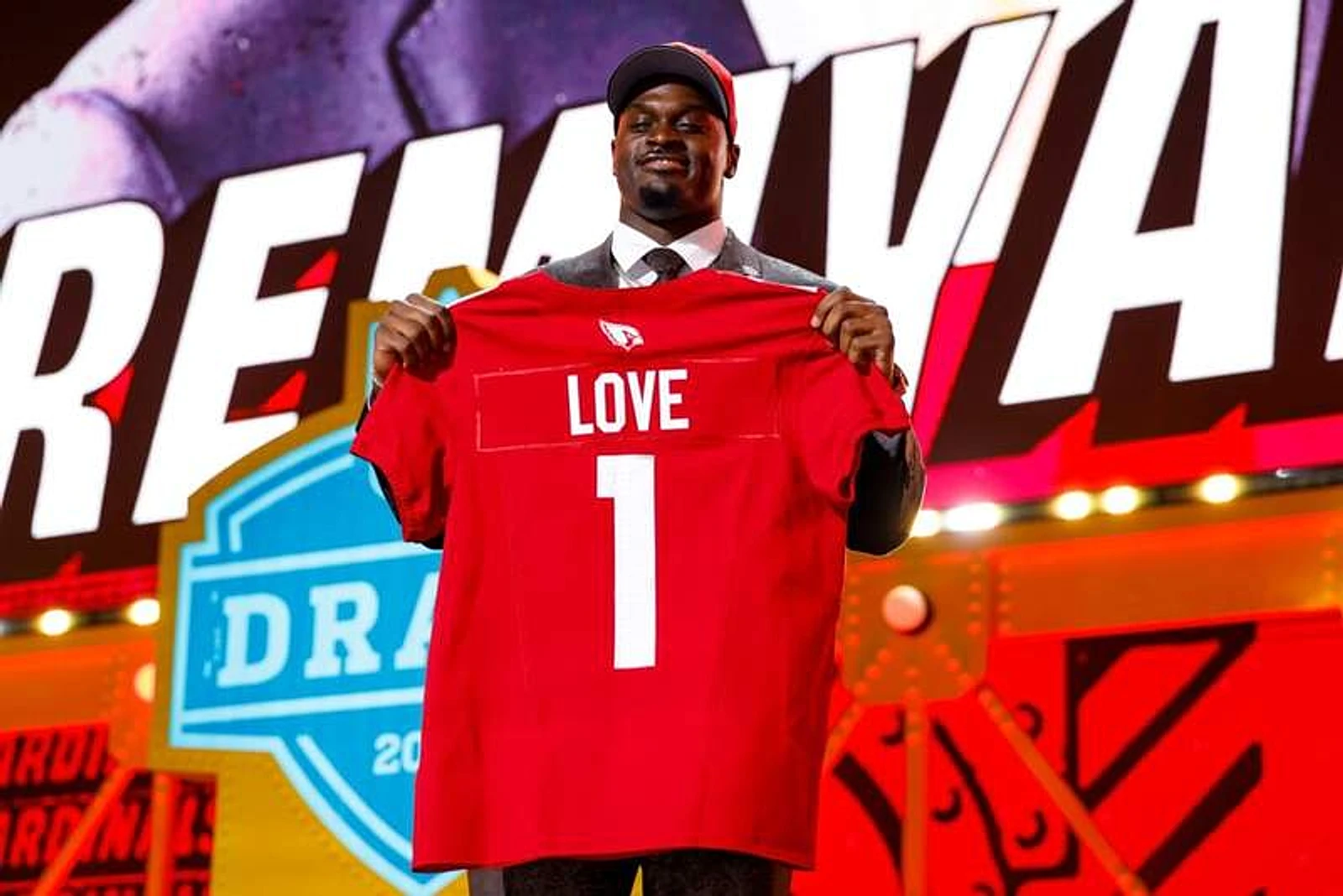


The Arizona Cardinals have a new running back in town.
The Arizona Cardinals did not draft Jeremiyah Love just to add another running back. They drafted him to become the stress point of Mike LaFleur’s offense. Love’s speed, receiving value, and three-down profile give Arizona a piece that can make James Conner, Tyler Allgeier, Marvin Harrison Jr., Trey McBride, and Carson Beck’s development fit into a more flexible structure.
Speaking on The Rich Eisen Show, LaFleur’s praise went beyond the usual post-draft comments. He mentioned that everyone in the building was on the same page, and even admitted he didn’t want any trade calls once Arizona was on the clock.
This is notable because Love wasn’t just another first-round pick; he was selected third overall. Players taken that high aren’t there to be complimentary pieces — they’re expected to shift the entire tone of an offence right away.
While LaFleur pointed out Love’s college production at Notre Dame, he spent just as much time focusing on his character: confidence, humility, maturity, and strong family support. These are qualities coaches look for when deciding if a young player can handle not just touches but also the spotlight and expectations.
The Cardinals clearly see more in Love than just his ability to move the chains. They believe he can help shape how their offence operates both on and off the field.
There’s good reason for that belief. He put up 1,372 rushing yards and 18 touchdowns in 2025, maintaining a 6.9-yard average per carry for the second consecutive season.
What really stands out is his explosiveness. At over 212 pounds, Love posted a 4.36-second 40-yard dash at the combine — showing rare speed for a player with his build.
Love also provides value as a pass catcher. In his final year at Notre Dame, he caught 27 passes for 280 yards and three scores.
That’s an important piece in LaFleur’s scheme because the backs aren’t just ball carriers — they’re involved throughout the passing game as well.
Love can handle wide zone runs, work through gap schemes, move out of the backfield, catch passes underneath, and challenge linebackers in space.
This kind of skill set can make life easier on everyone else in the offence.
Before picking Love, Arizona already had James Conner and Tyler Allgeier on the roster. Conner adjusted his contract to remain with the team, while Allgeier joined on a two-year deal worth $12.25 million.
While it may look like a crowded backfield from the outside, LaFleur doesn’t see it that way. He pointed out he’s never going to apologise for having too much depth at one position, referencing 2019 in San Francisco when four different backs contributed in meaningful ways.
“Yeah, and that’s been something I’ve said since coming in here,” LaFleur continued. “James is such a good person first and foremost but what he does for your organisation goes well beyond what you guys watch on Sundays or Thursdays or Mondays whenever we play games.”
That is where things become unique. The Cardinals have one of the deepest running back rooms in football but it looks like it will be Love who leads the way by getting more touches than either of his teammates.
During a recent interview, LaFleur touched on how the Cardinals are focusing on building a solid foundation before fully shaping their offensive identity. He referenced his time with the Rams, where the move to 13 personnel wasn’t planned but developed naturally because it suited the team’s strengths.
That’s important. Arizona don’t need to lock themselves into one style of play this early in the year. Instead, they should focus on gathering enough versatile talent to let their true identity emerge over time.
Love adds another layer to that approach. He can slot into heavier sets alongside Conner or Allgeier, or help spread things out with Harrison and McBride. His presence gives Arizona options—whether that’s pulling defenders into coverage or challenging smaller nickel packages to hold up against the run.
Building a modern offence isn’t about forcing a scheme. It’s about creating mismatches and then leaning into whatever opponents struggle to defend week-to-week.