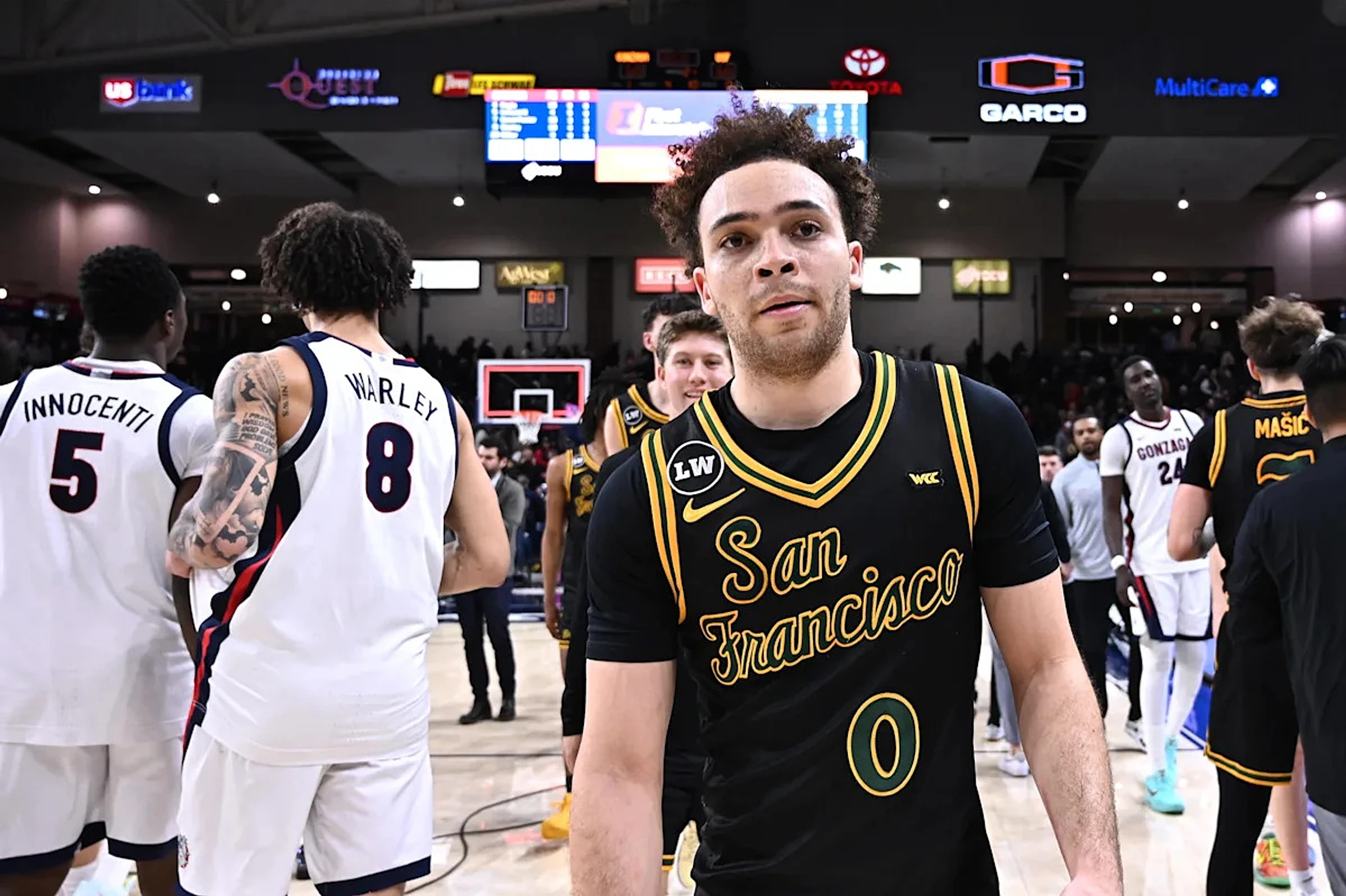


Washington helped fill their hole at the point guard spot today with the addition of San Francisco transfer Ryan Beasley. The 5’11 junior averaged career highs of 13.6 points and 4.0 assists per game this past season.
Beasley has seen steady improvement throughout his college career. He was lightly recruited out of high school in San Ramon, California likely due to his height and picked USF over Washington State as his only power conference offer. As a freshman, Beasley came off the bench to average 7.8 points per game playing the shooting guard spot. He took on increased ball handling responsibilities as a sophomore starting 4 games and increasing his per game averages with a big increase in 2-pt% and a slight downturn in 3-pt%.
Beasley took over the starting point guard spot this past season and didn’t shoot it quite as efficiently as he did the previous year but made great strides as a passer. His assist rate went up from 18.1% to 24.9% while his turnover rate simultaneously improved from 15.0% to 13.7%. That assist rate is still down from the elite passers in the game but the assist-to-turnover ratio is up there with what you would want from a college point guard.
There are some concerns with Beasley’s shooting particularly given his height. His effective field goal percentage dipped this past season mostly due to a decrease in his effectiveness from the midrange. About half of Beasley’s two-point attempts come from the midrange and he shot a blistering 49.1% on those shots as a sophomore compared to just 33% last year. For context, Zoom Diallo took about 60% of his attempts inside the arc from the midrange and shot 48.7% last year. Beasley will have to get back above 40% despite the move up in competition to become an adequate Big Ten scorer given his career 32% three-point shooting.
The good news is that Beasley’s stats haven’t been that dependent on the level of competition. He has career 49/32/84% 2/3/FT shooting splits and those numbers across 20 “A” tier games per KenPom are 46/35/80%. His two-point percentage in those games this past year was an abysmal 30% but the previous year it was 65% so the truth is likely somewhere in between.
Where Beasley likely isn’t a Big Ten player is on the defensive end. At 5’11 he is clearly undersized and his defensive stats reflect that. He had a good steal rate as a true freshman but the last two seasons they have been merely adequate. His defensive rebounding rate has been consistently between 9-10% which is about what you’d expect from a 5’11 point guard. Evan Miyakawa’s defensive BPR stat lists Beasley as just barely above average across all of D1 and it would’ve been one of the bottom-five marks among major contributors at the guard spot in the Big Ten last year. That’s of particular concern without Franck Kepnang available as a rim protector this season and puts pressure on Mady Traore to become a major piece to help defend the rim when Beasley is out there.
Beasley becomes Washington’s 3rd portal commitment so far joining SF Steele Venters from Gonzaga and SG Parker Friedrichsen from Davidson.