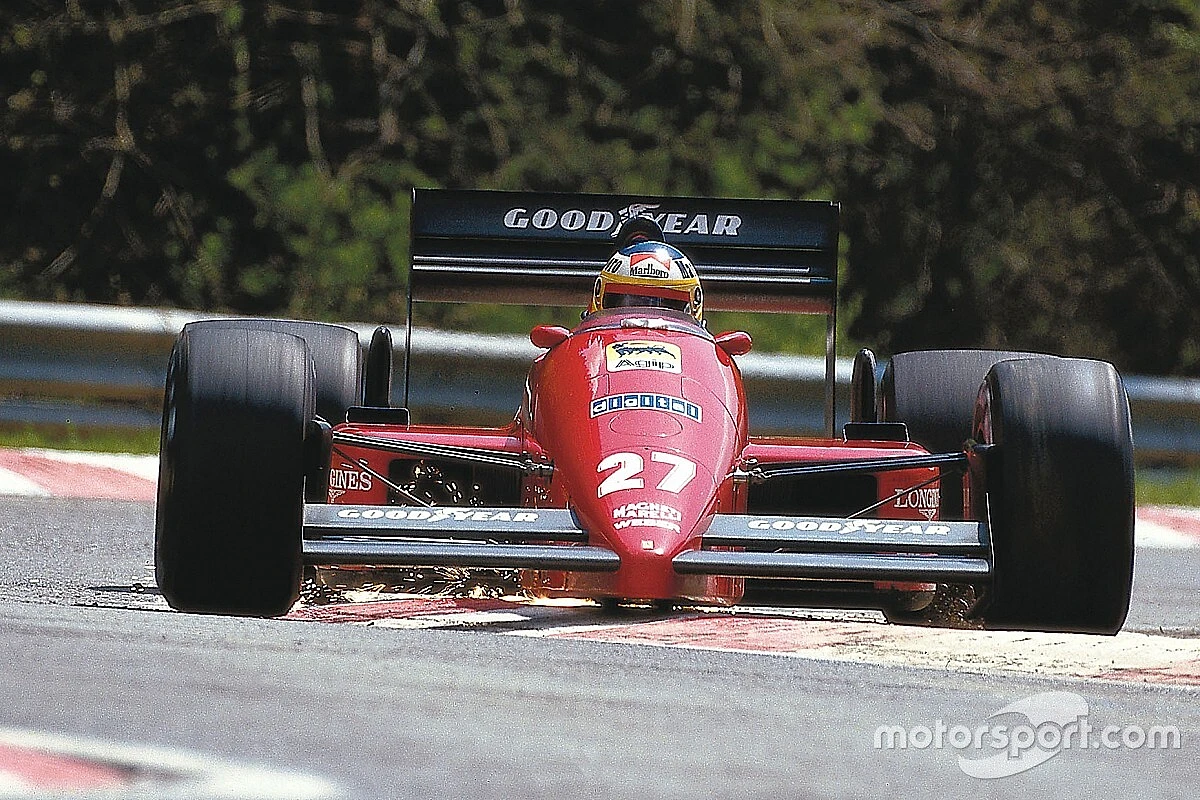

Michele Alboreto was not someone who became interested in racing only once he was involved. He was like you or I – a pure fan – long before he became a driver, and each year he’d make the 45min journey from home in Milan to Monza for the Italian Grand Prix.
In 1970, he was left tearful on witnessing Jochen Rindt’s fatal accident in practice, then felt the exhilaration 24 hours later as Clay Regazzoni, in only his fifth Grand Prix, won the race for Ferrari. In one weekend, 13-year-old Michele had experienced motor racing in extremis.
Perhaps in honor of Rindt, he became a fan of Lotus and in particular, Ronnie Peterson. Each year, Albo would bravely stand among the die-hard Ferrari-or-nothing tifosi but waving a Lotus flag for his hero. As soon as he started racing for Scuderia Salvati in Formula Monza in 1976 this young Italian lad adopted Peterson’s Swedish helmet colors, blue with a yellow peak. It would remain that way to the end.
Salvati, impressed with its new charge, moved him into Formula Abarth for 1978, and steady improvement in technique and understanding of racecars in general culminated in victory at Magione and fourth in the championship. That was enough to land Alboreto a drive in the final Italian Formula 3 championship round of the year – again at Magione – and on his debut he finished fourth.
Joining Giampaolo Pavanello’s Euroracing team for ’79, Alboreto raced in both the European and Italian championships. In the national series, it was a successful year, and he finished second overall, having triumphed at Magione, Misano and Imola. Inevitably the competition was tougher on the European stage, where he finished sixth, his highlights being poles at Magny-Cours and Monza, runner-up finishes at Zolder and Enna, a third place at Monza, and five fastest laps.
Rather than rush up the ladder series, 22-year-old Alboreto stayed on in F3 for ’79 and put his experience to good use, beating future F1 winner Thierry Boutsen’s Martini-Toyota to the European crown, while also grabbing third in the Italian Series. No less impressive was a one-off trip to Silverstone for a foray into the British Formula 3 scene. After qualifying 10th from 35 entrants, Alboreto raced his way up to fourth in the first heat, finished third in the second heat and took third overall – the lone Alfa-powered machine in a Toyota-dominated Top 10.
While F3 of course took priority when pursuing an open-wheel career, Alboreto was one of several young drivers who at this time raced for the Lancia Corse sportscar team in the World Championship for Makes, forerunner to today’s World Endurance Championship. Driving a Group 5 Beta Montecarlo Turbo, he started four races that year, two partnering future F1 rival Eddie Cheever, and two alongside rally legend Walter Rohrl. Alboreto’s three second places and a fourth helped Lancia very narrowly edge Porsche for the title.
Disappointed at being unable to land a works drive with March or Ralt for Formula 2 in 1981, ‘Albo’ joined Minardi in Formula 2, despite the team’s 281 chassis being off the pace. However, after four races he got word that Ken Tyrrell needed a new partner for Cheever in Formula 1, since incumbent Ricardo Zunino had been 1.7 and 2.4sec off the American’s pace in his two outings in the admittedly outmoded Tyrrell 010 Cosworth. ‘Uncle Ken’, also lacking a major sponsor, signed up Albo for the San Marino Grand Prix, the wheels to the deal having been oiled by funds from Count Zanon (one of Peterson’s former supporters who had become a friend of Alboreto), and sponsorship from Imola Ceramica, a local tiling company.
The new kid made an immediate impression by outqualifying the more experienced Cheever, although this would happen only one more time in the year-old Maurice Philippe-designed 010 as the rookie struggled initially to adapt to the numb ground-effect chassis. It wasn’t until the replacement 011 arrived mid-season that Alboreto showed more faith in finding the car’s limit and crept closer to Cheever’s pace – despite running Avon tires compared with his teammate’s Goodyears.
Alboreto’s simultaneous F2 campaign was fraught, the Minardi rarely capable of threatening the works teams, yet he earned pole in Pau, and later won in Misano, but necessarily skipped a couple of rounds to fulfill his F1 commitments. Arguably the high points of his season came in sportscars, finishing second in the Group 5 class in the 24 Hours of Le Mans after sharing a Beta Montecarlo with Cheever and touring car ace Carlo Facetti, and then winning the Watkins Glen 6 Hours outright with Riccardo Patrese.
Rival Formula 1 teams made offers to Alboreto for 1982, but the pragmatic 25-year-old elected instead to sign with Tyrrell for two more years and continue his Grand Prix education.
“For me, driving for Tyrrell was the best thing at that stage in my career,” he explained to Maurice Hamilton in an Autosport interview. “Absolutely fantastic. Ken taught me so much and yet never put me under pressure. I started learning the day I arrived and I was still learning the day I left. It was just the right experience for a driver starting in Formula 1.”
Elevated to team leader status for 1982, and with his 011 now running Goodyears, Albo scored two fourths in the opening three races of the season and, in the race boycotted by most FOCA teams at San Marino, he joined Ferrari drivers Didier Pironi and Gilles Villeneuve on the podium. At Zolder, the Ferrari entries were withdrawn following Villeneuve’s tragic death in qualifying, and Alboreto lined up fifth on the grid, but his usually reliable Cosworth engine let go on race day.
The normally aspirated teams were facing an uphill battle; compared with the turbo cars of Ferrari and Renault and soon Brabham-BMW, they were giving away some 300hp in qualifying and 150 on race day. Yet Alboreto, like eventual champion Keke Rosberg (Williams) and the McLaren drivers (Niki Lauda and John Watson) was at the forefront of the Cosworth battle. In fact, Alboreto’s next batch of points would come on what were very much ‘power tracks’ – sixth at the original Paul Ricard with its mile-long Mistral Straight, fourth at the original Hockenheim and fifth at Monza. His reputation was burgeoning. Come the finale at Caesars Palace, Las Vegas, Albo was outqualified only by the Renaults, and when one blew up (Rene Arnoux) and the other developed a bad tire vibration (Alain Prost), the Tyrrell driver was there to pounce with 24 laps to go, and land his first victory – and Ken’s first in more than four years.
Alboreto had continued to put his name up in lights in what was now called the World Endurance Championship, as Lancia moved up to Group 6 with its svelte barchetta, the LC1. Whenever his car finished, he would triumph – with Patrese again in the Silverstone 1000km, with both Riccardo and Teo Fabi in the Nurburgring 1000km, and with Piercarlo Ghinzani in the Fuji 6 Hours. However, these would remain his last sportscar wins for well over a decade, as in ’83 Lancia produced a Group C car, the LC2, and it was blown aside by the Porsche 956s. And anyway, for the next 10 years, Albo needed to focus on F1.
If the Cosworths had been struggling in ’82, things became even tougher the following season. The best normally aspirated cars were 4-5sec off pole at tracks such as Paul Ricard, and since the turbo-powered cars were becoming more reliable, so there were fewer opportunities for a ‘Cossie’ to swoop in for wins. The last to do so with the Cosworth DFV were Watson at Long Beach and Rosberg at Monaco, while Alboreto ran the development DFY unit from Monaco onwards and scooped a fortunate win at Detroit when Nelson Piquet’s Brabham picked up a puncture. Ford would not win again in F1 for six years, while Tyrrell would never win again.
Following Alboreto’s Vegas triumph the previous year, Enzo Ferrari had publicly commented: “I have said, and I confirm it, that the day Alboreto becomes available, I will be happy to put a car at his disposal.” In the mean time, for 1983 Il Commendatore had retained Villeneuve’s replacement, Patrick Tambay, and signed Arnoux from Renault, following Pironi’s F1 career-ending shunt at Hockenheim. Both Tambay and Arnoux performed well through the 1983 season and between them kept the Harvey Postlethwaite-penned Ferrari 126C2Bs and 126C3s prominent, so it seemed curious that Ferrari was willing to break up this team. Yet that is precisely what happened. Alboreto, made aware that Tyrrell had no turbo engine manufacturer lined up for the following year, put himself on the market and signed with Ferrari in July. A couple of months later he and others learned that the deal was at the expense of his friend Tambay.
Ken Tyrrell would miss his Italian ace, as he told Autosport a couple of years later.
“The thing about Michele was that he related so well to what was, for him, a foreign team,” said Ken, who had watched his team dominate in the Jackie Stewart era and then become occasional winners with Jody Scheckter, Patrick Depailler and Alboreto. “He has no airs or graces. If he says he will be somewhere at 3 o’clock, he will be there at 3 o’clock. He is a gentleman – and he’s bloody quick in a racing car!”
Race engineer Brian Lisles, later of Newman/Haas Racing Indy car team fame, observed: “[Alboreto] is one of the few drivers around who purposely adopts a completely different style for qualifying; he really put our car through its paces for that one lap. He would say that this was when he used ‘the extra half-second I carry in my pocket.’ He would come in, grinning from ear to ear, and the poor old car would sit there, breathlessly tinging and pinging as it cooled down. He really liked that. So did we.”