

Orlando, Fla. — After the Orlando Magic eliminated the Charlotte Hornets from the Play-In Tournament, coach J.B. Bickerstaff repeatedly expressed his belief Orlando was not a No. 8-seeded team.
He argued that, given their talent and his understanding of coach Jamahl Mosley, the Magic likely would have secured a higher seed if not for the injuries that plagued their season.
Despite being the favorites entering the first-round series, Bickerstaff acknowledged the Detroit Pistons faced a significant challenge. Seven days removed from the series opener at Little Caesars Arena, Bickerstaff's beliefs about the Magic have proven prophetic.
The Pistons lost 113-105 to the Magic at Kia Center on Saturday afternoon, and enter Game 4 on Monday night trailing 2-1 in the best-of-seven series with a mindset that reflects their urgency to save their series.
"It's one game at a time, and that's what playoff series are. You can't hang on to it. We come down here, we win on Monday — we take homecourt advantage back," Bickerstaff said. "Our guys have been consistent all year, and we've been able to move on to the next. So, I trust our guys. We'll be ready to go."
To avoid falling behind 3-1, Bickerstaff emphasized analyzing and learning from the mistakes of the first three games is essential to improving their chances of winning not just Game 4, but the series. The team used Sunday afternoon as a day away from the practice court. Game 3's game film contained a handful of valuable lessons — even beyond finding a solution to Jalen Duren's offensive struggles against the Magic's defense.
More: Magic cast defensive spell on Pistons' Jalen Duren: 'He'll figure it out'
Improving ball security became one of the team's top priorities, as turnovers have greatly impacted their postseason success. The Pistons currently have the third-highest average for playoff turnovers, with 17.7 giveaways over the first three games. The Magic have taken advantage of the Pistons' mistakes, scoring an average of 20.3 points off those turnovers.
"The ones you can't live with are the careless ones, and that's where we got to do a better job taking care of the basketball," Bickerstaff said. "Together, our spacing has to get better so that we can have better windows to make those plays. But again, the careless ones, the silly ones, we can do a better job of taking away."
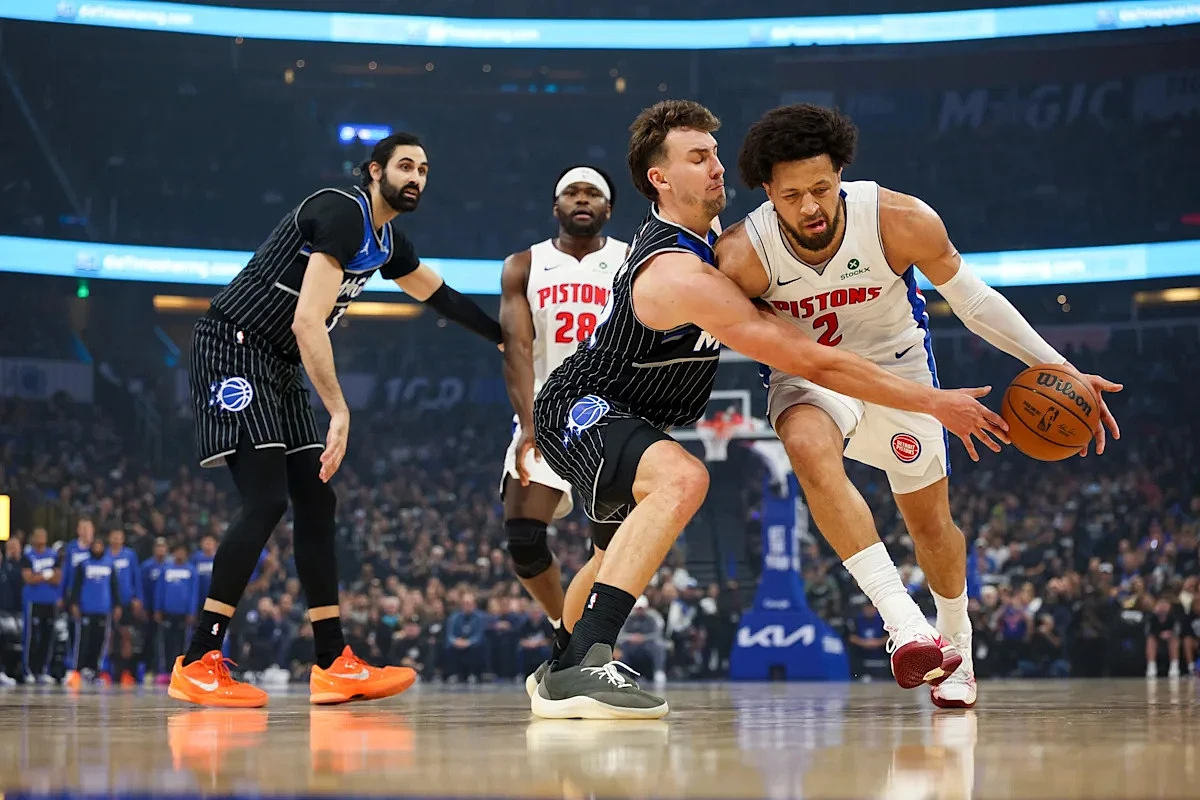
The Pistons have struggled with ball security as a team, but Cade Cunningham has taken full responsibility for the issue. In Game 3, he had one of his worst performances of the season, contributing to nine of Detroit's 16 turnovers. The Magic scored 24 points as a result.
Cunningham's most critical turnover occurred with just one minute remaining in the fourth quarter. The Pistons were down 110-105 when Cunningham attempted an in-and-out dribble, which caused him to lose his balance while driving toward the basket. His giveaway allowed forward Paolo Banchero to score a go-ahead 3-pointer on Orlando's next offensive possession, which ended up being the game-sealing basket.
"It's a possession game in the playoffs, and a lot of this falls on my shoulders where I have to be better," Cunningham said. "I have to make sure I am doing a good job of getting the ball out to my guys to make sure they can make plays. We have had too many empty possessions where we are giving the ball back to them. Again, that's on me."
After three games in the best-of-seven series, the Magic consistently have outperformed the Pistons in nearly every statistical category that defined Detroit's success during the regular season.
The Magic have gained control of the series by effectively executing their physical defense, and their bench unit has been more productive. It also has been surprising that they have looked like a cohesive, collective team, despite the apparent animosity they appeared to have by the end of the regular season.
More: Niyo: If Pistons can't flip this script, playoff flop is looming
One of the main reasons the Magic currently has a strong advantage in the series is their readiness. The Pistons have had slow starts in each of the first three games, forcing them to play consistently from behind.
"One possession by possession — we cannot worry about necessarily the whole game," Ausar Thompson said. "We have to win the game, but you look back in the fourth quarter … we be like, 'We could have done a lot to not be in this position,' little moments, little battles. So we have to be better at that."
Since 1984, the No. 1 seed has trailed 2-1 in the first round 13 times. Despite these tense moments, the top-seeded team has typically performed well when facing deficits, as 10 of the 13 teams have gone on to win the series.
Coincidentally, the last time the Pistons were down 2-1 as the No. 1 seed in a series was in 2003. At that time, NBA scoring champion Tracy McGrady led the Magic to a 3-1 series lead. However, the Pistons overcame the deficit and ultimately won the series, advancing to the Eastern Conference Finals.
Twenty-three years later, the Pistons stress the importance of not falling behind 3-1 against the Magic by applying the lessons learned during film study on a scorching Sunday afternoon in Orlando.