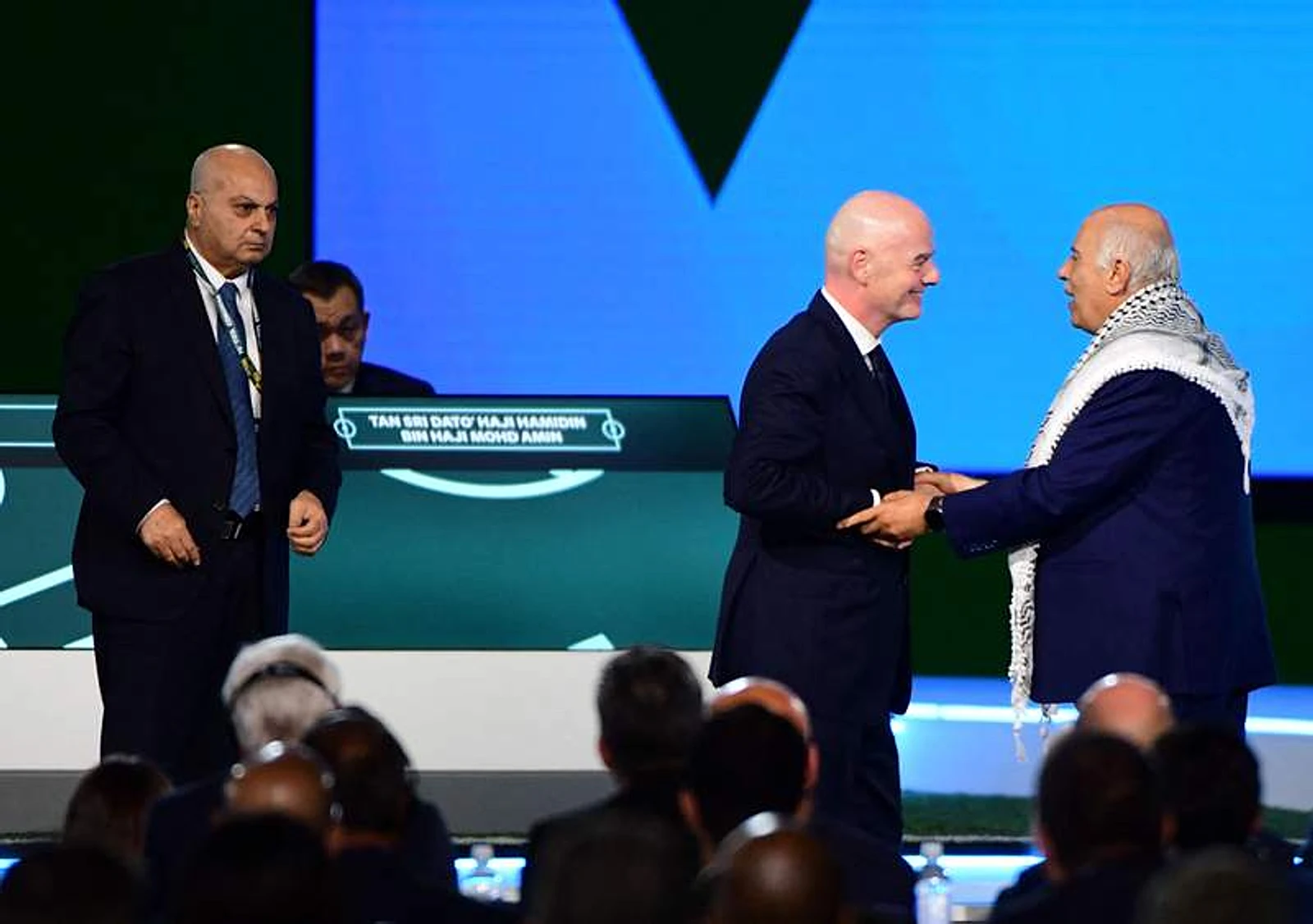
The 74th FIFA Congress in Bangkok witnessed a tense moment on Thursday when Palestinian Football Association President Jibril Rajoub refused to stand alongside Israel FA Vice-President Basim Sheikh Suliman. FIFA President Gianni Infantino attempted to broker a handshake between the two officials, placing his hand on Rajoub's arm and gesturing for him to come closer to Suliman—but the Palestinian chief stood his ground.
The confrontation comes at a time when sports and politics continue to collide on the international stage. Infantino, who addressed both men from the podium, urged unity: "We will work together, President Rajoub, Vice-President Suliman. Let's work together to give hope to the children. These are complex matters."
Rajoub's refusal was rooted in his ongoing campaign against Israeli clubs based in the West Bank—a issue he raised during his speech at the Congress. Palestinian FA Vice-President Susan Shalabi, who witnessed the exchange, explained that Infantino's gesture undermined the gravity of Rajoub's message. "To be put in a position where to have a handshake after everything that was said negates the whole purpose of the speech," she said. "He spent 15 minutes explaining how the rules matter, how this could become a precedent where member associations' rights are violated with impudence—and then we'll just wrap this under the carpet. It was absurd."
When asked what Rajoub said in refusing the handshake, Shalabi recounted: "I cannot shake the hand of someone the Israelis have brought to whitewash their fascism and genocide. We are suffering."
Rajoub himself later stated firmly: "I refused to shake hands. Sport is sport... for me, that should be respected. But if the other side is representing a criminal like Bibi (Benjamin Netanyahu) and speaking on behalf of Bibi as if Bibi is a saint—that's where I draw the line." He added, "From my side, I still respect and follow the legal procedure, but I think it's time to understand that Israel should be sanctioned. The double-standard policy should stop."
The incident underscores the increasingly charged atmosphere surrounding international football governance, where political tensions often spill onto the pitch—and into the halls of power. As the debate over the role of sports in geopolitical conflicts continues, moments like these remind us that for many, the beautiful game is never just a game.