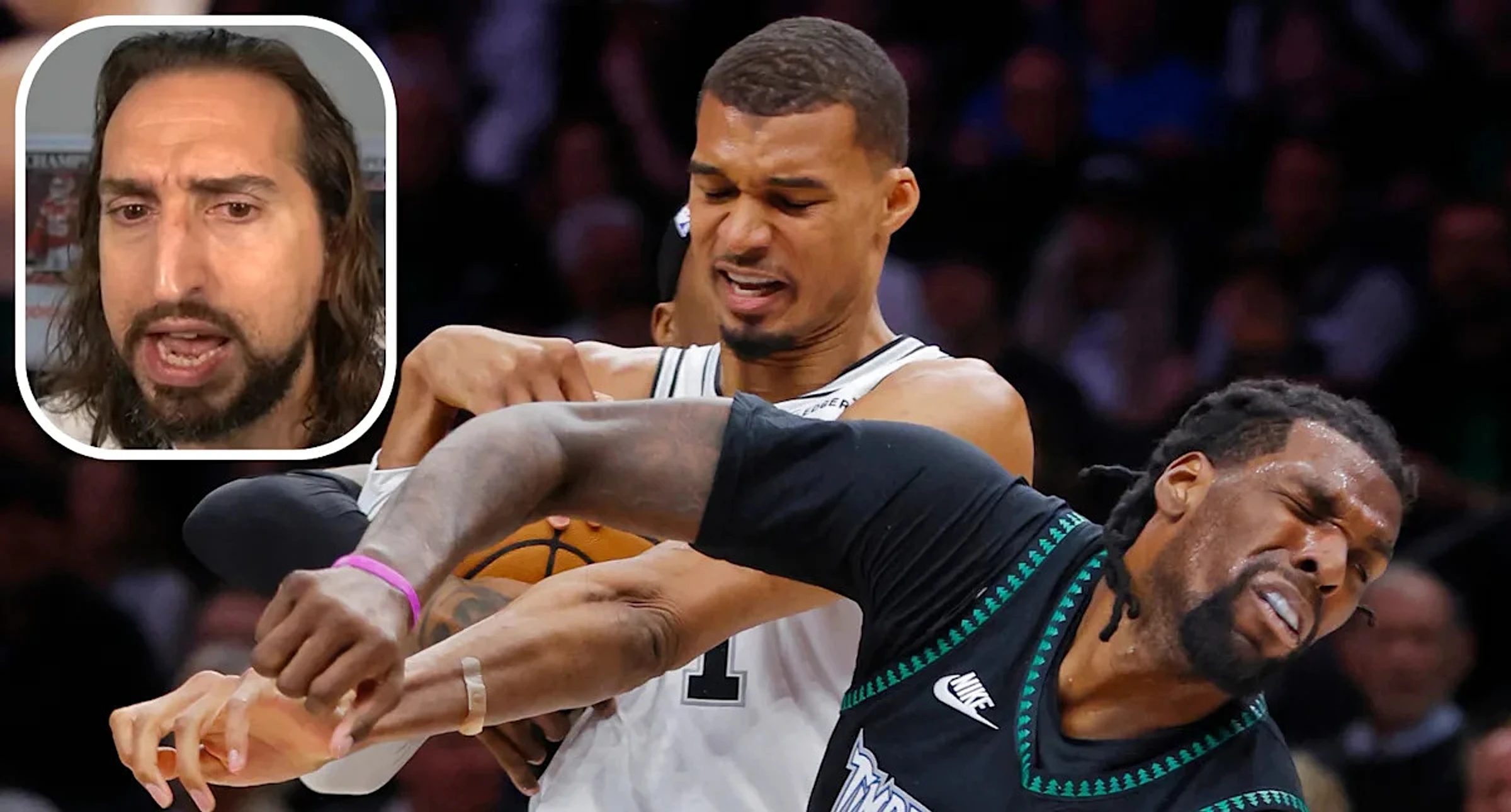
Victor Wembanyama may have avoided a suspension for his flagrant-2 foul in Game 4 against Minnesota, but he couldn't escape the scrutiny of FS1's Nick Wright. After the NBA decided not to sit the Spurs' rookie sensation for Sunday's ejection—where he elbowed Timberwolves forward Naz Reid in the face—Wembanyama returned for a pivotal Game 5 that San Antonio won to take a 3-2 series lead. But Wright wasn't impressed with how NBC framed the young star's comeback, calling it an over-the-top "redemption" narrative.
On his podcast The Right Time, Wright took aim at the broadcast's portrayal of Wembanyama as a hero making a "valiant return," despite the fact that he was the one who threw the elbow. "It was never more apparent than last night in the broadcast where they framed a game that Wemby was fortunate to be playing because he had avoided what would have been a totally reasonable if not a little punitive suspension, as if he was the one who got elbowed in the neck," Wright said. "The entire conceit of the broadcast was Wemby's hero return, as if he had been the one who was wronged."
Wright argued that the coverage felt like Wembanyama was the victim, not the aggressor. He pointed to an early technical foul called on Reid for shoving Wembanyama during a box-out, which Wright believed reflected a larger bias. "I felt like I was a crazy person," he added. "Everything about this is as if Naz had elbowed Wemby, and Wemby valiantly fought through it."
Later, on his show First Things First, Wright highlighted a graphic from NBC's pregame intro that referenced Wembanyama's "redemption." To Wright, that was a missed opportunity to focus on what really mattered: how the young star would handle the mental challenge of a mistake that cost his team a big postseason game. Instead, the broadcast leaned into a narrative that Wright believes has followed Wembanyama throughout his career—one that paints him as an untouchable talent, even when he's in the wrong.
For sports fans, this debate is a reminder that even the most promising players face growing pains. As Wembanyama continues to develop, how he responds to adversity—on and off the court—will define his legacy far more than any single broadcast's spin.