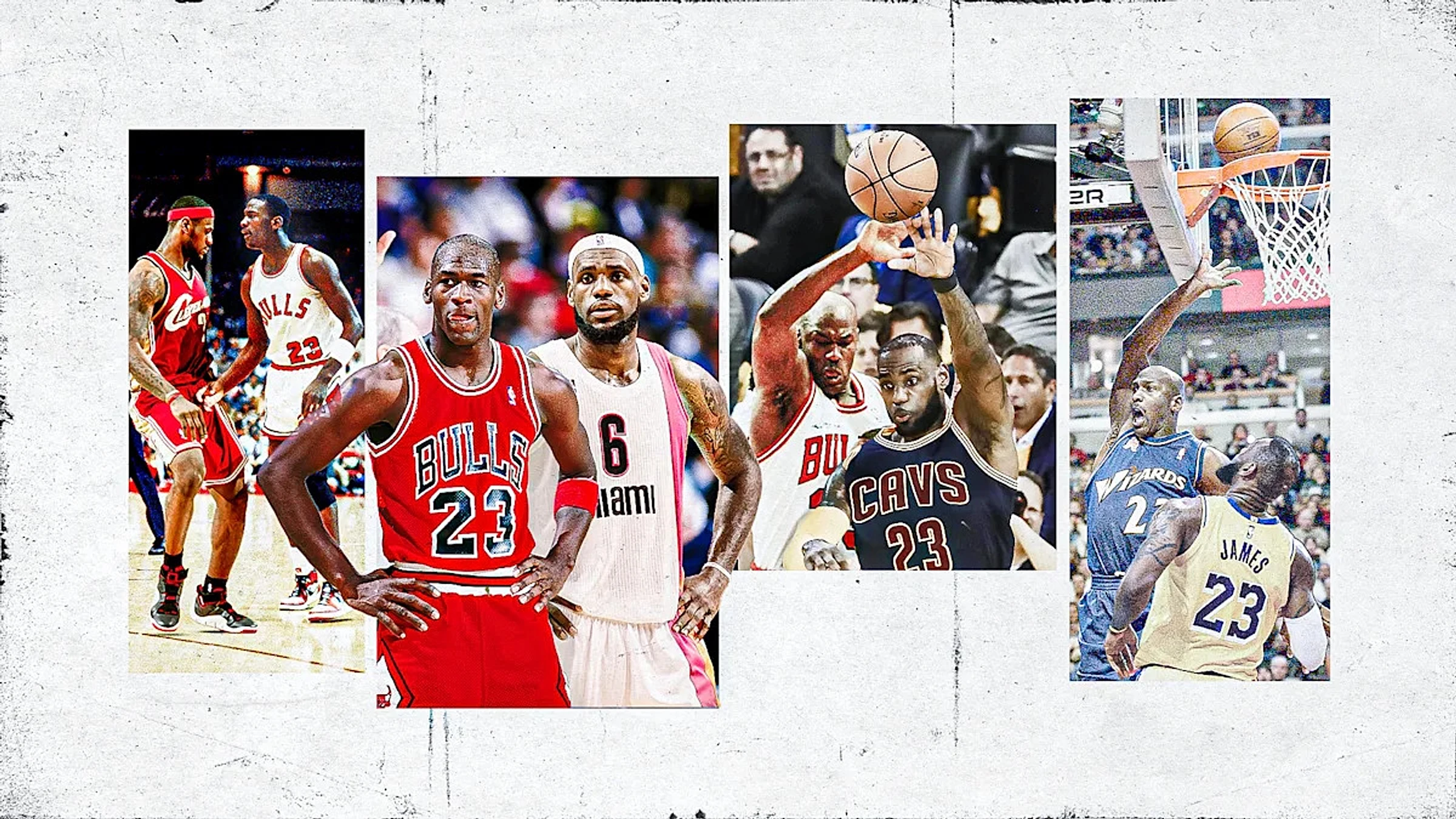


As if the GOAT debate hasn't been beaten into the ground already, we're going to put a new spin on the Michael Jordan vs. LeBron James discourse today by comparing them head to head for each year of their careers, from age 19 through age 41.
Everybody feel free to cherry-pick the outcome you like the most for use in your GOAT debates, which can be found on the final slide.
Ready to dive into the legendary careers of Jordan and LeBron, year by year? Let's get started.
MJ college stats: 20.0 ppg, 5.5 rpg, 1.6 apg, 1.2 spg, 0.8 bpg, 53.5 FG%, 73.7 FT%LeBron regular season stats: 20.9 ppg, 5.5 rpg, 5.9 apg, 1.6 spg, 0.7 bpg, 41.7 FG%, 29.0 3PT%, 75.4 FT%
MJ accolades: Sporting News National Player of the Year, 1st Team Consensus All-American, Pan American Games gold medalLeBron accolades: Rookie of the Year, 9th in MVP voting, Olympic bronze medal
Fresh off a national championship, Jordan averaged 20 points per game his sophomore season at UNC-Chapel Hill, his best average in college and no easy feat considering the lack of a three-point line in NCAA competition at the time and the snail-slow pace of the college game (the 45-second shot clock in NCAA wouldn't arrive until 1985-86). Regardless, at that point, James was already Rookie of the Year in a stacked class that featured Dwyane Wade and Carmelo Anthony, two other all-timers, and already receiving MVP votes.
James would miss the playoffs that season through no fault of his own, as the Cleveland Cavaliers went 35-47 in 2003-04 to miss the postseason by just one game as they finished ninth in the East that year.
Jordan's North Carolina team, meanwhile, made it to the Elite Eight but with James Worthy departed, lacked the firepower outside of Jordan and Sam Perkins to repeat as national champions.
Jordan was one of the best NCAA players around in his age-19 campaign but James was already producing at a very high level in the NBA. Could Jordan have had a similarly good rookie season when he was 19 to James? Impossible to know but we have to go with the facts here – James was already doing it at the highest level, winning Rookie of the Year and nearly leading a team to the playoffs – leaving us with an obvious choice.
MJ junior year college stats: 19.6 ppg, 5.3 rpg, 2.1 apg, 1.6 spg, 1.1 bpg, 55.1 FG%, 77.9 FT%LeBron regular season stats: 27.2 ppg, 7.4 rpg, 7.2 apg, 2.2 spg, 0.7 bpg, 47.2 FG%, 35.1 3PT%, 75.0 FT%
MJ accolades: National College Player of the Year, Sporting News National Player of the Year, 1st Team Consensus All-American, Olympic gold medalLeBron accolades: 2nd Team All-NBA, All-Star, 6th in MVP voting, 6th in Most Improved Player voting
In his junior season at North Carolina, Jordan put up similar numbers to his sophomore season but his Tar Heels were upset in the Sweet 16 of that year's NCAA Tournament by Indiana despite having Jordan, Perkins, Brad Daugherty and a freshman year Kenny Smith on the roster.
1983-84, Jordan's age-20 campaign, also saw him suit up for Team USA at the Olympic Games, leading the team in scoring at 17.1 points per contest as he helped the Americans secure the gold medal in men's basketball. Jordan was so dominant in Olympic trials that legendary NCAA coach Bob Knight, who coached Team USA that year, told then-Portland Trail Blazers general manager Stu Inman, whose team had the No. 2 pick in the 1984 draft, to just draft Jordan and play him at center if he wanted a big man that badly.
Still, James was already an All-Star and earned All-NBA 2nd Team honors in his age-20 season. James made a leap to the point that he put up a stat line eerily similar to his career averages, though not yet as efficient as he'd be later on. James' Cavaliers missed the playoffs again that season despite having the same record as the eighth seed due to a tie-breaker but again, how can you remotely blame the guy putting up 27/7/7 with two steals per game for that?
Once again, we don't know how Jordan would have done in the NBA had he been thrust into the league as a 20-year-old (he probably would have done all right, truth be told) so we have to go with what actually happened, and that was James already being a proven superstar in the NBA by Year 2.
MJ regular season stats: 28.2 ppg, 6.5 rpg, 5.9 apg, 2.4 spg, 0.8 bpg, 51.5 FG%, 17.3 3PT%, 84.5 FT%LeBron regular season stats: 31.4 ppg, 7.0 rpg, 6.6 apg, 1.6 spg, 0.8 bpg, 48.0 FG%, 33.5 3PT%, 73.8 FT%
MJ playoff stats: 29.3 ppg, 5.8 rpg, 8.5 apg, 2.8 spg, 1.0 bpg, 43.6 FG%, 12.5 3PT%, 82.8 FT%LeBron playoff stats: 30.8 ppg, 8.1 rpg, 5.8 apg, 1.4 spg, 0.7 bpg, 47.6 FG%, 33.3 3PT%, 73.7 FT%
MJ accolades: 2nd Team All-NBA, All-Star, Rookie of the Year, 6th in MVP votingLeBron accolades: 1st Team All-NBA, All-Star, All-Star MVP, 2nd in MVP voting, World Cup bronze medal
Jordan came out absolutely firing as an NBA player, averaging 28/6/6 as a rookie with over two steals nightly, even managing to up those averages in his first taste of the playoffs. James' age-21 season was also his first time in the playoffs as his Cavaliers' got to Game 7 of the second round, taking an experienced former champion Detroit Pistons team to the brink of elimination. Meanwhile, Jordan's Bulls were defeated 3-1 in the first round by a strong Milwaukee Bucks team in the 1985 playoffs.
James was already statistically the best player in the NBA in his age-21 campaign, averaging a career-high 31.4 points, a mark that came at a time when teams averaged roughly 97 points per contest. James finished second in MVP voting that year behind a veteran Steve Nash, a decision that was not super controversial at the time but would have had Twitter up in arms these days if you just look at the two players' respective numbers (Nash averaged 18.8 points and a league-leading 10.5 assists in 2005-06).