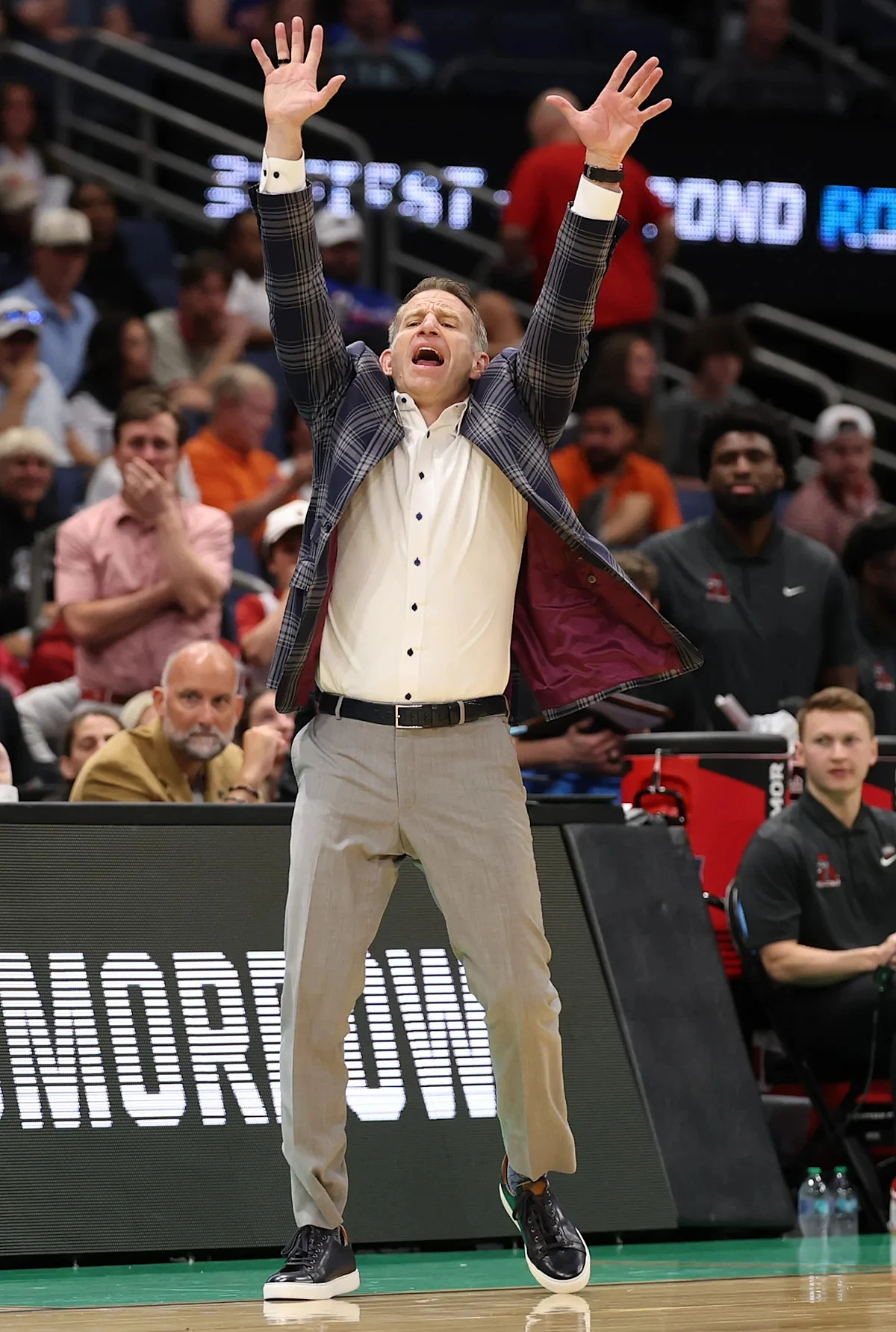


The big news yesterday was the commitment of Boise State center Drew Fielder to play for coach Nate Oats and the Crimson Tide:
Oats had one major goal in mind this offseason for the Crimson Tide: get bigger, tougher, and more versatile. Mission accomplished.
Alabama landed a commitment on Monday from Boise State forward/center Drew Fielder, the biggest portal addition to date for the Crimson Tide so far. Fielder averaged 14.7 points and 5.7 rebounds per game for Boise State this past season while knocking down 41% of his threes on over three attempts per game.
Fielder joins a portal haul that includes SEC-experienced big men in Brandon Garrison (Kentucky) and Jamarion Davis-Fleming (Mississippi State), to go along with NC State wing Cole Cloer, who was a Top 30 overall recruit in the 2026 recruiting class before a late reclassification and redshirt with the Wolfpack.
Fielder is an impressive offensive threat, and his 41% from three at 6’11” is downright nuts. Nate Oats said when the season ended that his team needed to get bigger. And, well, with Fielder, Garrison, and Davis-Fleming, they added a whole lot of size.
It is no longer just about choosing the best quarterback. It is about managing the risk that comes with that choice.
In previous eras, the decision was straightforward. Coaches played the quarterback who gave them the best chance to win, which often meant leaning on experience. Veterans understood the system, had game reps and could handle pressure situations more consistently.
That logic still applies, but it is no longer the only factor. With the rise of the transfer portal and NIL, playing time has become just as important as performance in roster management. If a highly touted young player does not see the field, there is a real possibility he will leave for another opportunity.
Paul Finebaum highlighted that dilemma on “The Paul Finebaum Show,” pointing directly to Alabama’s current quarterback situation.
“If you go with the veteran, Austin Mack, who has been a part of the (Kalen) DeBoer system with (Ryan) Grubb, and you do run a risk of really losing your other player,” Finebaum said.
That puts Alabama in a difficult position between Austin Mack and Keelon Russell.
To the shock of no one, I actually think Pawwll is being a little dramatic here. This dilemma has ALWAYS been the case with the QB position, even before the Portal Chaos Era. If a guy didn’t win a job, there’s always been a good shot he’d transfer, solely because of the nature of the QB position. You get four seasons to show you can make it to the NFL. And as a QB, you never get to rotate in. You either start, or you never play.
If a veteran wins a job, a younger player will often still stay. That could still happen, but in this case, Russell and Mack are close enough in age that Russell could look at Mack still having two years of eligibility and go ahead and leave for somewhere so that his entire career isn’t hinging on one final season. And Mack will almost assuredly transfer if he loses.
So yeah, either way, the coaches are managing the risk. I just don’t think that’s anything new or noteworthy.
“The longer you watch him, you feel a little, man,” an AFC executive told Pelissero. “What’s he going to look like in our league? History’s betting against us here. He gets thrown around. The kid’s not very big, he’s not very gifted. When he gets sacked, it looks like your dog swinging around their squeaky toy.”
After falling to Florida State in the season opener during his first career start, Simpson showed exponential growth over the next couple of months. He was being perceived as a Heisman Trophy candidate, but in the final handful of games, including the postseason, he struggled.
In the first 11 games, Simpson averaged 266.7 passing yards and 2.0 touchdowns on 66.9 completion percentage. In the final four games, including the Rose Bowl where he exited early in the third quarter due to a rib injury, he averaged 158.3 passing yards and 1.5 touchdowns on 57.1 completion percentage.
Pelissero revealed on Feb. 23, the first day of the NFL Combine, that Simpson was “dealing with a severe case of gastritis toward the tail end of the season. He was weighing in the 190s by the time they got to the Rose Bowl.”
Simpson was back up to about 211 pounds at the NFL Combine, but even when he reached this weight, another AFC executive told Pelissero, “When he walked in our room, he looked like one of the ball boys.”
“They’ve tried to get him to 210, and I think he’s really struggled to get there. I think he played in the low 200s and then he got the crap beat out of him in that offense. All the dropback and struggling to run the ball. But early on, he was really decisive, he’s accurate, he can throw on time, he processed quickly – all those things were really, really encouraging, and then he just fell apart physically.”