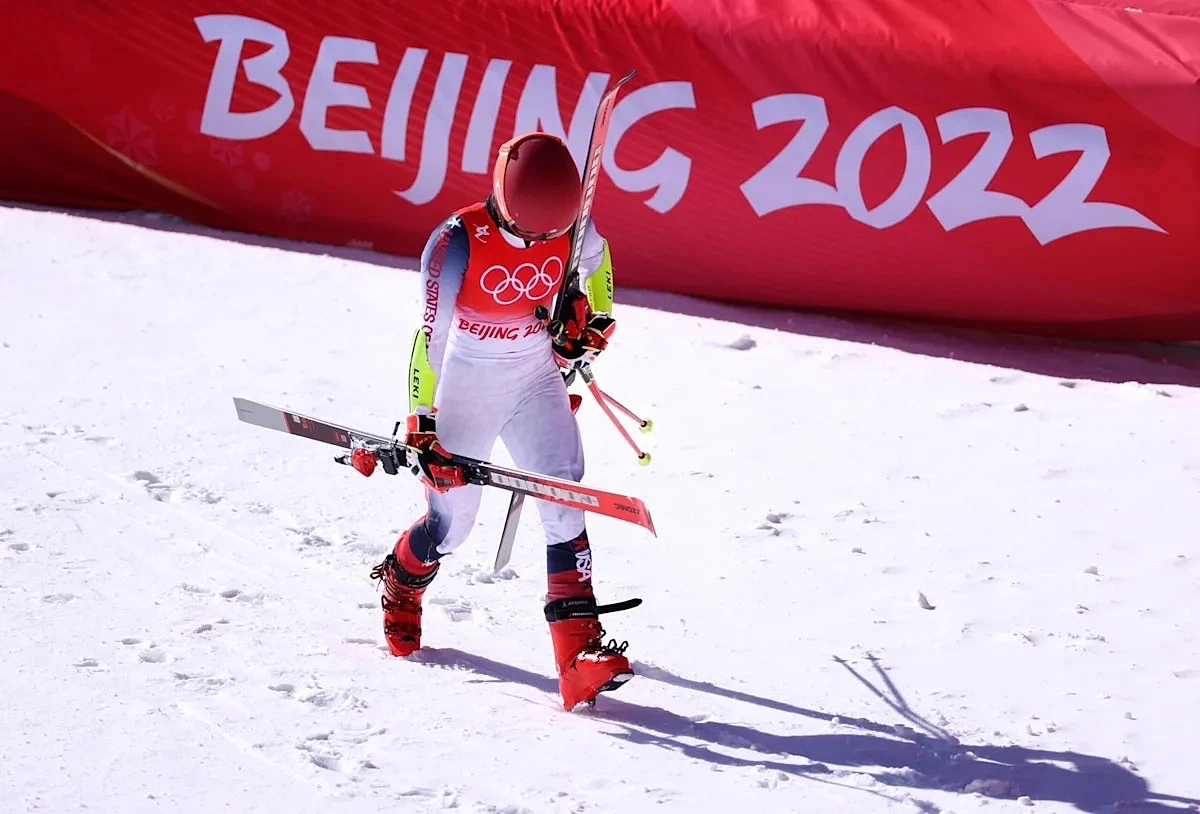


For more than three hours on Feb. 10, Mikaela Shiffrin and her team hashed through how a day that had begun with so much promise had turned nightmarish.
The American Alpine skiing star had spent the past four years answering questions about a disastrous showing at the 2022 Beijing Olympics, where the greatest skier in history had crashed three times in six races and left China with zero medals. Now, an ugly run in her first race at the 2026 Games — the slalom half of the team combined event, in which a slalom skier and speed skier each take a run in their specialty and the best combined time wins — had cost her and Breezy Johnson a medal.
The questions about Shiffrin having an Olympic hex were coming at her again. This was exactly how Shiffrin, her coaches and her psychologist didn’t want to start her Olympics in Cortina d’Ampezzo, Italy. Now they needed to find a path forward, a way to keep the Games from heading sideways once more.
Shiffrin’s mother, Eileen, a former competitive skier who still helps coach her, had even floated the idea of skipping the Olympics, because she was worried that her daughter might not be able to endure a reprise of Beijing. Shiffrin had dismissed the idea, choosing instead to work through the tears with her longtime psychologist.
It was nearly 9 p.m. when Johnson, one of Shiffrin’s oldest and closest friends on the U.S. team, entered the room. She told Shiffrin she didn’t need to feel bad. She implored her to be rational about what had happened, like she is after every race. Test your equipment, study the video, figure out why you didn’t ski up to your level. Solve the problem, so it doesn’t happen again.
“And then we went and did it,” Shiffrin recalled recently over a cappuccino in a Manhattan hotel at the end of a triumphant season. “I was not freaking out. I didn’t break anything. I wasn’t really mad. I was more just like, ‘Alright, guys, we got to, like, buckle up, because we still have work to do.'”
Eight days later, Shiffrin stood atop the podium with the slalom gold medal around her neck as the sun descended behind the craggy peaks of the Dolomites.
This is the story of how Shiffrin dodged all the psychological landmines that the Olympics threw at her to achieve the result that the public expected from the woman who is far and away the winningest skier in the sport’s history. Only winning would allow her to escape the criticism she so feared, even if it was going to come from people with little understanding of her or her sport.
“They just don’t think that I have to do work anymore to be good at slalom,” said Shiffrin, who has won a record 73 slalom and 110 overall World Cup races in her career. “Actually, I’m that good at slalom because I do work constantly every single day. I do not ever settle or rest.”
Shiffrin had been working with psychologist Abbey Fox for years, ever since her struggles in Beijing, but especially during the previous six months as the Milan Cortina Games approached. In one exercise, Fox would have Shiffrin write the word “Olympics” on a piece of paper over and over, and then write down the emotions that it conjured.
A lot of those emotions centered on Shiffrin’s fear of being criticized again. Sometimes, the simple act of writing the word would make her cry. So together, she and Fox worked to figure out the emotions behind those tears. Many of them had to do with Shiffrin’s father, Jeff, an early ski mentor and her biggest fan, the guy who was always in the finish area with his camera, who died from an accident in the family home in Colorado in 2020. There was a question Shiffrin needed to confront:
“Maybe I don’t want to win an Olympic gold medal when he is not here?” she said.
Was winning a way to honor his memory? Would winning another Olympic gold medal, eight years after he had watched her win her last one in South Korea, simply be too painful when he’s not alive to experience it with her?
“Maybe it feels like another level of accepting a world where he’s dead, and I don’t want that,” she said.
But then, she also wanted to win. Desperately. Shiffrin may be gracious in defeat, but she is a fierce competitor. She decided that working through all the hard stuff to get to the Olympics, when the spotlight was brightest, would make her dad proud and honor his memory in its own way.
She knew the Olympics were going to throw curveballs at her that might knock her out of sync. If she was going to have any chance at achieving her goal, her team was going to have to get her back on track. She’d told them all this during a meeting at a training camp in Chile in September. Sometimes, they were going to have to tell her things she might not want to hear.
Five months later, Shiffrin headed to Cortina on a hot streak unlike any skier had before. She’d won seven of the season’s eight slalom races and come in second in the other one by a hair. Almost nothing and no one could beat her.
Even before the Olympics started, something felt a little off about Cortina to Shiffrin. As she drove into the city that is a playground for Italy’s aristocracy, where she has competed and trained during so many seasons, Shiffrin’s eyes kept focusing on the light blue color scheme everywhere she looked. The usual red of a World Cup venue that carries so much familiarity and comfort was gone. It made the place feel far more foreign than she expected.
In a news conference, she was asked how it felt to compete for the U.S. as protests raged over a surge in aggressive deportation operations and the recent killing of two civilians in Minnesota by federal agents. She shared a quote from Nelson Mandela:
“Peace is not just the absence of conflict; peace is the creation of an environment where all can flourish regardless of race, colour, creed, religion, gender, class, caste or any other social markers of difference.”