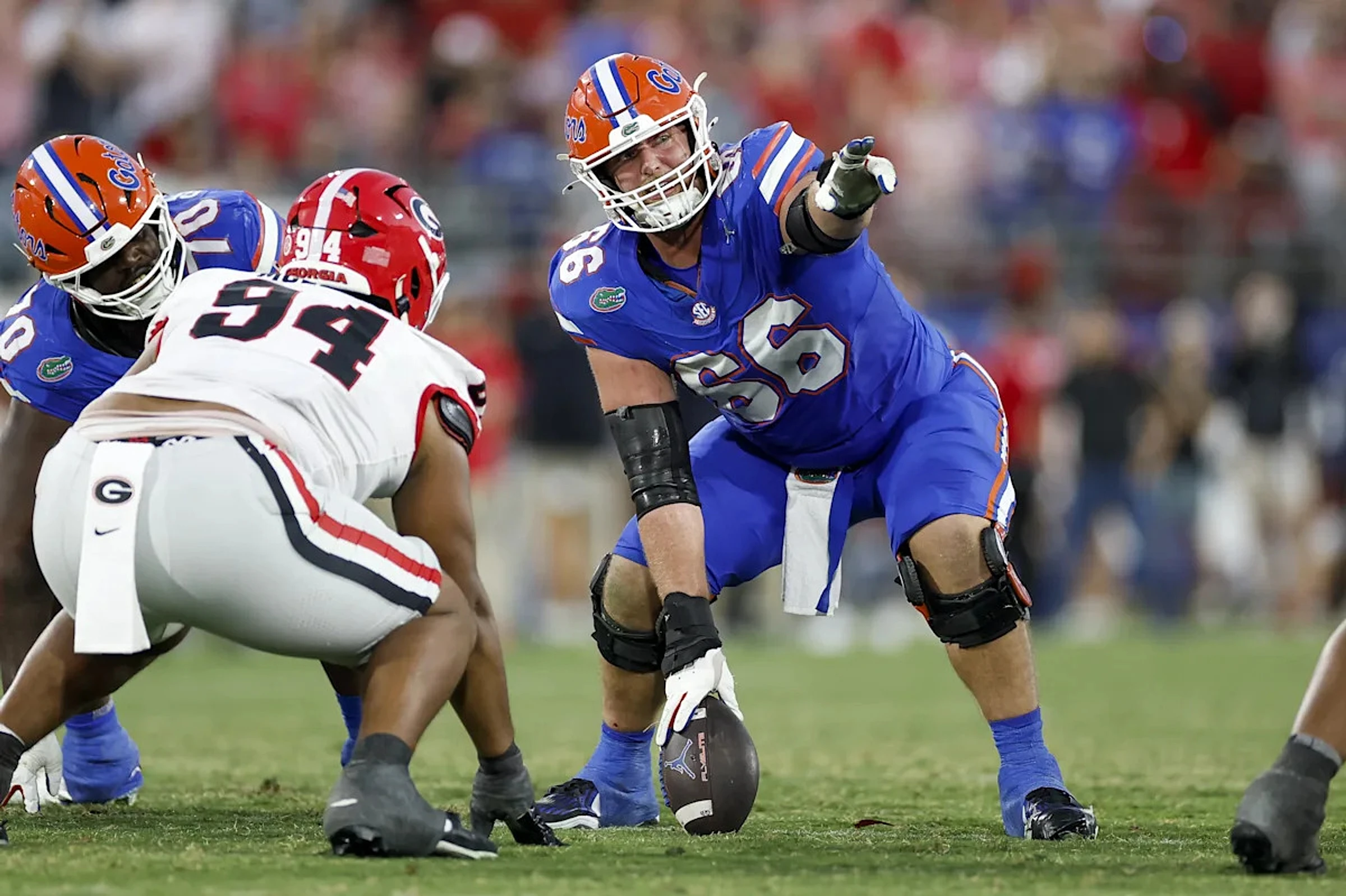


Last, but not least in the series of draft position roundup is Center.
Adam Peters was active in the first wave of free agency, with multiple additions on defense and offensive skill positions. The two biggest remaining needs he was unable to address were Wide Receiver and Center. Washington was reportedly in the bidding for premium targets WR Alec Pierce and C Tyler Linderbaum, but fell short of the massive price tags that each player commanded.
That leaves the Commanders heading into the draft with veteran backup Nick Allegretti pencilled in as the starting center. Dan Quinn has affirmed the team’s trust in the seven year vet, who has mainly played backup guard, and occasional emergency replacement center. But it wouldn’t be a surprise if the Commanders look to the draft and post-draft free agency to find more competition and potential upgrades at the position.
The 2026 draft class has been described as deep at the position. The consensus draft board lists 22 interior offensive linemen who have entered the draft as centers. And there are a few additional players seeking to switch from other positions. However, there are currently no experienced center prospects with consensus top-50 projections. Like most years, there are several prospects who could earn starting jobs this season, and one or two probably will. But fans might want to temper expectations of the team drafting a Day 1 starter to send Allegretti back to the bench in training camp.
Some common themes in draft profiles of many of the top ranked prospects were short arms and average play strength. However, as Hogs Haven’s LA Skin noted in a recent draft profile for one of the prospects, I have to wonder if the media analysts who write these profiles are fully across the size of centers in today’s NFL, and particularly those who play in zone-heavy schemes. Every prospect under 310 lbs and/or 33” arm length seems to get labelled “undersized”, which is setting the expectation on the high side. And the expectations for play strength seem to be set on centers in gap-blocking schemes or guards.
For this round-up I used advanced blocking metrics, along with athletic testing results and draft profiles from around the internet to identify center prospects who suit a zone-heavy blocking scheme, with potential to earn a starting role at some point in their NFL journey. I was also guided by the Commanders’ prospect visit schedule.
More so than for any of the previous position roundups, I found there was frequently disagreement between the different sources of information on individual prospects. I did my best to synthesize and reconcile what different channels were telling me, and have indicated where I was left with lingering uncertainty.
“Advanced Metrics” sounds fancy, but it really just means metrics that are derived from film breakdown, as opposed to standard stats reported by the NFL, which are mainly derived from where the refs spot the ball on the field. This roundup relied heavily on two performance metrics sourced from Pro Football Focus.
Pressure Rate is the percentage of Pressure Opportunities on which the blocker allowed a pressure (Sack, QB hit, QB hurry). Pressure Opportunities are non-spike passing snaps on plays that were not negated by penalties.
As an alternative to purely subjective analysis of technique to attempt to identify the best pass blockers, Pressure Rate focuses on the results of the blocking process. It still has a significant subjective component, because it relies on human observers to score pressures. But variability and bias are mitigated through PFF’s quality assurance process, which you don’t usually get with film breakdowns from individual analysts.
The following table shows the Pressure Rate benchmarks for NCAA centers. Center prospects in this roundup were ranked against two different cohorts: the 22 center prospects listed on the consensus board, and 166 FBS centers who played a minimum of 200 blocking snaps in 2025. Not surprisingly, blocking metrics for consensus-ranked draft prospects were higher as a group than those for all FBS centers.
I have yet to find a truly satisfying analytical metric for run blocking by NCAA players. In the absence of a better alternative, I used PFF Run Blocking Grades. My past attempts to cross-validate PFF blocking grades for NFL players against different metrics, such as SIS Blown Blocks, have shown very strong correlation between different metrics from different sources, which provides some level of reassurance. And PFF grades do have the advantages of being derived through a quality assured process for all NCAA players, in every game, to provide a large sample for analytical comparisons with the players we are interested in.
Run Blocking Grade benchmarks for the center class are provided in the following table:
Lastly, thanks to a tip from LA Skin, I also used TEF values as a secondary athleticism metric, after RAS and individual athletic testing numbers. The TEF is a metric developed by the Seahawks Draft Blog to measure explosiveness of OL prospects, which you can read about here. It combines vertical jump, broad jump and bench press measures into a single metric, which is intended to identify OL prospects with the desired explosiveness for the NFL. Values over 3.0 indicate an explosive player, and values around 2.5 in the current sample seem to indicate more plodding types. As an aside, it is a mystery to me why bench press reps are included, since that is more of a measure of endurance than explosiveness.
Prospects are listed in order of consensus ranks, not order of preference. When available, Hogs Haven draft profiles are linked to the player’s name.
6-4 | 316 lbs | 33.25” arms | RAS 9.53 | TEF 2.98 | Age 22
2025 Stats: 13 Games | 872 Blk Snps | 1.4% Pressure Rate | 0 Sacks | 76.8 Run Blk Grade
Rutledge was featured in the Week 9 edition of Future Hogs. He is a big, nasty bully of an interior blocker. He took 98% of his snaps at right guard in college, and not one at center. But he worked out at center, to showcase his versatility to NFL scouts at the Senior Bowl, and has continued to do so throughout the draft process.
Rutledge has the power to move defensive tackles out of the way. He ragdolls linebackers, if he gets his hands on them. He looks to finish defenders through the whistle, and ends a lot of reps with opponents on the ground. He is exceptionally athletic for a player his size, with the combination of power and movement skills to excel in any blocking scheme. His Pressure Rate allowed in pass protections slots in between the 5th and 6th consensus-ranked centers in the draft class. And he is a road grader in the running game.
Rutledge would be a premium option if Adam Peters acquires a second round pick in a trade. He could be an instant upgrade over whomever the Commanders were planning to start at left guard, with potential to become a transformative addition at center, once he masters the position. However, that might be a pipedream, because it would be unusual for the Commanders to draft a player on Day 2 whom they haven’t met.