
Like this article? Keep independent journalism alive. Support HuffPost.
If there's one country guaranteed to clean up at the World Cup, it's Japan.
Buzz: Stephen Colbert Reveals 1 Of His Final 'Late Show' Guests: 'I Will Be Sitting Down With...'
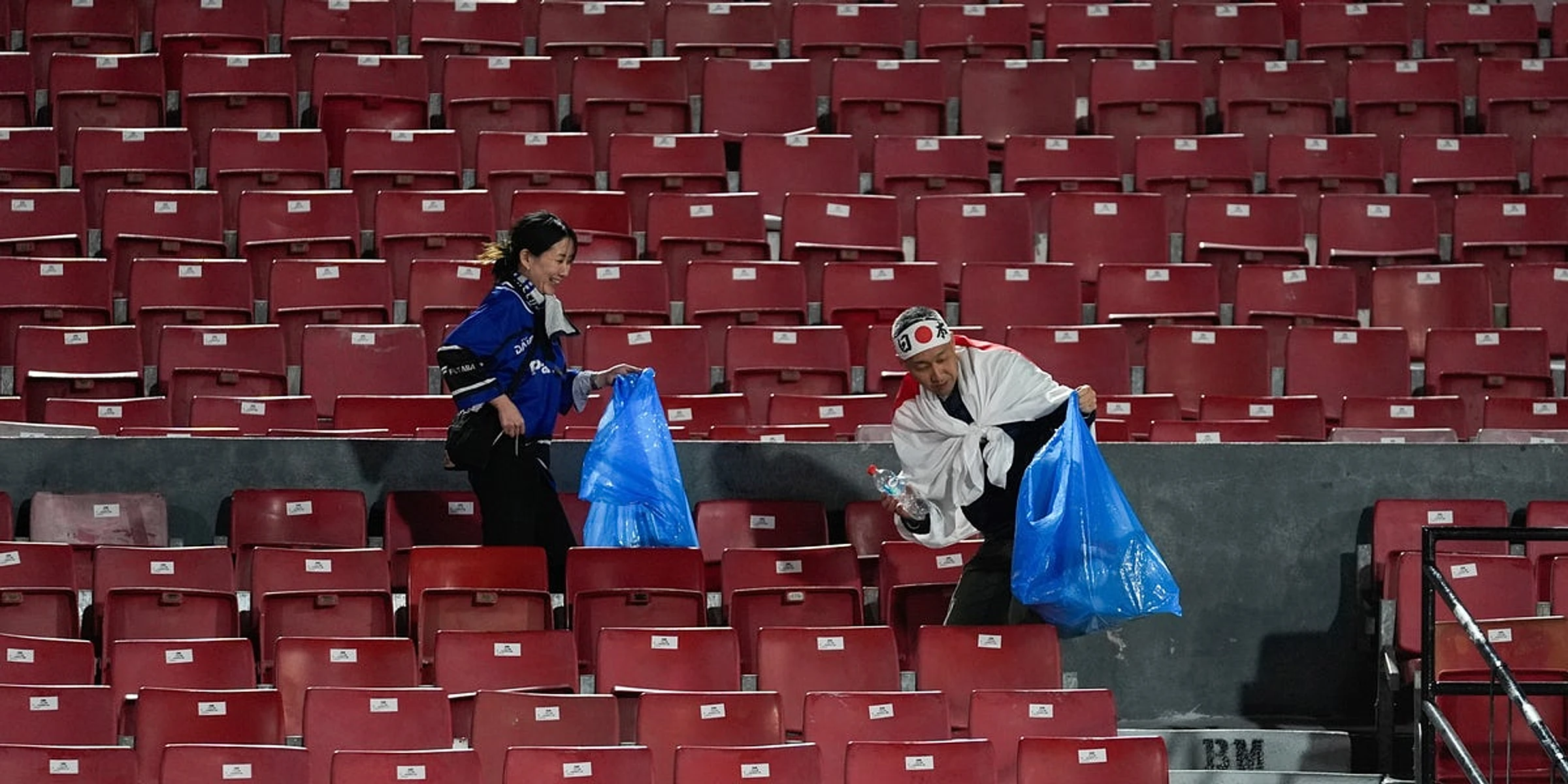
Scenes of Japanese soccer fans sweeping stadiums and picking up trash after a match first drew public attention in France in 1998 — Japan's first appearance in the World Cup.
The tradition has continued every four years. It happened at the World Cup in Qatar in 2022, and it's certain to continue when Japan opens play in June with group games in Arlington, Texas, and Monterrey, Mexico.
The cleanup astonishes non-Japanese who might be accustomed to leaving stadiums and stepping over half-eaten food, shredded paper wrappers, and cups — empty or with liquid dribbling out.
At the World Cup in Russia in 2018, Japanese players famously cleaned the dressing room after a loss and left a thank-you note in Russian. In 2022, fans left thank-you notes on rubbish bags written in Arabic, English and Japanese.
Buzz: Sydney Sweeney’s R-Rated Film Tanked At The Box Office — Now It’s A Top Movie On HBO Max
It's not that complicated. Beginning in elementary school, students are socialized to behave this way — in the classroom, in the school yard or on a playing field.
“Japanese sports fans at world events who clean up the stadium are behaving much the same way they did when they learned how to enjoy sports as school boys and girls,” Koichi Nakano, who teaches politics and history at Sophia University, told The Associated Press.
Buzz: Jon Stewart Reveals The Most Awkward 'True Colors' Moment Of WHCD Shooting
The literal translation is: “A bird leaves nothing behind.”
Rendered in English the message is: “Return it the way you found it.”
Many Japanese elementary schools don’t have janitors, so the clean-up work is left to students. Office workers often dedicate time to sprucing up their areas.
Also, there are relatively few trash containers in public spaces in Japan, so people take their waste home with them. This keeps the sidewalks cleaner, saves the cost of emptying trash cans, and keeps away vermin.
Buzz: Anthony Kiedis’ Girlfriend Speaks Out On 33-Year Age Gap With Red Hot Chili Peppers Singer
“The way most ordinary soccer fans experience soccer at school is no different from other sports, and the emphasis is not just on physical education but also on moral education as well,” Nakano added.
Raised in Germany, Barbara Holthus is the deputy director of the German Institute for Japanese Studies in Tokyo. A sociologist, she agrees it's prudent not to put Japanese on a pedestal. Japan, like any country, has its own challenges and shortcomings.
“An academically sound explanation is that people in Japan just happen to be socialized different,” she told The AP. “If you grew up with a certain way of how things are being done, you apply that to even cleaning up a stadium afterwards.”
At work here is also the Japanese concept of “meiwaku,” which implies not causing trouble or annoying others. From the Japanese point of view, leaving rubbish piled up in a stadium would be a bother to others.