

Ricky Stenhouse Jr., who’s known for his superspeedway racing prowess, says the fuel-saving strategy implemented at Talladega and Daytona won’t change until the NASCAR Cup cars return to a wheel that needs five lug nuts instead of the single one now used.
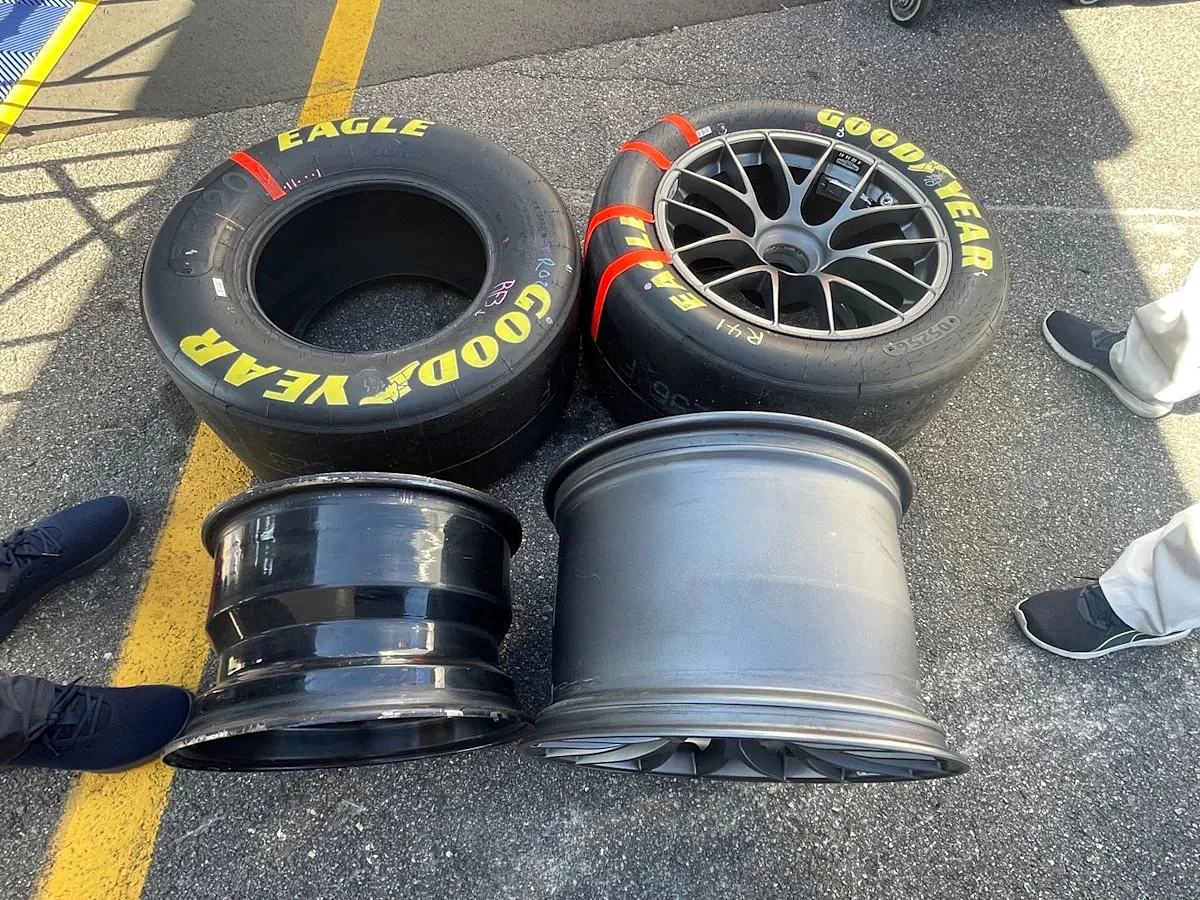
The wheel used on the current Cup car is much wider and lower than the one used in NASCAR’s O’Reilly Auto Parts Series and attaches with a single, center-locking lug nut system. It’s 18 inches in diameter, 12 inches wide, and made of forged aluminum. The O’Reilly Series wheel, which is identical to the one previously used in the Cup Series, is 15 inches in diameter. 9.5 inches wide and made of steel, thus allowing five lug nuts to be used.
NASCAR has said a five-lug system wouldn’t be safe for use on the alloyed aluminum wheel. The single, center-locking lug nut system has enabled four-tire fuel stops to be made in 10 seconds or less. It now takes longer to fuel the car than it does to change tires.
“If you don’t have to pit in a Stage, I’ll still save fuel because when you do come down pit road, you’re still gonna want the least amount of fuel as possible,” said Stenhouse, whose four NASCAR Cup victories have all been at Talladega or Daytona. “That’s still our limiting factor. Until you go back to five lug nuts, the fuel is gonna be the issue.”
In recent years, the Cup teams developed a fuel-saving strategy at NASCAR’s two biggest speedways because that allowed them to spend less time on pit road. In an effort to derail that strategy in Sunday’s Jack Link’s 500 at Talladega Superspeedway, NASCAR reversed the length of the Stages, making the first Stage the longest one. For the 188-lap event, NASCAR set the first Stage at 98 laps and the final two Stages at 45 laps each, which is the approximate fuel window. John Probst, NASCAR executive vice president and chief racing development officer, said the teams could possibly make one stop in Stage 1 instead of two.
Spire Motorsports Competition Director Matt McCall said there definitely was an opportunity to complete Stage 1 with only one pit stop.
“I really think it dictates on how the pace of the race starts,” McCall said. “There probably will be a little cat-and-mouse to figure that out within the first five to 10 laps. If a caution falls in the middle of it, that will change everything.”
Stenhouse noted that everyone knows the amount of fuel their competitors possess.
“So, you can always kind of pick and choose who you feel like you need to pit with,” Stenhouse continued. “(If) you have to take a second less fuel than other people … you’re going to come off pit road by yourself and (have to) wait for everybody to catch up with you. You want to pit with the people that need the same amount of fuel you do so you can leave pit road and get hooked up as quick as you can.”
McCall said that drivers comprising the lead pack will determine how the race unfolds from the beginning with the pace being determined by the first 10 cars.
“Our approach right now is to be as aggressive as we can because, obviously, we need points and you want to maximize each Stage,” says McCall, whose team fields Chevrolets for Daniel Suarez, Michael McDowell and Carson Hocevar.
However, McCall notes you want your drivers as close to the front as possible when the 45-lap final Stage begins.
“There’s nothing that stands out that is going to be a ton different, except most likely, you won’t have leaders running 50 percent unless there’s an OEM that commits to trying to maintain that speed to start the race,” McCall said.