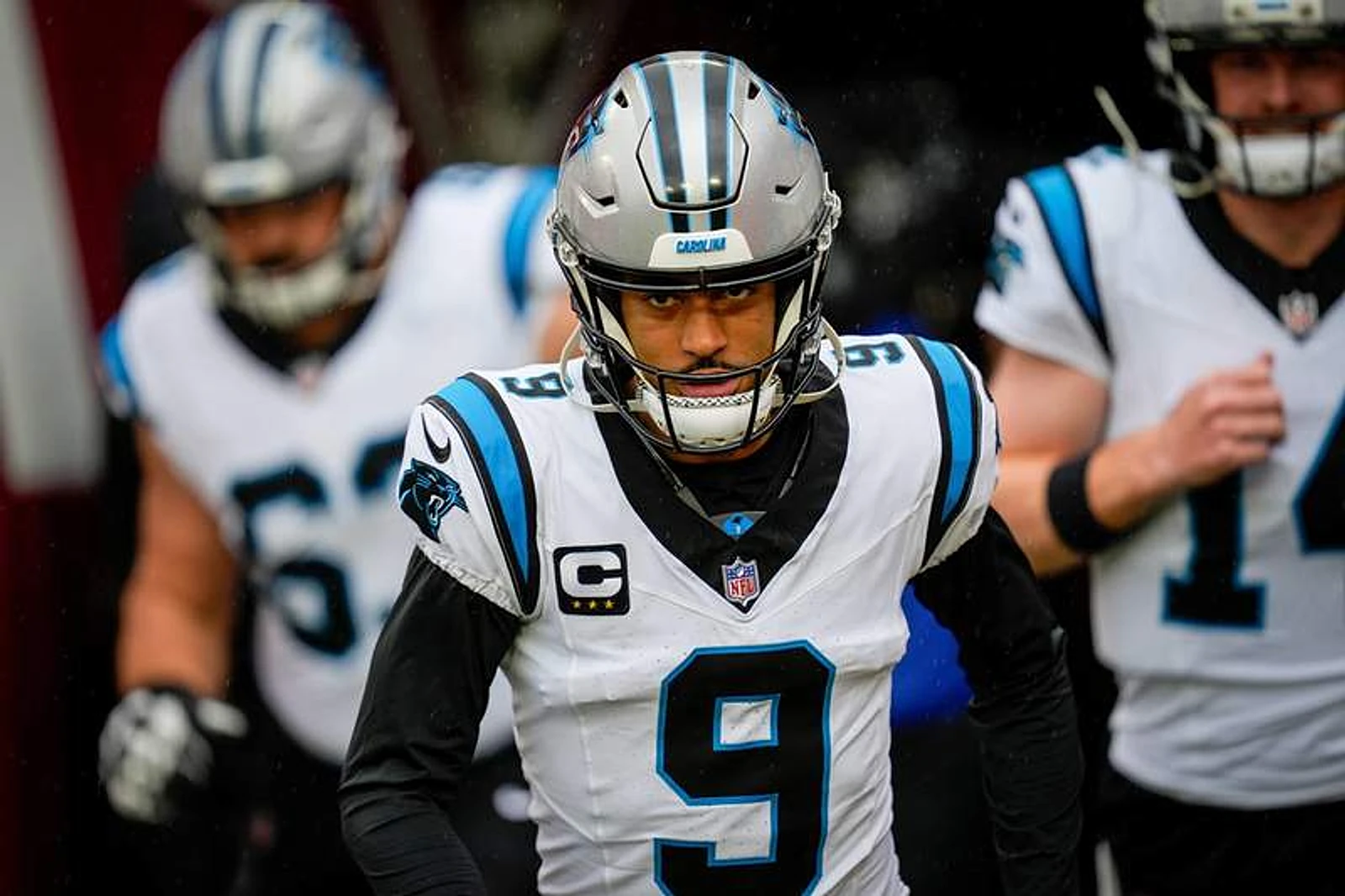


During his Heisman Trophy-winning days at Alabama, Bryce Young showed the ability to win games despite lacking elite athleticism or prototypical quarterback size. In the 2023 NFL Draft, the Carolina Panthers made a big investment in that ability by trading up with the Chicago Bears to select Young with the No. 1 overall pick. The message was clear: Carolina believed Young could be the face of their franchise. But has that leap of faith in Young’s abilities paid off yet?
Young’s rookie season was anything but smooth sailing. He got benched early and secured just two wins for Carolina. In over three uneven seasons, Young has recorded 49 touchdowns against 30 interceptions. So, this offseason, when Young’s fifth-year option became available, many expected the Panthers to reconsider their investment in him. But last week, Panthers’ general manager Dan Morgan made it clear that his team is exercising the option rather than releasing Young.
“Once the draft’s over, we’ll definitely get that going,” Morgan said while talking about Young in the Panthers’ pre-draft presser. “Obviously, the player’s not in the building yet. We’ll get that done as soon as he gets back in the building.”
That option will keep Young in Carolina through 2027, and he will get a guaranteed $26.5 million under the contract. Morgan also hinted at adding another QB on the Panthers’ roster, but stopped short of ruling out a long-term extension for Young.
“We are still talking through the roster and where things look from a big-picture view,” Morgan added. “That is still stuff that is up in the air that we are still working through at this point.”
Carolina clearly saw something in Young to double down on still having him as their QB1. Now, hear me out when I say that Young can even become the Panthers’ long-term starter during the window provided by his fifth-year option. Let me walk you through the things that have made me believe Young’s career trajectory has been quietly trending upward.
QB development comes in fits and starts, but Bryce Young has shown steady growth over the last three seasons. Young struggled early after being thrown into the fire in Week 1 of his rookie season. In his first two NFL starts, Young posted a 44.4 passer rating before the Panthers benched him, and he felt lost. But when he returned in Week 8, Young looked like a different player. For the rest of his rookie season, Young recorded an 86.2 passer rating, showcasing his ability to adjust and respond to setbacks.
In his second season, Young’s passer rating improved to 82.2, and he began to look more comfortable running the Panthers’ offense. Then last season, when things finally started to click under head coach Dave Canales, Young led the Panthers to an 8-8 record as a starter and a playoff berth. Young threw for 3,011 yards, 23 TDs, and 11 INTs with an 87.8 passer rating to help the Panthers win their first NFC South title in over a decade.
In the Week 7 game last season, Young also suffered a right ankle sprain, which sidelined him for one game and troubled him for the rest of the season. Still, in the Panthers’ Week 11 game against the Atlanta Falcons, Young recorded 448 passing yards (a franchise record) while leading his team to a 30-27 overtime win. Even in the Wild Card loss to the Los Angeles Rams, Young stayed composed, finishing with 264 yards and a touchdown.
So let me ask this: if this is what Young’s Year 3 looked like, why assume he’s already hit his ceiling? My point here is that Young still possesses the traits needed to develop within a typical QB growth timeline in the NFL. Many QBs have walked in Young’s cleats, and Baker Mayfield is one of them.
After being drafted No. 1 overall by the Cleveland Browns in 2018, Mayfield showed promise early with a 93.7 passer rating as a rookie. But in Year 2, Mayfield took a step back, recording a 78.8 passer rating. In 2020, Mayfield bounced back with a 95.9 rating and led the Browns to a playoff win. It looked like he had finally turned the corner to become the Browns’ long-term starter.
But in 2021, injuries and inconsistency threw a wrench in Mayfield’s development, and he went 6-8 as a starter. Next year, the Browns shipped him off to Carolina in favor of QB Deshaun Watson, and Mayfield’s career seemed to spiral. During the 2022 season, he struggled with the Panthers, went 1-5 as a starter, and got benched, much like Young.
But after the Panthers released him mid-season, Mayfield revived his career with the Los Angeles Rams, which then led to a fresh start with the Tampa Bay Buccaneers. Since 2023, Mayfield has taken over as the Bucs’ QB1 job, recording 12,237 yards, 95 TDs, 37 INTs with a 97.4 passer rating. So, it took years for Mayfield to prove that he can be a long-term starter in the NFL. Even Josh Allen had to go through a similar career arc before becoming an MVP-level QB.
In 2018, when the Buffalo Bills drafted him with the No.7 overall pick, Allen was a raw prospect coming out of Wyoming. During his first two NFL seasons, Allen struggled with decision-making and accuracy, leading to 27 turnovers. In his rookie year, Allen completed only 52.8% of his passes, a figure that only slightly improved to 58.8% in his second year. Yet the Bills stayed patient as Allen had some special traits that made the franchise believe he could be their QB1.
Then, in Year 3, Allen made a big leap, recording 69.2% completion rate, 37 TDs, and just 10 INTs. Allen also earned his first Pro Bowl nod and led the Bills to the AFC Championship Game. Since then, Allen has played five more seasons as the Bills’ starter, recording a passer rating over 90 each season and leading the team to multiple playoff appearances.
Like Allen, Bryce Young’s completion percentage has also improved each season, from 59.8% in 2023 to 60.9% in 2024 and finally 63.6% last season. Young’s PFF passing grade now sits at 68.2, placing him in 27th position among qualified QBs. These numbers may not jump off the page, but they show that Young is moving in the right direction. This is also just the beginning, considering how much Young can improve with further offensive adjustments in Carolina.
Now let’s talk about Bryce Young’s environment, because no QB develops in a vacuum. In 2020, when Young joined Alabama, he served as a backup to Mac Jones in a loaded offense that won the National Championship. Next year, even after he took over the starting QB, Young had top draft prospects on his offense, which allowed him to make plays in the pocket. But that’s not what he walked into in Carolina.
In 2023, the Panthers’ offensive line struggled badly due to injuries to starters and ranked near the bottom of the league. During the preseason, Young faced pressure on nearly half of his 31 dropbacks. Then, throughout the season, Young was sacked 62 times, and his sack-yardage lost totaled 477 yards. How is any rookie supposed to develop under those conditions in the NFL?
Things improved in 2024, when the Panthers’ offensive unit ranked 7th in PFF grade, and Young had more stability in the pocket. But in 2025, the Panthers’ offense showed mixed development, despite featuring AP Offensive Rookie of the Year wide receiver Tetairoa McMillan.
There were quite a few injuries in the Panthers’ OL, which allowed 27 sacks. Meanwhile, the Panthers’ rushing offense ranked 19th in the NFL, thanks to running back Rico Dowdle, who led the team with 1,076 rushing yards. So, in the pre-draft presser last week, Dan Morgan acknowledged that Carolina’s roster needs upgrades for the team to reach the next level. And now, look at what the Panthers have already done around Young.