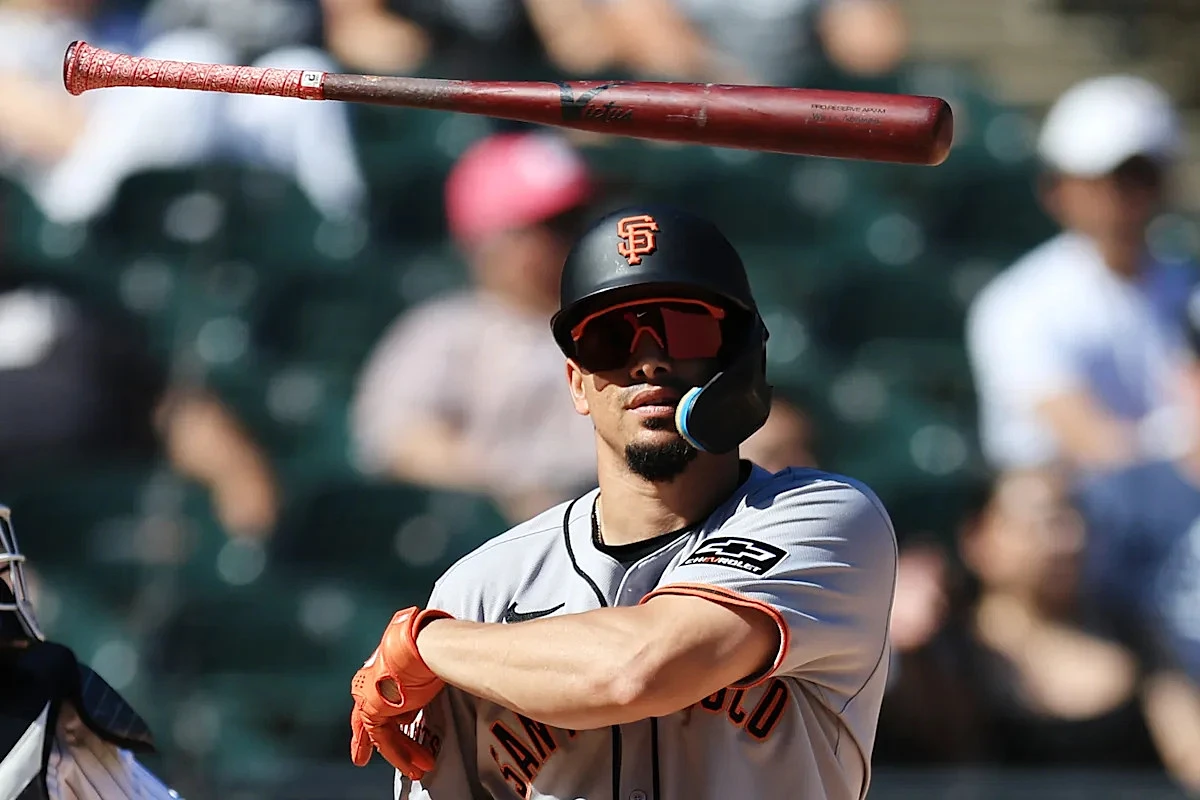


The San Francisco Giants are on pace to end the month of April with either the fewest walks over the team’s first 30 games in 125 years or 108 years. Only twice have the Giants started a season with 65 or fewer in games 1-30: 1901 (60 BB) & 1918 (65 BB). After last night’s disastrous 2-hit, 12-strikeout, zero walks performance by the dismal lineup, the Giants have just 58 walks to go with their 97 runs scored — both the lowest totals in the sport.
The only possible explanation is that walks are a joke to the Giants. What sort of insults do you think they sling at walks? I’m going to give them the benefit of the doubt and say they know better than to invoke some sort of antiquated slur. So, what’s left? “Walks are dumb”? “Walks are cringe”? “Woke”? It’s clear something’s afoot, because at this point last season, the team was right around 9%. This year’s roster isn’t substantially different.
It’s clear that the organization’s emphasis on contact is having a somewhat profound influence on a crucial component to scoring runs: the base on balls. Outside of all those intentional walks to Barry Bonds and the Farhan Zaidi era of the front office, the “walks are good” era of baseball as made mainstream by Moneyball has been vigorously rejected in San Francisco, by the fans and the front office alike. With the help of the ABS Challenge System, the league’s walk rate is the highest it’s been since 1951 at 3.69 BB/9 (9.6 BB%). The Giants are 30th in MLB by nearly 2% at 5.6%.
Only 56 teams in MLB history of recorded 65 walks or fewer in their first 30 games of a season and only five of those instances have come in the 21st century: the World Champion 2015 Royals, the 2015 Rockies (68-94), the 2010 Astros (76-86), the 2008 Twins (88-75), and the 2006 Angels (89-73). Prior to this group, the last MLB team to do this was Cleveland in 1990 (77-85). And before that it was in 1968. So, this is a somewhat rare feat, and it a lot about the sport has changed since it last happened: Statcast, balanced schedule, universal DH, and now ABS.
Is it just a front office edict that’s causing this or is it personnel? Well, maybe it’s a bit of both. As Andrew Baggarly pointed out this morning in a post for The Athletic about the team’s worrying walk rate:
No team is seeing a higher percentage of pitches in the strike zone. When pitchers face the Giants’ lineup, the fear factor just hasn’t been there.
Hard to walk if pitchers are staying inside the strike zone.
And maybe that’s the one simple tricks staffs are using to subdue the Giants, because the walk rates for the core of the lineup are way down despite seeing plenty of strikes:
Matt Chapman: 10.8 career BB%, 2026: 9.0% | 50.3% career pitches in strike zone percentage, 2026: 49.7%
Jung Hoo Lee: 7.3 BB% career, 2026: 7.1% | 52.7% career zone, 2026: 48%
Luis Arraez: 6.5 BB% career, 2026: 5.1% | 50.8% career zone, 2026: 53.9%
Rafael Devers: 9.4 BB% career, 2026: 5% | 47% career zone, 2026: 50%
Heliot Ramos: 7.2 BB% career, 2026: 5.6% | 48.7% career zone, 2026: 44.9%
Willy Adames: 9.8 BB% career, 2026: 4.2% | 48.2% career zone, 2026: 47.7%
Hmm, maybe it’s better to take the Baggarly comment this way: for a roster of players who have, historically, tended to see a lot of pitches in the strike zone, they’re not doing very much damage with that situation here in the first month of the season.
I would argue that’s because the team has virtually dropped the walk from their game and because I’m a fabulist and not a journalist, I’m pitching that the reason for this is because of an ideological bent bordering on hostile. The statistical case for the walk is straightforward. Unfortunately, my statvestigation wasn’t thorough enough and so I’ll pull from this 2019 article that shows that, although a walk is not as good as a single, its correlation with run scoring is meaningful.
The post also goes into the psychological/perceptive value of singles over the walk. Singles tend to signal to people that the hitter is good whereas a walk indicates a flaw in a pitcher. There’s also the whole thing about how walks don’t drive in runs unless the bases are loaded. We can also probably extend this thought to a cynical conception of player valuation. If walks are less valuable, then walks are cheaper, which explains why the efficiencymeisters who have made cheap baseball “real baseball” here in the last 20 years. Though, to be fair, if you’re trying to make player spending more efficient, the guy who walks and hits home runs is financially more reasonable than the guy who gets a lot of hits and walks and homers. So, yes, the obsession with Three True Outcomes is because it’s cheaper.
Aha! You might say. Here’s proof that the Giants’ strategy is sound. They are spending money on hitters who have value because they get hits. Except, well, it takes a lot of Luis Arraezes to make that strategy work, and entirely discounting the walk looks foolish even on paper. I mentioned this a few weeks ago, and I’ll reiterate:
Still, it’s a little alarming that the Giants have dipped so far below not only [the league average] but their own lineup average since 2022 […] Still not convinced walk rates matter? Some additional information: During the championship era, the 2010, 2012, and 2014 teams posted walk rates of 7.9%, 7.8%, and 7%.
It’s the second-most likely outcome according to this chart, and Oracle Park is pretty good at suppressing home runs — offense in general — so, you might as well look at the complete picture rather than dismiss the walk out of hand. What good reason is there to avoid it?