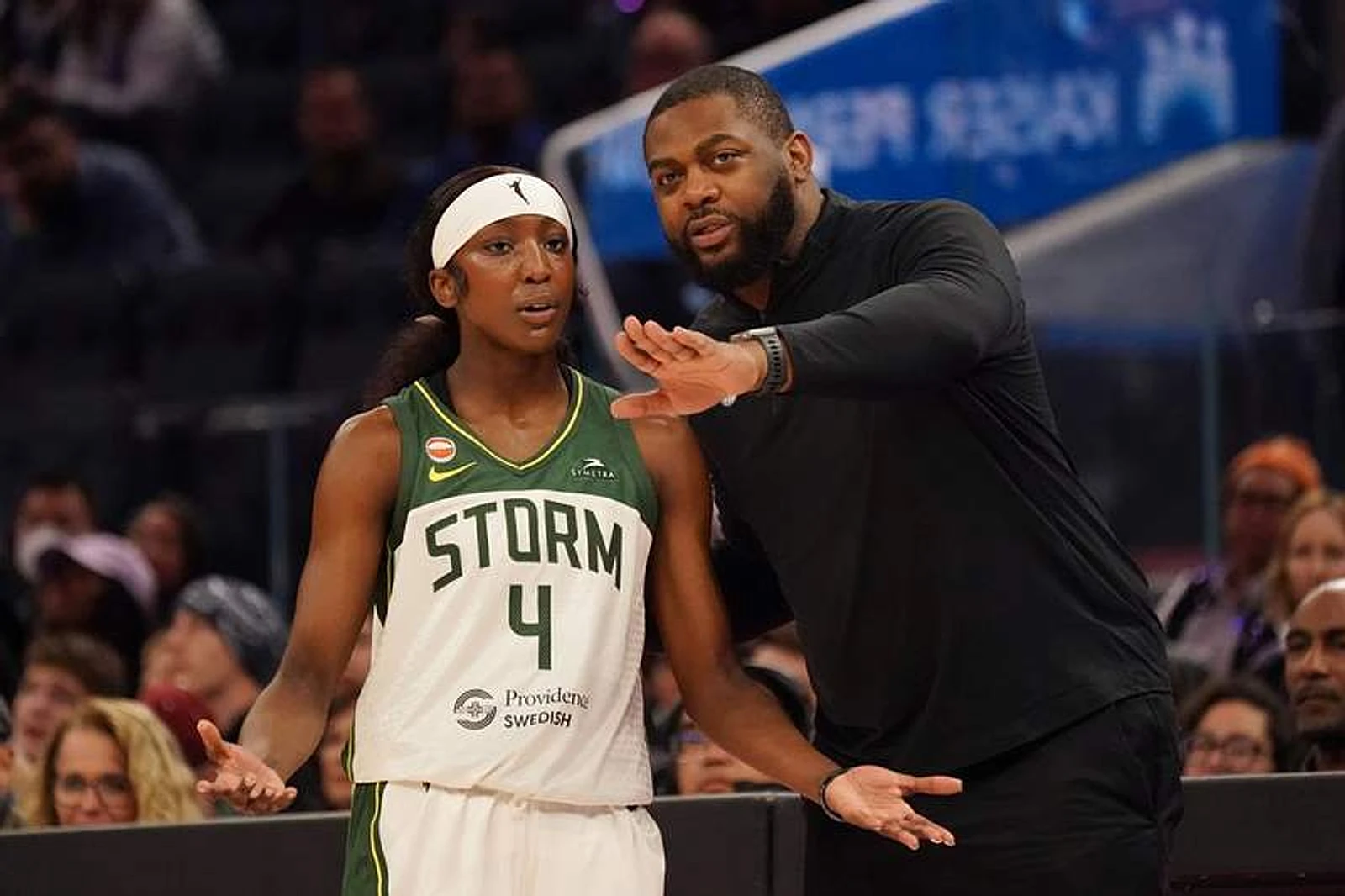
The Golden State Valkyries' front office is finally pulling back the curtain on one of the most talked-about moves of the offseason. Three weeks ago, the franchise drafted Flau’jae Johnson with the No. 8 overall pick—a selection that seemed like a perfect match on paper. But then, in a move that left fans scratching their heads, the Valkyries traded Johnson's rights to the Seattle Storm in exchange for the No. 16 pick, Marta Suarez, and a 2028 second-round pick. Now, General Manager Ohemaa Nyanin is explaining the reasoning behind the decision.
During the Valkyries' media day, Nyanin pointed to salary cap flexibility as the driving factor. "The decision-making around the draft had a lot to do with cap flexibility," she said. "We had the opportunity, or we thought we had the opportunity, to potentially sign another athlete." Under the new collective bargaining agreement, Johnson was set to earn $309,622 in her first season—a total of $1,386,092 over four years. By trading for Suarez, the Valkyries saved roughly $40,000 annually, as Suarez's contract starts at $270,000 per season.
Cap space was already tight. After the draft, the Valkyries had about $750,000 available, but the majority of that went toward re-signing veteran guard Tiffany Hayes. With a goal to "sign as many returners as possible" and maintain long-term flexibility, the front office made the tough call to swap picks.
The decision also reflects deeper roster concerns. Nyanin didn't hide her disappointment when discussing the expansion draft, which cost the team two promising players. "Expansion draft was pretty sad," she admitted. "We lost two elite athletes in María Conde and Carla Leite." Leite had already shown flashes as a rotation guard, averaging 7.2 points and 2.0 assists over 37 games, while Conde represented a high-upside international piece the team never got to fully integrate. With those losses still stinging, the push for flexibility looks less like a simple cost-cutting move and more like a front office trying to stay prepared after taking an early hit.
For a team building from the ground up, every dollar and every roster spot matters. As Nyanin put it, "My job, very specifically, is to make sure that we maintain an under..."—a reminder that in the WNBA, smart cap management can be just as important as talent evaluation.