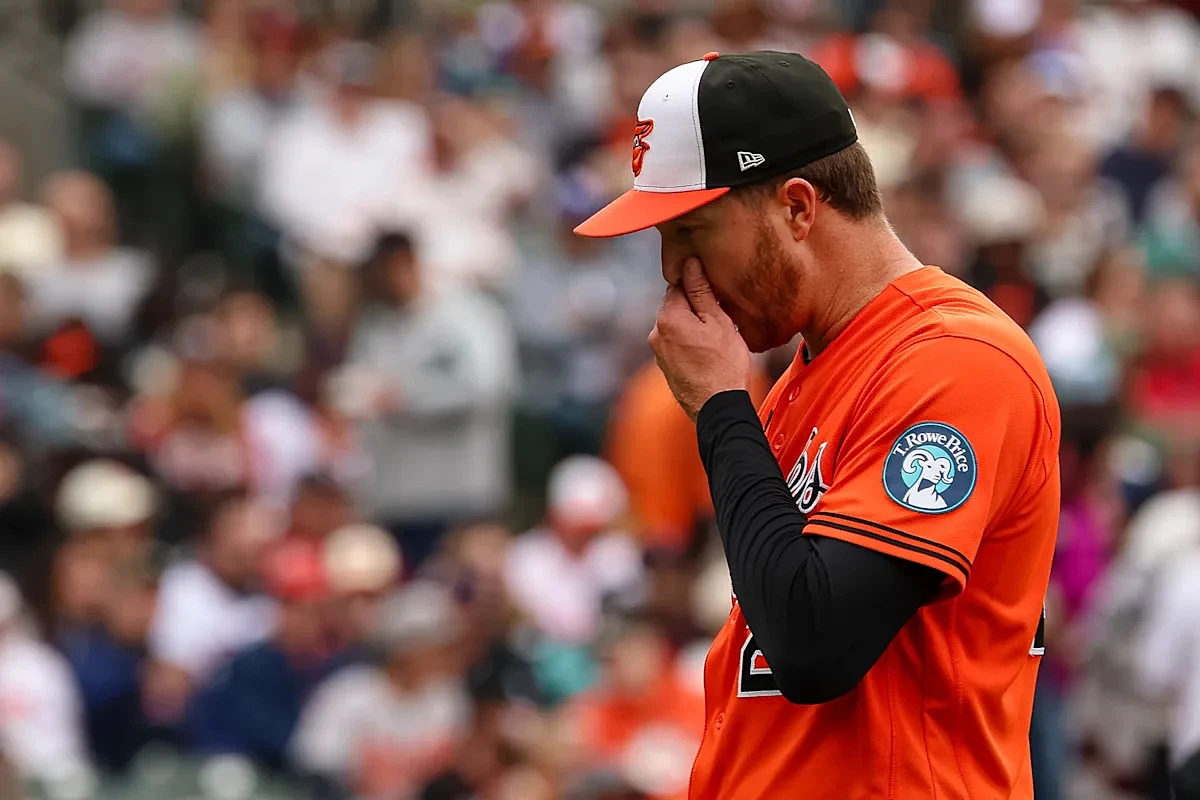


After Friday night’s record-setting win over the Red Sox, Birdland should have been feeling good about the O’s winning their first AL East series of the season. After all, Baltimore went into the weekend with ace Trevor Rogers taking the ball Saturday and former top-5 Cy Young finisher Kyle Bradish pitching the series finale. Perfect set up for a successful series against the scuffling Red Sox, right?
What played out was as predictable as it was disappointing. Instead of going toe-to-toe with Red Sox ace Garrett Crochet, Rogers delivered his worst performance in an Orioles uniform, lasting only five outs in a game the O’s went on to lose 17-1. In the Sunday rubber match, Bradish was once again aggressively mediocre. His final line of 5 IP, 4 H, 3 ER, 4 BB and 3 K wasn’t egregious, but it was another performance where it looked like the right-hander was trying to cut a steak with a butter knife—it works, but it’s hardly effective.
To say that Rkeogers and Bradish shoulder a large portion of the blame for the Orioles’ tepid start to the season would be an exaggeration. This team was designed to be an elite offensive squad with the requisite pitching needed to support that offense. The fact that the O’s currently sit two games below .500 feels like more of the offense’s fault than the pitching staff.
And yet, the team going 5-7 in the 12 games started by Rogers and Bradish (along with their combined 4.48 ERA) is certainly a barrier to the Orioles’ team success. The reigning Most Valuable Oriole and the O’s 2023 ace were supposed to be a steadying force at the top of the Orioles rotation, the tone setters for a revamped Baltimore rotation. Instead, their lack of consistency has set a tone that has the Orioles 22nd in starting rotation ERA through the season’s first nine series.
When Rogers and Bradish are successful, they find that success through two very different approaches. At his best, Rogers is the new-age Tom Glavine. He establishes himself with his four-seamer, tw0-seamer and change-up low and around the edges of the zone. He then plays his cutter/slider and sweeper off of those core pitches, as strikeout pitches. Rogers has always welcomed contact, as he looks to convert his strong command into weak ground balls.
Bradish is a power pitcher whose two-seamer, slider and curveball give him a trio of devastating pitches (when they’re on) and an approach to pitching that few, if any, right-handers can match. We’ve seen Bradish have success with two distinct approaches. From the second half of the 2022 season through the entire 2023, we saw Bradish attack hitters with his slider early in the count, expanding his repertoire to all four pitches once ahead. In 2024 and 2025, the O’s top righty started throwing more two-seamers early in counts, relying more on his breaking balls as out pitches.
Rogers’ struggles stem from two big differences between his success last year and his uninspiring start to this year. The lefty has struggled to keep the ball down, with his fastball in particular living a lot more in the upper third of this zone this season. We’ve also seen Rogers largely abandon his sinker over his first six starts this year. In 2025, he threw his sinker 15% of the time overall and 26% of the time to LHB’s. This year, usage is down to 9% and 24%, respectively.
And while the sinker was statistically his least effective pitch last year, it was still key in generating ground balls and setting up Rogers’ changeup low in the zone. This year, with a four-seamer that’s lived closer to the top of the zone and a less frequent sinker, the lefty’s ground-ball rate has dipped from 46.4% to 38.9% (a career-low), while his line drive rate has jumped up to 24.2% (worst since 2022).
The reigning MVO is also struggling to put batters away once he gets ahead. Last year, opposing hitters hit .120 off Rogers in two-strike counts. This year, that number has skyrocketed to .317. A lot of that comes down to his fastball command and his inability to miss bats with his four-seamer. Last year, Rogers’ fastball held opponents to a .127 average in two-strike counts while generating a 22% whiff rate. This year, opponents are swinging through only 8% of the southpaw’s two-strike four-seamers, while hitting .333 on such pitches. His fastball also has two inches less arm-side run, which may contribute to it being altogether more hittable.
The lack of success with his fastball has had a ripple effect on his changeup. Opposing hitters are swinging through the changeup more in two-strike counts in 2026, but they’re hitting it way harder when they make contact. Opposing slugging percentage on Rogers’ two-strike changeup has jumped from .140 last year to .412 this year, while average exit velocity has jumped by 5mph.
We’ve already seen Rogers have success this season, as he was largely excellent in his first three starts before falling into this recent funk. As a command-oriented pitcher, you’d expect him to be able to figure out his fastball issues, which in turn should better set up the rest of his arsenal. Alternatively, if he continues to struggled against RHB’s in particular, we may see more sweepers; opposing righties are only hitting .200 off the lefty’s breaking ball this season with a 40% whiff rate.
Getting Bradish back to the pitcher I thought was capable of challenging for the Cy Young can take one of two paths: getting better command of his slider or leaning more heavily on his sinker. In the past, Bradish’s slider has been one of the best weapons in baseball. This year, it’s playing more like a Nerf gun than a howitzer. Coming into this season, opponents had a lifetime average of .175 off Bradish’s slider. This year, that’s up to .256.
A big factor in the diminishing returns on his slider is his inability to throw it for strikes and to generate whiffs. Bradish has typically thrown his slider in the zone about 46% of the time; this year, his in-zone rate has dropped to 39%. His struggles with the command of the pitch have seen his whiff rate on the slider drop to a career-low 29%. And since Bradish is back to being a slider-first pitcher, being able to locate the breaking ball in the zone is a must if he wants to go back to dominating lineups.
Bradish has actually gotten better results from his sinker this year, but his feel for the pitch is also a little off. At his best, he’s used the sinker to primarily attack the inner third to righties and outer third to lefties—locations that help set up his slider and curveball. This year, his sinker has been a lot more over the plate, which may explain his decreased trust in the pitch.
Both Bradish’s sinker and slider are devastating when commanded correctly, and both can be used early in counts. If the 29-year-old can get a better feel for one of them, we should start seeing plenty of more strikeouts and a resurgence in Bradish’s overall performance.