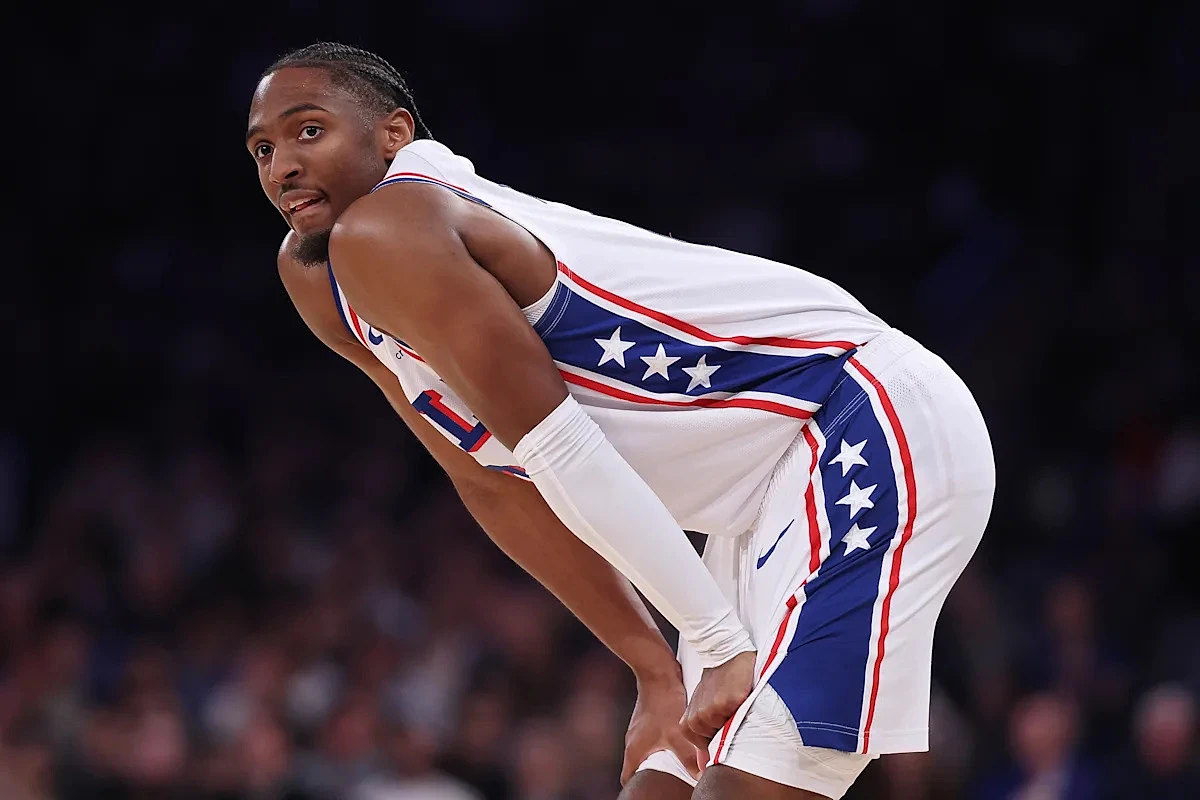
Tyrese Maxey saw it coming.
Less than four minutes into Game 2, the Philadelphia 76ers star grabbed a rebound off a missed corner three from Josh Hart and sprinted upcourt. With his team trailing by one—both in the game and the series—he knew it was time to make a statement. And he also knew the New York Knicks had other plans.
As Maxey crossed half-court, he was met by Mikal Bridges, whose calm demeanor and wingspan-for-days frame have been his primary matchup throughout the Eastern Conference semifinals. The two squared off near the right wing, about 35 feet from the basket, as Maxey called for a ball screen.
Andre Drummond lumbered up to set it. And that’s where things get interesting. Because while Drummond is a lot of things—historically elite rebounder, a guy nicknamed "Big Penguin" for reasons even he can't explain, and a surprisingly reliable corner three-point shooter 14 years into his career—he is not Joel Embiid.
Embiid, even in his injury-riddled form, remains one of the most lethal scorers in the game. Drummond? Not quite. But with Embiid sidelined for Game 2, the Knicks saw an opportunity to turn up the heat.
As Drummond approached, his defender followed suit. Instead of playing drop coverage—a tactic that would keep him below the screen and protect the paint—Karl-Anthony Towns sprinted to the sideline, planting himself on Maxey's right side. Before Drummond could even fully set the screen, Maxey fired a pass across the court to Paul George, who quickly swung it to Kelly Oubre Jr.
This is the trap game: two defenders in Maxey's path, forcing him to navigate heavy traffic or give up the ball. For the Knicks, it's a high-stakes chess move designed to unplug one of the league's most electric players. And so far, it's working.