
Nekias DuncanContributorWed, April 29, 2026 at 3:23 PM UTC·10 min readThere’s an excitement attached to the unknown, particularly when it comes to basketball. It’s a big reason why I was initially drawn to the first-round matchup between the Cleveland Cavaliers and Toronto Raptors.
There’s an inherent style clash between the two teams. The Raptors with an aggressive, versatile defense and a half-court offense (10th during the regular season) that can hit more notes than you think; the Cavaliers with an electric, star-led offense with a defense that can hit real high notes depending on the personnel.
Normally, when prepping for a playoff matchup, you can glean some insights based on their regular-season meetings. You couldn’t really do that this time around; while the Raptors won all three games, all of those games occurred before Thanksgiving. Multiple key pieces were missing in each matchup; heck, the James Harden trade was nearly three months away.
In short, we were flying blind heading into this series — at least compared to others. We got a real look at Hawks-Knicks two weeks before the playoffs started, for example.
I’m pleased to announce that this best-of-seven has become a best-of-three, with a pivotal Game 5 on the horizon.
The Cavs took care of business at home behind their coverage-breaking sets and nuclear shot-making (124.7 offensive rating). The Raptors returned the favor during their homestand, leaning on their defensive versatility to flip matchups and bog down the Cavaliers’ high-powered attack (99.5 defensive rating).
As we enter the final sprint of this series, we’re going to examine the subplots that will ultimately decide the winner.
During the regular season, the Cavaliers were one of seven teams to generate at least one point per possession (1.01 PPP) on trips featuring a pick-and-roll. Filter for just the Harden Era (Feb. 7 onward) and that remains true, with a slight bump (1.02 PPP).
At their best in this series (the wins), the Cavaliers have been able to manipulate the matchups they want for Harden or Donovan Mitchell to face, then putting the Raptors in no-win situations with their collective skill level and spacing principles.
An early favorite for me was the Cavaliers spacing a shooter in a corner, and having them relocate to the wing during the drive so there would be no help present on the roller.
Like the flow here from Cleveland.And once again, they are thrashing Toronto with those late lifts from the corner (look at Schroder going from left corner to left wing), another lob opens up. pic.twitter.com/FXsxy5zJ7U
— Nekias (Nuh-KY-us) Duncan (@NekiasNBA) April 18, 2026
Mitchell was able to boogie his way into pull-ups and impressive drives; Harden put pressure on the Raptors with his drives and (late) playmaking. Even if the Raptors were able to handle the initial action, the Cavaliers did a good job of slowing into secondary attacks and winning later in the clock.
That has completely flipped during the last two games.
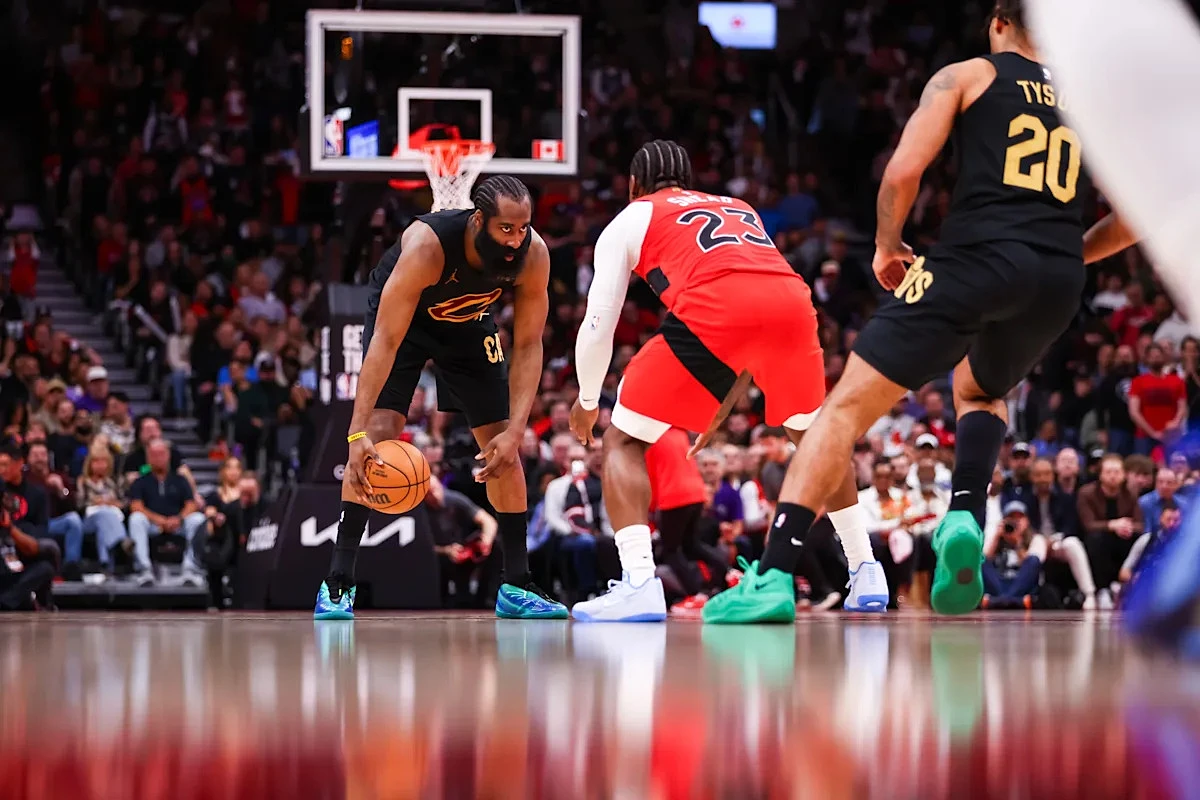
There have been loud lineup and matchup changes from the Raptors. They’ve upsized against the Cavaliers’ star backcourt: Ja’Kobe Walter replaced Jamal Shead ahead of Game 3 to assume the Mitchell assignment, while Scottie Barnes has increasingly spent more time on Harden.
The most notable downstream effect of Barnes guarding “down” the positional spectrum is RJ Barrett having to guard “up” in his place. He spent some time on Evan Mobley in Game 2 — that didn’t go well — but has largely assumed the Jarrett Allen assignment over the past two games.
That adjustment has taken the wind out of the sails of the Harden-Allen partnership. Allen set roughly 14 on-ball screens per game for Harden during the regular season; he set a total of 16 during the Raptors homestand.
With size on the guards and a wing on the Cavs’ most frequent on-ball screener, it’s become more of a chore to run their pet actions. In their worst moments, it’s been an absolute slog for the Cavaliers to generate anything positive.
On a quieter note, the Raptors have also dialed back their pickup points compared to earlier in the series. Instead of meeting (and attempting to pester) a ball-handler behind half-court — opening up some half-court screening and giving said-ball-handler a full head of steam — they’ve largely waited for those guys to cross half-court before ramping up their pressure.
Even when the Cavaliers have tried to tap into higher screens, the Raptors have done a better job of navigating and rotating.