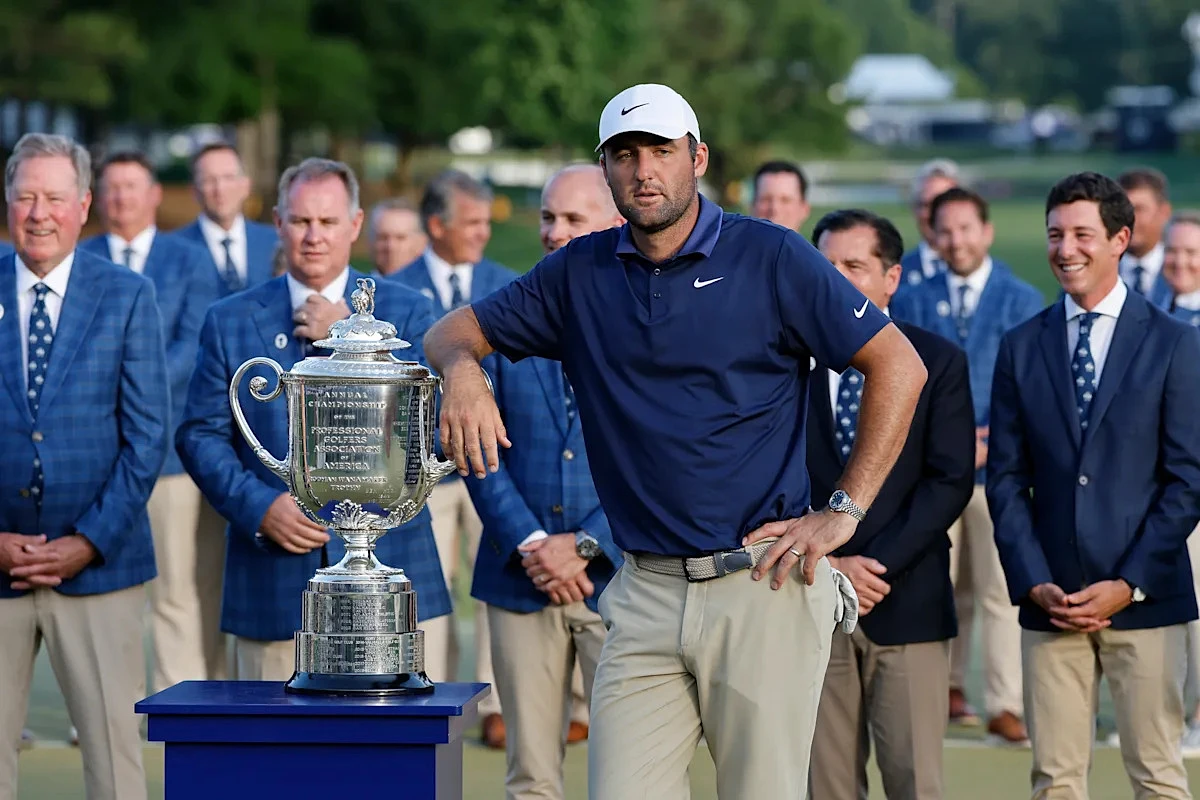
The PGA Championship has a problem: it doesn't quite know what it wants to be. While the Masters oozes aspirational tradition, the U.S. Open flexes brute-force muscle, and The Open Championship exudes generational sophistication, the PGA sits awkwardly in between. It's a major, yes—one that counts every bit as much as the other three in the legacy department—but its identity is fuzzy at best.
This year's tournament is upon us, and you could be forgiven for thinking, "Wait, already?" The afterglow of Augusta hasn't even faded before the PGA sneaks up. Sandwiched between the Masters and the majesty of the U.S. Open, it feels like an awkward fit. Even the PGA Tour's Signature Events seem to crowd its calendar. And let's be honest: the most memorable thing about the PGA in recent years might be a player's arrest, which isn't exactly the kind of brand you want to promote.
So how do you fix it? Kerry Haigh, the PGA's chief championships officer, suggests that the tournament's identity is its variety. "Every year we play a new, different golf course: different grass, different architect, different climate, different geography," he said Wednesday. "The championship never favors one particular player. This week is totally different than last year, will be totally different than next year. So in that way, that's our identity."
That's a noble idea, but it's a bit abstract. Here are some more concrete ways to give the PGA Championship a distinct personality.
Embrace the "Glory's Last Shot" ethos—but with a May twist. The old slogan "Glory's Last Shot" wasn't perfect, but it was better than the neurotic "This Is Major." At least it had a clear message: one last chance to claim a life-changing win before winter. The PGA moved from summer to May in 2019 to avoid conflicts with the Olympics and the NFL season, which makes sense. But now it's "Glory's First Shot"—the first major after the Masters, a fresh start for players who missed their chance at Augusta. That could be a powerful narrative.
Lean into the venue rotation. Unlike the Masters, which is forever Augusta, the PGA moves around. That's a strength, not a weakness. The May slot opens up states like Texas and Oklahoma, where the heat isn't as brutal as it would be in July. Imagine a PGA Championship in the Texas Hill Country or the Oklahoma plains—courses that feel raw, rugged, and uniquely American. That's an identity you can market.
Make it the players' major. The PGA is run by the PGA of America, which represents club pros and golf professionals. Lean into that. Give the club pros a bigger stage. Create storylines around the everyday heroes who make the cut. It's a major that celebrates the game's roots, not just its superstars.
Stop trying to compete with the Masters. The green jacket is untouchable. The U.S. Open has its brutal reputation. The Open has history. The PGA doesn't need to be any of those things. It just needs to be itself: a major that's unpredictable, diverse, and unapologetically modern. That's a look that works on the course—and in your wardrobe.