
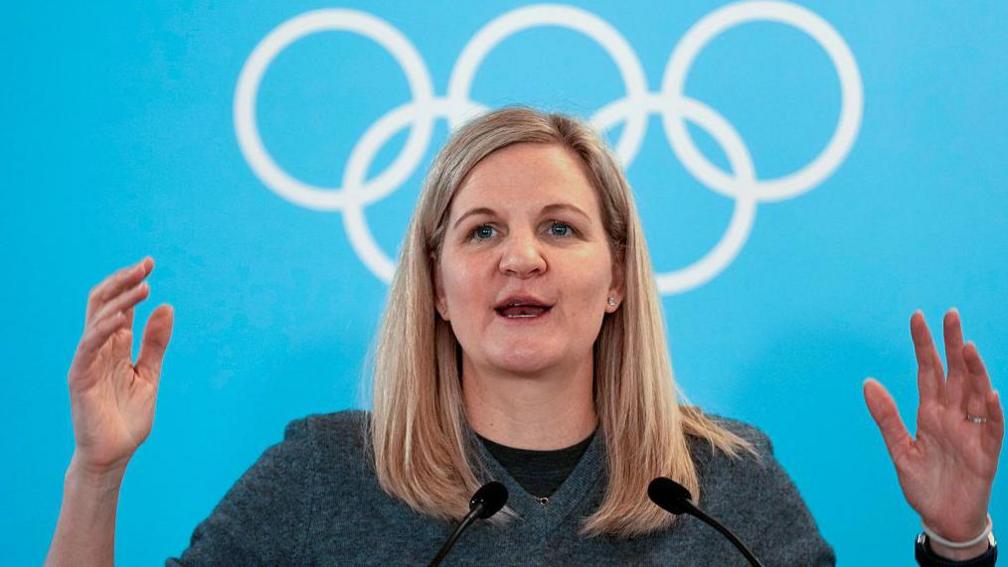




Image source, Getty ImagesImage caption, Olympic president Kirsty Coventry was elected to the role one year ago
Sports editorPublished31 March 2026"This is a question where there is no one-size-fits-all solution. It differs from sport to sport."
The words of former International Olympic Committee (IOC) President Thomas Bach in July 2021, when claiming that sex eligibility criteria should be left to each individual sport to determine.
A few months later, the organisation issued a new set of guidelines, reiterating that it was "not in a position to issue regulations that define eligibility criteria for every sport". And that "athletes should not be deemed to have an unfair or disproportionate competitive advantage due to their sex variations."
Yet just five years on, Bach's successor Kirsty Coventry has announced a blanket ban on transgender women, as well as athletes with differences in sex development (DSD) who have gone through male puberty from female events, "to protect fairness, safety and integrity".
From the 2028 LA Games, eligibility for women's competition at all IOC events will be limited to biological females, and determined on the basis of a one time SRY gene screening, which detects the presence of a Y chromosome and male sex development.
So what explains the IOC's dramatic change in approach? How divided has the reaction been? And what challenges and questions remain? BBC Sport takes a closer look.
Olympic women's sport limited to biological females
Published7 days agoWhy the u-turn?The IOC says its new approach is a reflection of "relevant ethical, human rights, legal, scientific and medical developments, including stakeholder feedback", and that a review on the issue took into account "the state of the science, including developments since 2021, and reached consensus that male sex confers performance advantage in all sports and events that rely on strength, power, and/or endurance"
It added this was irrespective of testosterone suppression, which until now has been relied upon by a number of sports when regulating the inclusion of transgender and DSD athletes in female competition.
The IOC has not published the scientific research it based its decision on, but has stated that at the elite level, there is a 10-12% male performance advantage in most running and swimming events, and that rises to 20% in most throwing and jumping disciplines, and 100% in sports such as boxing, that involve explosive power.
Those who have long called for this change in policy argue that the science has shown such advantages for years, and some believe the IOC has been forced into this by a series of controversies, and the fact that a growing list of sports had already shown it was possible legally to introduce tougher eligibility criteria.
After New Zealand weightlifter Laurel Hubbard became the first openly transgender women to compete at an Olympics in Tokyo in 2021, the governing bodies of swimming and cycling brought in transgender bans for women's events amid concerns among female athletes that they could also face biological males in elite competition.
By then, World Athletics had tightened its rules after the 2016 Rio Olympics, when all three medallists in the women's 800 metre final were DSD athletes, introducing mandatory sex testing in 2025.
World Boxing did the same after a major crisis at the women's boxing competition engulfed the 2024 Paris Olympics, where fighters Imane Khelif and Lin Yu-ting both won golds, despite being disqualified from the previous year's World Championships for allegedly failing sex eligibility tests conducted by then-governing body the IBA.
Lin has since been cleared to compete in female competition by World Boxing. But in the initial wake of the row, the United Nations' special rapporteur on violence against women called for sex screening for female athletes to be reintroduced. A group of academics agreed, claiming it was "overwhelmingly preferable to targeted testing based on allegations, suspicion and bias".
Having been a senior figure at the IOC when it controversially stated that competitors were eligible for the women's boxing competition if their passports simply said they were female, Coventry then pledged to do more to protect the female category during her election campaign for the presidency.
There may have been wider political considerations at play too. Last year, US President Donald Trump signed an executive order that prevents transgender women from competing in female categories of sports, and warned he would deny visas for transgender Olympic athletes trying to visit the US to compete at the LA Games.
Coventry has denied this had any influence on the new policy, but Trump has taken credit for the IOC's move.
The IOC used an SRY gene test back in the 1990s, but amid a number of 'false positives', and fears that female athletes were being punished for natural variations, sex verification tests were then abolished before the 2000 Sydney Olympics.