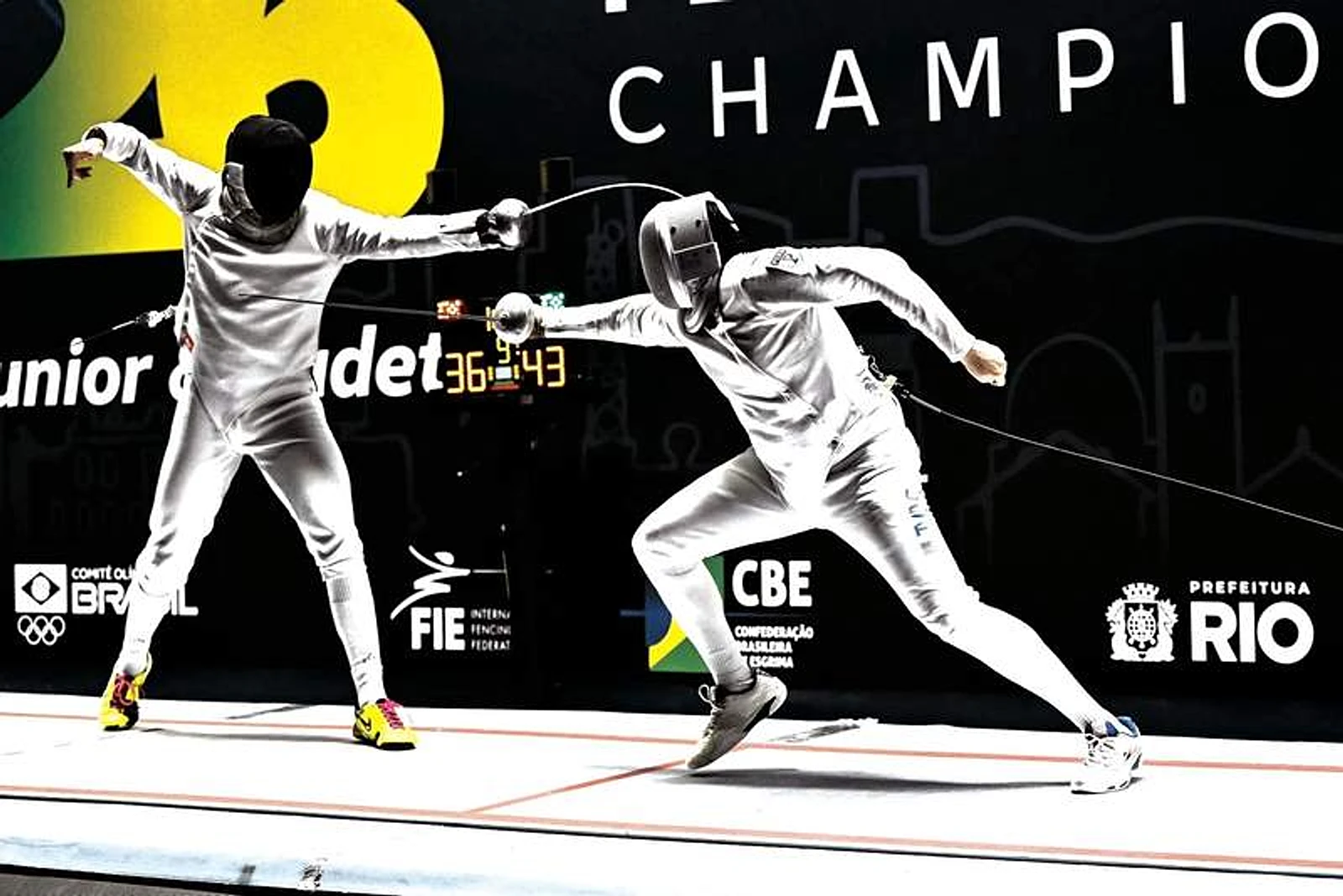

Against the odds, Israel's junior fencing team secured a silver medal at the Junior World Championships in Rio, marking a historic achievement for the nation.
In the world of international fencing, the “bout” is more than just a sequence of parries and ripostes. It is a psychological chess match played at the speed of light, where the distance between victory and defeat is measured in millimeters, and the weight of a nation’s complex identity often rests on the tip of a three-foot steel blade.
Last week, in the humid air of Rio de Janeiro, four young Israelis, ranging from high schoolers to soldiers, did more than just compete. They shattered a glass ceiling that had stood for decades. By clinching the silver medal in the Junior World Championships in men’s epee, Alon Sarid, Fedor Khaperskiy, Mordechai Lachman, and Eitan Charmatski didn’t just bring home hardware; they signaled a seismic shift in the anthropology of Israeli sport.
To the uninitiated, fencing can look like a blur of white suits and flashing lights, but the epee, the weapon used by this silver-medal team, is unique and steeped in realism. Unlike the foil or sabre, there are no “right of way” rules to dictate who deserves the point based on priority. It is the most direct descendant of the ancient dueling sword. If you hit your opponent first, you get the point. If you both hit within 1/25th of a second, you both get a point. The entire body, from the top of the head to the tip of the toe, is a valid target. It is the most popular, and arguably the most punishing, of the three disciplines, requiring a level of patience and tactical waiting that can be agonizing for both the athlete and the spectator.
The story of the tournament began with a number that didn’t inspire much confidence: 18. That was Israel’s starting rank as they entered the competition. In a sport dominated by centuries-old traditions from Hungary, Italy, and France, starting at 18 usually means a respectable showing followed by a quiet exit. To the uninitiated, a ranking of 18 suggests a team that is “filling the numbers,” a participant rather than a protagonist. But rankings in fencing are often lagging indicators of raw talent and sudden chemical synergy.
However, the team’s journey to Rio nearly collapsed before it even began. Amid the Israel–Iran war, with Israeli airspace severely restricted and only a handful of flights departing the country, uncertainty loomed until the final hours. Until the day before departure, it was still unclear who would make up the team competing in Rio. The athletes faced a grueling three-day journey through various airports, a logistical nightmare that would have broken less determined competitors.
“The support from the Olympic Committee of Israel and the Ministry of Culture and Sport was vital,” says Irina Tal, CEO of the Israel Fencing Association. “They worked tirelessly to secure flight tickets and, crucially, to obtain exit permits for the soldiers on the team. There is currently a sweeping ban on soldiers leaving the country during wartime, and without their intervention, the boys wouldn’t have made it to the strip.”
The tactical brilliance behind this success rests with a specialized coaching staff. Alexander (Sasha) Ivanov serves as the national coach, supported by team coaches Doron Levit and Ohad Balva. Both Ivanov and Balva are Olympic-level coaches who have successfully guided athletes to the Olympic Games, bringing a depth of elite international experience to the junior squad.
The decisive victory against Mexico (45-17) in the early stages was the first sign that the rankings were lies. The Israelis moved with a predatory efficiency, closing distances and finding targets with a clinical precision that left the Mexican side reeling. But the real test, the one that would define the team’s character, was waiting.
Sportsmanship is the bedrock of fencing. At the end of every bout, athletes are expected to salute their opponent, the referee, and, crucially, shake hands. It is a ritual of mutual respect that predates modern Olympic history, rooted in the chivalric codes of the Renaissance.
When the Israeli quartet faced Egypt, the world’s number two ranked team, in the round of 16, the atmosphere was already thick with tension. The Egyptians were the heavy favorites, boasting a roster of internationally acclaimed fencers. But what happened after the final point was scored went beyond the tactical. The Egyptian athletes, despite their prowess on the strip, refused to shake the hands of their Israeli counterparts.
“We knew they were ranked second. We knew they were favorites,” says Alon Sarid, the 20-year-old veteran of the group. “But when a team refuses to shake your hand, they are trying to fight a war that isn’t on the strip. Our response was simple: we let the epee do the talking.”
The Israelis didn’t just beat Egypt; they dismantled them 45-40, in match that was more lopsided than the final score reflected.
“In a team bout, the order is everything,” Sarid explains. “We kept the lead, and as the gap grew, you could see them breaking mentally. Every time they lunged and missed, you could feel their frustration boiling over. We stayed cold. In fencing, the colder you are, the sharper you are.”
For the Israeli team, the refusal of a handshake wasn’t a distraction; it was fuel. It was a moment where the resilience of a generation raised in the shadow of regional complexity met the discipline of an elite athlete. The snub by the Egyptians was not merely an insult to the players; it was a rejection of the very spirit of the sport. Yet, the Israelis stood tall, offering their hands despite the silence from the other side.
To understand the gravity of this silver medal, one must look back beyond the modern State of Israel, into the deep and often overlooked history of Jews and the blade. For centuries, fencing was the “sport of kings” and the “art of gentlemen,” a world often closed to Jews in Europe. Yet, as the 19th century dawned and emancipation began to take root, Jews turned to fencing as a means of asserting their honor and physical equality.
In the late 1800s, Jewish students in German and Austrian universities found themselves the targets of anti-Semitic provocations. The solution? The duel. Jewish fraternities, such as the “Kadimah” in Vienna, embraced the sword. They refused to be victims, learning the art of the saber and the foil to defend their dignity. This was “Muscular Judaism” in its most literal form, a concept championed by Max Nordau, who argued that Jews must reclaim their physical strength to survive the modern world.
The early 20th century saw a golden age of Jewish fencing. Legends like Helene Mayer, an Olympic gold medalist, and the Hungarian masters Jenő Fuchs and Endre Kabos dominated the world stage. For these athletes, the blade was a tool of assimilation and excellence. Kabos, tragically, perished in the Holocaust, but his legacy remained. When the State of Israel was founded, the tradition of fencing was carried over by immigrants from Europe, who saw the sport as a vital link to a heritage of discipline and courage.
“We aren’t just four kids in white suits,” notes Mordechai Lachman. “We are part of a very long line of people who used this sport to prove they belong. When you hold the epee, you feel that history. You aren’t just fighting for a medal; you’re maintaining a tradition of Jewish resilience.”
If Egypt was a battle of wills, the quarterfinal against Hungary was a battle of legacy. Hungary is to fencing what Brazil is to football, the birthplace of the modern game, a factory of gold medals. Their fencing academies are legendary, producing athletes who seem to move with an instinctive, almost hereditary grace.