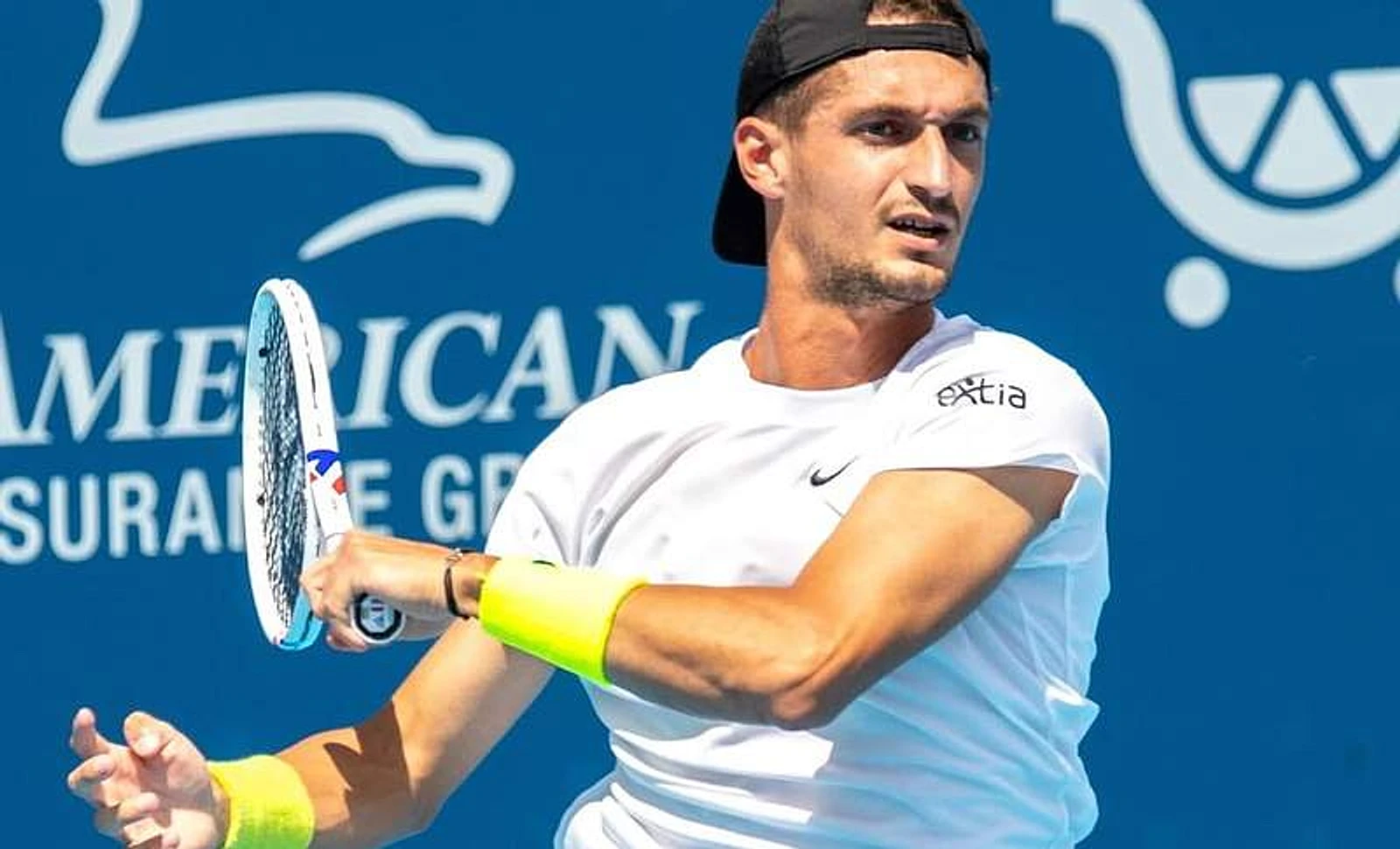


At the 2023 French Open, Carlos Alcaraz faced a brutal turning point when cramps tore through him mid-battle against Novak Djokovic, forcing a shocking decision. With his body breaking down, he sacrificed his service game to seek urgent treatment, choosing survival over collapse in a moment of pure agony. But at the Madrid Open, Terence Atmane defied logic, barely able to move, yet still winning, leaving Ugo Humbert stunned in a net exchange charged with disbelief.
Terence Atmane began cramping in the second set after failing to serve out the match at 7-6, 5-3. What looked like a routine closeout quickly turned into a physical collapse. The cramps hit hard and without warning, leaving him struggling to stay competitive. From that point, the match started slipping rapidly out of his control.
He could barely move as Ugo Humbert broke back to level the score at 5-5. Momentum had completely shifted, and the physical toll on Atmane was obvious. At 4-5, 40-15 on Humbert’s serve, Atmane leaned against the back fence. His face showed clear pain, and he could hardly stand upright.
Minutes passed without a single point being scored as the situation worsened. Even when medical staff arrived, he remained hunched over, unable to move properly. The umpire eventually returned and urged him to continue the match. Atmane could only gesture in response, making it clear that movement itself had become a challenge.
At that stage, the question was unavoidable; could he possibly survive this bizarre encounter? It looked nearly impossible given his condition. Yet somehow, he did more than just survive. Atmane adapted, rolling in heavy topspin serves and, against all odds, held for 6-5.
He stayed on his feet during the changeover, avoiding the added pain of sitting down. On the other side, Humbert only needed composure to close things out.
An underarm serve might have been enough, but Humbert chose not to take that route. He instead played conventionally, holding serve to force a tiebreak while trying to ignore Atmane’s visible struggle.
When Humbert surged ahead 4-2 in the breaker, Atmane collapsed again against the fence, writhing in pain for nearly three minutes. After 90 seconds, he barely stood, and moments later, he dropped into a squat mid-court, shouting in pain.
Play resumed after a long changeover lasting two minutes and 45 seconds. At that point, the match seemed all but over. But what followed defied logic. Atmane won the next five points in a stunning turnaround, sealing one of the most surreal victories in recent memory.
At 5-5, he delivered a body serve and followed it with a forehand winner from mid-court. On the next point, he simply kept the ball in play long enough to draw an error from a tightening Humbert.
At match point, 6-5, he summoned one final effort. A strong serve forced a weak reply, and Humbert’s backhand drifted wide. The crowd erupted instantly, but the reaction was divided. Cheers mixed with boos and whistles, creating a strange atmosphere around the finish.
Atmane gestured for silence, showing little celebration in the moment. His reaction suggested awareness of how unusual the victory had been.
He appeared sympathetic toward Humbert, fully understanding the circumstances that shaped the ending. In the end, the match left behind more questions than celebration.
Throughout the entire episode, Ugo Humbert chose not to protest. He did not challenge the umpire or demand time violations, even as the situation grew increasingly unusual.
For reasons that remain unclear, no time violations were issued at any point. At least, none were communicated audibly to the players or the crowd during the match.
The contrast with the Acapulco Open in February was striking. In that quarterfinal against Miomir Kecmanovic, Terence Atmane had been penalized on match point while dealing with physical issues.
That penalty effectively ended the match back then, making the Madrid situation even more controversial. The difference in officiating raised serious questions about consistency.
Later, French journalists asked Atmane about complaints from Humbert and his coach, Jérémy Chardy, regarding the absence of time violations. He responded directly, saying, “I understand completely. But unfortunately, these are things—things that Jérémy (Chardy, Humbert’s coach), Ugo, and I myself have no control over. You have to ask the umpire why he didn’t issue me a time violation.”
“I have nothing to do with it. I’m just trying to fight using whatever strengths I have at that moment. I don’t collapse to the ground on purpose; it’s simply because I genuinely can’t stand up anymore,” he added.
He continued by emphasizing his intent to follow the rules as best as he could. “I try to respect the rules to the best of my ability. As for the time violations, those are questions that need to be directed to the umpire and the tournament referee. As for me, I just try to do my thing; I tried to fight as best I could, and that’s it.”