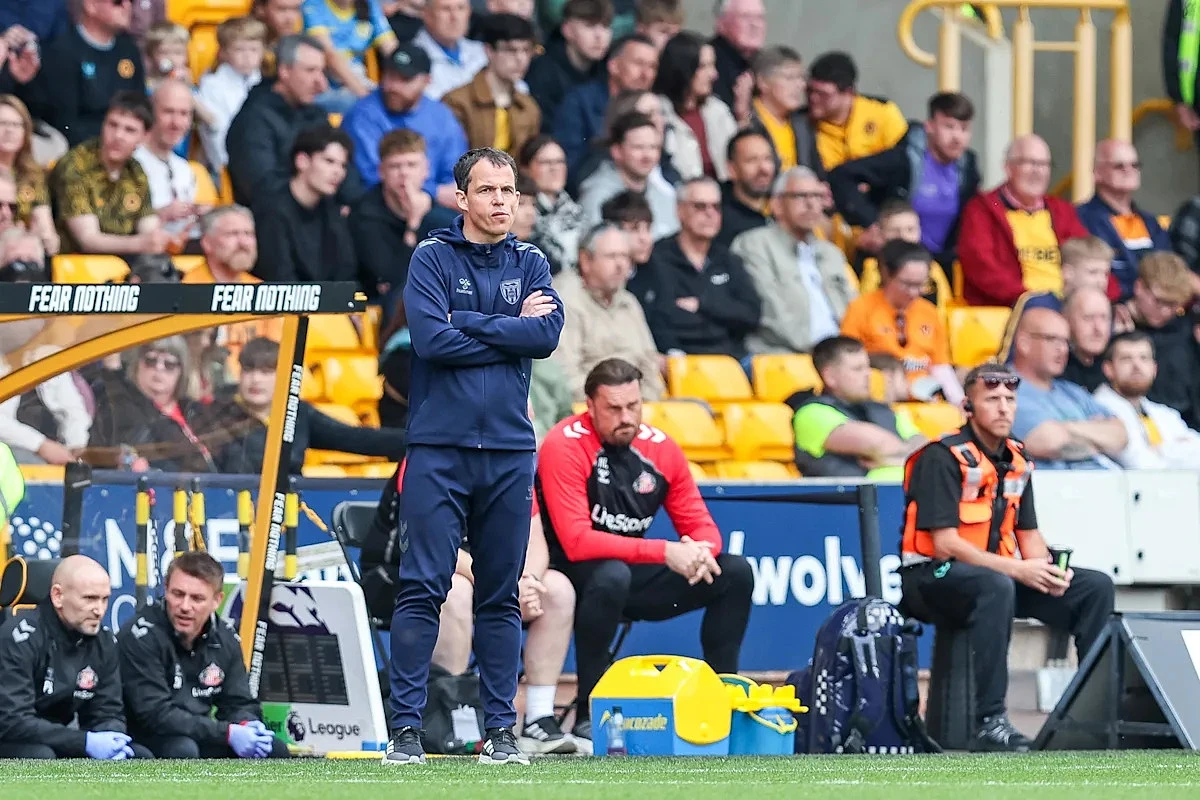
Sunderland returned to action in the Black Country after a dismal showing against Nottingham Forest, but once again, a set piece proved to be their undoing. Facing an already-relegated Wolves side playing with next season in mind, the Black Cats saw another opportunity to add three valuable away points slip through their fingers. So, what does the underlying data tell us about this frustrating draw?
With a full week to recover from the disastrous result against relegation-threatened Nottingham Forest, manager Régis Le Bris had several key decisions to make. He needed to set his side up against a Wolves team that, under Rob Edwards, were playing without fear after their relegation to the EFL Championship was confirmed. Le Bris prioritized defensive stability while also aiming to mirror and contain the hosts' shape.
In midfield, he made two notable changes. Habib Diarra and Chris Rigg both dropped to the bench, making way for Chemsdine Talbi and Trai Hume. This shift signaled a return to the system Sunderland deployed earlier in the season: a hybrid 4-3-3 / 5-4-1 formation. In this setup, Hume operated as a wide midfielder in possession but dropped back to form a defensive back five when the team lost the ball and looked to defend more deeply.
Elsewhere, Enzo Le Fée resumed his playmaking duties in the center of the pitch, while Noah Sadiki and Granit Xhaka anchored the base of midfield when required. Hume's positional flexibility was key—though he wasn't used as an out-and-out winger, he could tuck inside to support play, compete in aerial duels out wide, and create space for Nordi Mukiele to overlap and deliver crosses.
After shipping five goals the previous week, Le Bris was always likely to make a more defensive switch to solidify his backline and avoid further embarrassment against the league's bottom side with nothing left to play for. When the team was announced, it came as little surprise to fans online and in the concourse. But even with a more cautious approach, Sunderland couldn't escape the familiar sting of a set piece—leaving them to wonder what might have been.