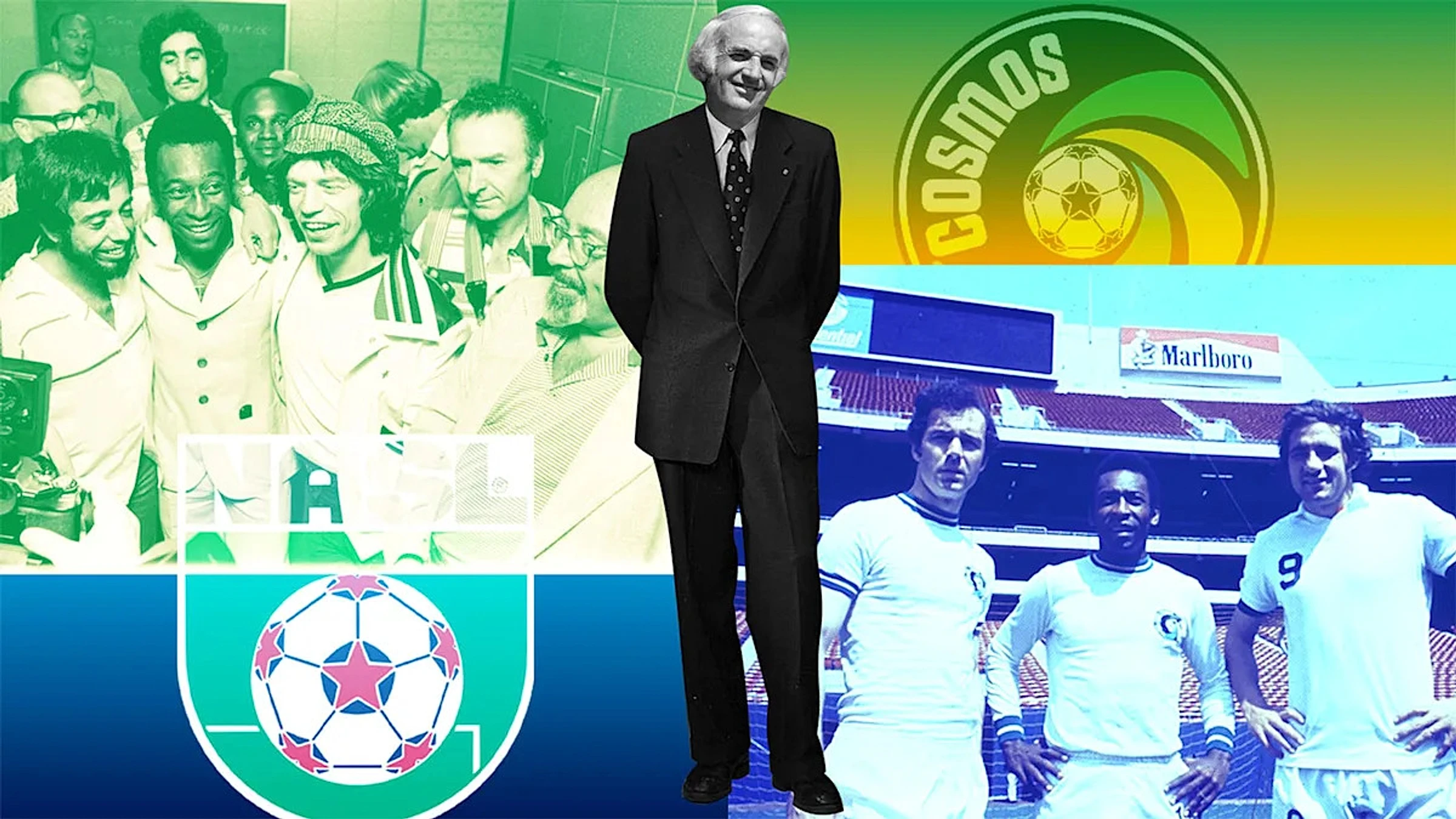


The modernization of the global game has brought lucrative riches in addition to harsh criticism from traditional fans. All of this — the good and the bad — could very well be traced back to American businessman and sports mogul Steve Ross.
Football has changed dramatically over the past few decades. What was once primarily a community based sport has increasingly become a global entertainment industry, where marketing, media exposure, and star power often play roles nearly as important as the action on the field.
Yet this transformation did not begin recently. In many ways, the foundation for today’s spectacle-driven version of the game was first tested in the 1970s with the rise of the New York Cosmos in the North American Soccer League, guided by the vision of media executive Steve Ross.
The early history of the NASL and the sudden surge of popularity surrounding the New York Cosmos is often remembered through the famous players who appeared on the field. However, behind the scenes, the league’s brief moment in the global spotlight was shaped by a handful of influential figures. Among them, Ross stood out as the man who saw soccer not simply as a game, but as an untapped entertainment opportunity in the United States.
A native of Brooklyn, New York, Ross rose to prominence as the head of Warner Communications, transforming the company into a powerful force across film, music, television, and publishing. He believed that different forms of media could work together to create cultural influence on a massive scale.
He founded the Cosmos in 1971, and applied the same philosophy to sports. To Ross, football could be more than a competition, and could function as part of a broader entertainment ecosystem.
One of his central ideas was that athletes could act as global ambassadors for both sport and business. Ross understood that star players had the ability to attract attention not only to their teams but also to the brands and products connected to them. From the boots they wore to the clothing they endorsed, he saw sports stars as a bridge between media exposure and consumer culture.
That philosophy shaped the Cosmos project. By bringing internationally famous players to the United States, Ross hoped to transform soccer from a niche sport into a major attraction, even if it was just for a brief moment. The most famous example was the arrival of Brazilian legend Pelé, whose signing instantly elevated the NASL’s visibility around the world.
Ross’s influence on American soccer is still recognized today. When Inter Miami visited Donald Trump at the White House, Trump paused to mention Ross while reflecting on the history of the sport in the United States. Ross, who died on December 20, 1992 after battling prostate cancer, was remembered with unexpected admiration by the president. Trump described Ross as a “legendary businessman” and credited him with helping establish the foundations of professional soccer in the country through the Cosmos and the arrival of Pelé.
Ross’s ambitions, however, extended beyond the sport itself. He viewed the Cosmos as a platform to promote the Warner brand around the world. In many ways, the strategy he pursued decades ago resembles what major football clubs now do as part of their global expansion.
The 2006 documentary Once in a Lifetime: The Extraordinary Story of the New York Cosmos captures Ross’s approach to both business and sport. It illustrates how he recognized the potential for soccer in the United States long before many others did, even within the halls of the NASL.
Ross believed that one major signing could transform the perception of an entire league. Pelé became the centerpiece of that strategy for the Cosmos, drawing worldwide attention to the NASL. Decades later, similar moments would occur again in modern American soccer when MLS attracted stars such as David Beckham and later Lionel Messi.
The Cosmos also approached football in a way that was unusual for the 1970s. Rather than focusing solely on the sport itself, the club emphasized spectacle and entertainment. Alongside Pelé, the team signed global stars like Franz Beckenbauer and pursued talents such as Johan Cruyff, who eventually played elsewhere in the NASL. Matches were staged in large venues like Giants Stadium and promoted as major entertainment events designed to attract audiences beyond traditional soccer fans.
The Cosmos enjoyed being Warner ambassadors all over the world, flying as far as Uruguay to play exhibition matches.
Today, many of those same ideas have become standard practice. Clubs such as Real Madrid, Barcelona, and Manchester United operate as global brands with supporters across multiple continents. Their biggest stars serve not only as athletes, but also as powerful marketing figures.
Modern football now benefits from enormous television contracts, digital media platforms, and international sponsorships that allow clubs to reach billions of fans. Yet the core concept behind this model, one that uses star power, media attention, and entertainment value to grow the sport, was already being tested decades earlier by the Cosmos.
In that sense, the experiment Ross helped create offered an early glimpse of what football would eventually become: a sport where competition, celebrity, and global branding exist side by side.
Photo by Len Hawley/Consolidated News Pictures/Keystone/Hulton Archive/Getty Images
The model Ross envisioned for soccer in the United States ultimately collapsed beneath the feet of the Cosmos, with several contributing factors. The Cosmos spent far more money than most other clubs in the NASL, creating a financial imbalance across the league. At the same time, the league expanded too quickly while its fan base was still developing.
Perhaps the most persistent problem, however, was television viewership. Soccer struggled, and in many ways still struggles, to attract consistent television ratings in the United States, particularly for domestic leagues.