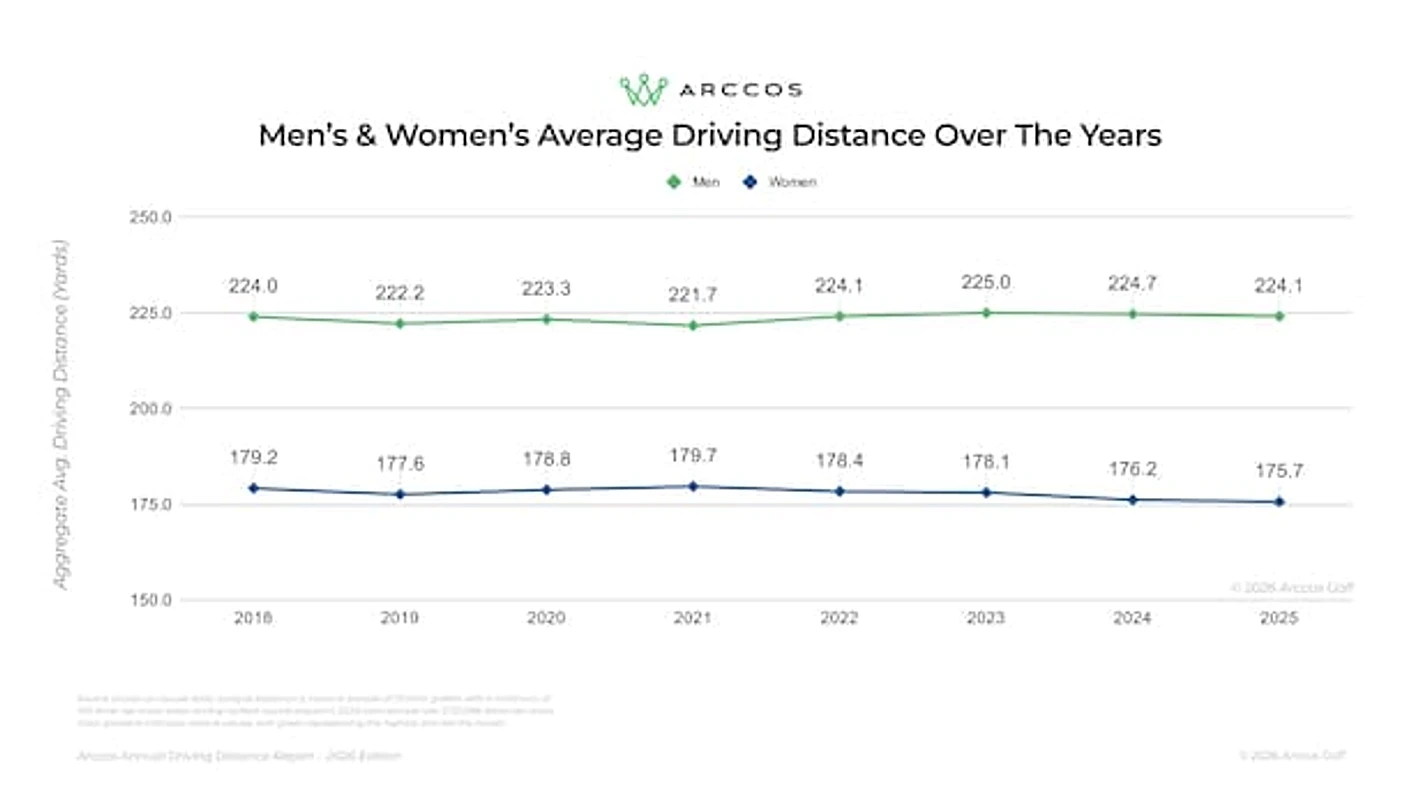
For the eighth consecutive year, Arccos has released its annual distance report, and the findings are clear: if there's a distance "problem" in golf, it's not coming from the average player. The GPS stat-tracking system's latest data, based on over 37,000 golfers and nearly 10 million tee shots on par 4s and par 5s, shows that average driving distances have remained remarkably flat since 2018.
In 2025, the average male golfer's drive measured 224.1 yards—almost a full yard shorter than in 2023 and just 0.1 yards (about four inches) longer than in 2018. Over the past eight years, the average has fluctuated between a low of 221.7 yards (2021) and a high of 225 yards (2023), settling at an overall average of 223.6 yards. The 2025 figure lands almost exactly at the 2022 average, underscoring a trend of near-zero growth.
For women golfers, the news is even more sobering: average driving distance has actually declined by 3.5 yards since 2018, landing at 175.7 yards in 2025. This regression challenges the narrative that everyday players are gaining significant yardage.
Breaking it down by age, sex, and handicap, the story remains consistent. Even the most skilled players—those with handicaps under 5—show no explosive gains. For instance, good players in their 20s (handicaps of 5 or less) are actually two yards shorter in 2025 (263 yards) than they were in 2018 (265 yards). Meanwhile, the prototypical average golfer—a 50-something male with a handicap between 10 and 15—has gained just one yard over the same period, now averaging 220 yards off the tee. Similarly, the average 40-something female player with a handicap between 20 and 25 is only one yard longer than she was in 2022.
Skill, it seems, remains the true driver of distance. Across all age groups, lower-handicap players consistently hit the longest drives, reinforcing that technique and consistency—not equipment or course changes—are what separate the long hitters from the pack.