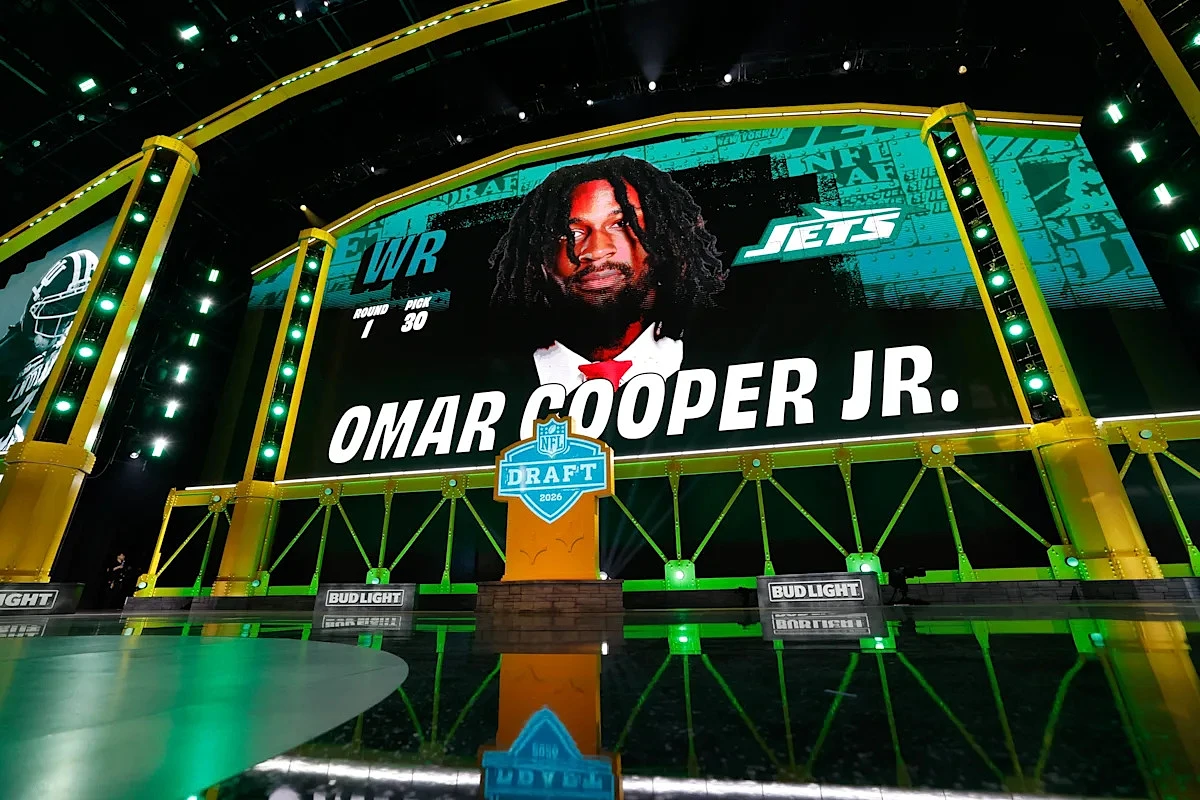


Over the next few months, we’ll be breaking down all of the rookies added by the Jets during the draft and as undrafted free agents. We begin today with wide receiver Omar Cooper Jr.
The 22-year old Cooper is listed at 6’0” and 199 pounds and was the 30th overall pick out of Indiana. Cooper had only started six games before 2025, but he was a big part of the Hoosiers’ national title winning game as he caught 13 touchdown passes and was named as a second-team All-American.
Having been a four-star recruit out of high school, Cooper headed to Indiana where he was one of their few key contributors that was already on the team when head coach Curt Cignetti arrived and multiple players transferred to Indiana with him.
Cooper ultimately redshirted his first season in 2022 having played in four games without registering a catch.
In 2023, he broke out with a 100-yard game in the second game of the season and eventually caught 18 passes for 267 yards and two scores as he started two games.
His role increased in 2024 and he led the Big Ten with a 21.2 yards per catch average. He ended up with 28 catches for 594 yards and seven touchdowns, while also rushing for a touchdown.
2025 saw Indiana go unbeaten on the way to a national title with Cooper a major contributor as he had 69 catches for 937 yards and 13 touchdowns. A postseason injury limited his production down the stretch but he still had five catches for 71 yards in the national title game.
After the season, having been named as both a second-team All-American and second-team all-Big Ten selection, Cooper announced he was entering the 2026 draft and impressed during the pre-draft process to establish himself as a potential first round selection.
The Jets moved up from 33 to 30 to select Cooper, who reportedly was a player they had been considering taking at 16.
Let’s move onto some more in-depth analysis of what Cooper brings to the table, based on in-depth research and film study.
Cooper didn’t perform a full workout at the scouting combine and only did position drills at his pro day but his 4.42 time in the 40-yard dash and 37-inch vertical are solid indicators of how dynamic he looks on film.
He lacks ideal size and doesn’t have a big catch radius but displays good play strength in certain situations.
Cooper’s role in his breakout 2025 season was completely different than the one he played in his first two seasons, but the Jets would presumably consider this to be evidence that he can excel in either role.
For two years, he played primarily on the outside and was more of a downfield threat. However, his primary role in 2025 saw him lining up in the slot and catching a higher percentage of his passes that were typically closer to the line of scrimmage.
He carried the ball on end arounds or reverses five times in his career and scored on two of these, including a 75-yard touchdown.
As noted, Cooper was typically targeted more downfield in his first two seasons but he still had some success going down the field last year. He was still a consistent big play threat as he had at least one catch of 38 yards or more in seven of 16 games.
He averaged 21.2 yards per catch in 2024 to lead the Big Ten and has shown the ability to get behind the defense on deep throws as he locates the ball early and can also make plays down the field on jump balls or back shoulder throws.
Cooper caught over 75 percent of his targets last year and showed sure-handedness throughout his career as he had just five career drops, three of which came last season. None of these seemed to be routine focus drops.
His catch percentage was below 60 percent in his first two season, not so much because he had more low percentage targets down the field but more because he was rarely used on high percentage short passes.
He has an ability to make spectacular catches, including the clutch grab that gave Indiana one of their biggest wins of the season against Penn State. He regularly showcases excellent body control and agility.