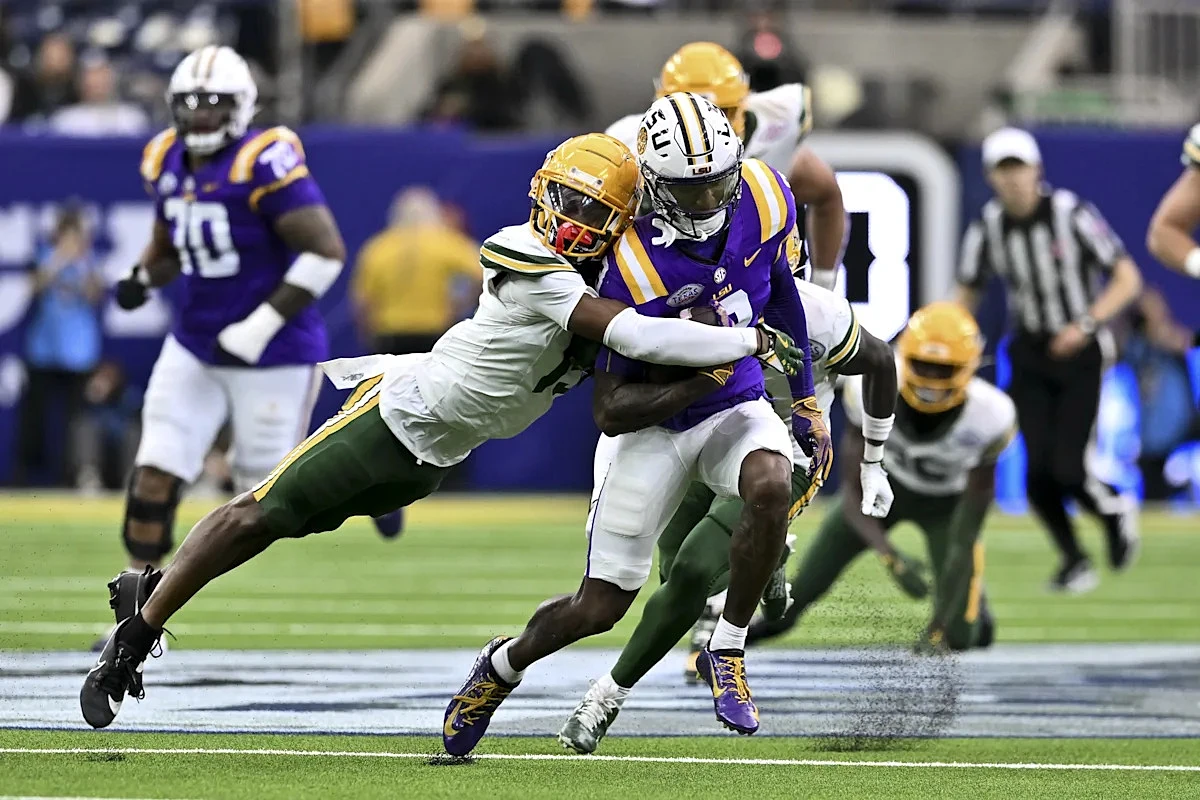


Carl Williams IV signed with Baylor in 2023 as a high 3-star (0.8803) corner having played both ways in high school. Despite not being a blue chip prospect, he saw snaps during meaningful time as soon as week 1 of his true freshman season. He played in all 12 regular games during 2023, beginning as part of a four-man rotation at outside corner before moving to his permanent spot at nickel corner in week 6 against Texas Tech.
Williams was the starter at nickel to begin his true sophomore season in 2024, but suffered an injury to his miniscus that he struggled with throughout the year. He was limited to only seven games during the regular season but returned for the bowl game.
The injury continued to bother Williams throughout the off season heading into 2025. He was medically cleared to play in week 2 against SMU but was only on the field for a total of five plays during the entire game. After this he elected to take a medical redshirt, and announced his intention to enter the transfer portal in January. Less than a week after officially entering the portal he committed to Oregon.
Williams’ background is quite similar to 2025 starting nickel/STAR safety Jadon Canady’s before he arrived at Oregon. Both had experience at outside corner, inside corner, and deep safety as well as losing a year to a serious injury before becoming Ducks. Unlike Canady though, the film I had on Williams is all from before he took his medical redshirt. As such, I cannot predict exactly what his abilities will be once he returns to the field.
I suspect the Ducks’ staff did quite a bit of work checking on his health before offering him a roster spot, but also hedged their bets by taking Aaron Scott Jr. from Ohio State as a developmental player and backup as well. I’m hopeful Williams will be full go for the Spring game this Saturday so I can compare his athleticism to his previous tape. Assuming he is fully recovered, his experience in a very similar role at Baylor would seem to put him in contention for Oregon’s starting nickel role in the Fall.
Though he was listed as a cornerback coming out of high school and played outside in the first part of his freshman season, the Bears staff saw Williams talents were more suited to the nickel position. This meant he lined up over receivers in the slot or the #2 (inside) position depending on the offenses’ alignment. From here he could most often do what the film showed he did best: read the play in front of him and attack the ball carrier. I found his ability to properly diagnose what the defense was doing very impressive for an underclassman. He doesn’t have elite foot speed, but accelerated well when breaking on the ball. Below I’ve compiled a representative sample of clips from Williams’ true freshman and sophomore seasons show him successfully diagnosing and reacting to passing plays.
(Reminder: you can click on the gear icon in the upper right of the video to adjust the play speed.)
:00 – Williams is #15 here (as he is in all clips shown in this article), lined up over the slot receiver to the offense’s left. This was his designated position against trips formations. Williams reacts immediately to the #3 (inside most) receiver heading toward the sideline behind the line of scrimmage and attacks the slot receiver’s outside shoulder to keep contain against a screen pass. He works through the block by keeping his arms extended and throws the ball carrier out of bounds before they make the line to gain.
:09 – Iowa State runs the same screen as in clip 1, but has the receiver get up to speed in motion before the snap. Williams is lined up over the inside receiver on the offense’s left. He completely discards his blocker and cuts off the ball carrier’s path to the sideline. The WR ISU #13 is nimble enough to dodge the first tackle, but this forces him back in toward where the pursuing defenders can finish the job.
:19 – The plan for the offense is to run a switch release with the receivers to the boundary (on the offense’s left). This will allow a catch-and-run that will at least put them in better field goal range if they cannot convert third and long. Williams is over the inside receiver, and knowing the down and distance gives ground at the snap to not let his assigned man behind him. Williams dodges traffic to follow ISU #13 outside to force him out of bounds well short of the line to gain.
:31 – West Virginia tries to catch the defense in a bad alignment by putting four receivers to the field in an unbalanced formation. Williams is in tight press coverage against the slot receiver in the cup centered on the hash marks. He’s at a size disadvantage against a tight end, but makes up for it with proper leverage. He turns the blockers shoulders so the receiver (a split out RB) tries to go in-and-out but Williams effective hand use lets him disengage to assist with the tackle.
Listed at 6’ 1” and 192 lb. going into the 2025 season Williams was one of the smaller players who regularly saw the field for the Bears (though he is bigger than Canady was). I thought he used leverage very well to compensate when at a size disadvantage, but in some situations it led to poor match ups for him. Aside from his physical limitations my only concern for him in a read-and-react scenario is that I caught his tackling form getting lazy on occasion. This is something a new coaching staff will have a chance to address before competition begins in the fall. Below are examples of these issues.
:00 – Williams has inside position against the stack on the offense’s right. Against this bubble screen he tries to keep the receiver in front of him to cut off his chosen path. The Red Raider does a good job with his path to guide the defender right into an offensive lineman releasing downfield, which is too much a difference in mass to overcome.
:10 – Over the slot receiver to the offense’s right, we see again Williams’ excellent technique in engaging the blocker so he can get to the ball carrier. He fails to sink his hips before wrapping up though, allowing the receiver to shed the tackle.
:31 – This play is why “keep your head on a swivel” is such a coaching cliche. Williams is so focused on reading the action in the backfield and the inside most receiver he doesn’t see the outside receiver coming to shoulder check him on his way to the corner.
:46 – No excuse for tackling technique like this. Williams is playing zone over the #2 receiver and makes a good reaction too the short in-breaker to the #1. If he wraps up the TCU player’s thigh it’s only a three yard gain. Using his shoulder to try and dislodge the ball just lets the Horned Frog turn his body to protect the catch and keep running.
AtQ was able to acquire footage of all off Williams’ FBS games from 2023-2025, but unfortunately not all of it was high quality and most games I didn’t have access to all-22 camera angles. This made evaluating his performance as a coverage defender more difficult than it was for Aaron Scott (Ohio State all-22 is easier to find) on a per play basis but thankfully I had a much larger sample size. Another complicating factor is that I did not think he was always being properly deployed. Baylor’s defensive staff tended to run a lot of simulated pressures that left him on an island if called at the wrong time. I also found an uncomfortable number of instances where players in the Baylor secondary were playing with improper leverage. All of this comes down to coaching, though whether poor defensive play design or poor teaching of coverage fundamentals is something I was not able to determine. As long as he wasn’t being asked to do too much, I found Williams to be a capable pass defender at the nickel position. Here’s a sample of his successes in pass coverage.
:00 – The challenge defending slot receivers is that there is usually space for them to break either inside or outside, so unless there is help from other defenders in zone defenders cannot over commit with their alignment. Williams initial foot placement has outside leverage, which is risky unless he is expecting help inside. He turns his hips to the middle of the field as he comes out of his back pedal so he can react to the receiver’s cut. As the ball arrives he strikes a good balance of getting his left hand in front of the receiver to break up the pass, but not turning the receiver with his right hand and drawing a flag.
:14 – Often a coverage defender’s best plays do not show up on the stat sheet. Keep your eyes on Williams and the slot receiver on the offense’s left. The quarterback seems to want this out route even though Williams is in position to undercut it. The ball gets batted and falls short, but Williams played this as well as almost anyone could.
:21 – The defense is playing man across the board with two deep safeties over the top, so Williams won’t have any help inside and his alignment reflects that. He’s on the inside of the hash marks even though his man is just outside of them. This does leave him at a disadvantage against out breaking routes, but those are somewhat harder passes to complete so it is smart trade off. As it is the receiver runs a slant, and Williams is able to use his hands at the top of the route to disrupt the timing and cause an incompletion.