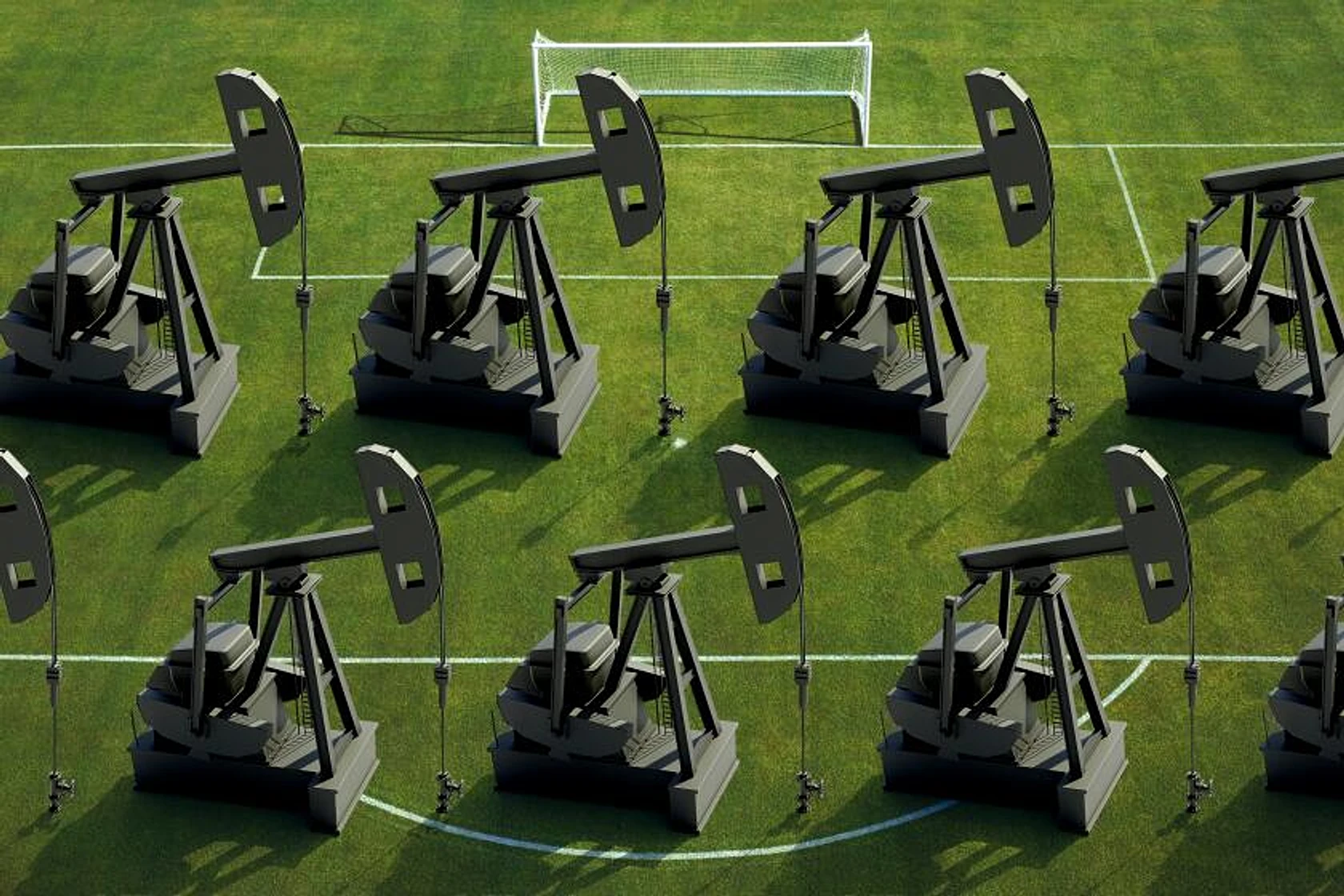
As the world's biggest sporting event prepares to kick off across North America this summer, FIFA is once again positioning itself as a champion of environmental sustainability. But beneath the green messaging lies a sponsorship deal that has raised more than a few eyebrows.
In late 2024, FIFA announced a four-year global partnership with Saudi Aramco—the world's largest oil and gas company. That means when the 2026 World Cup kicks off in Los Angeles and other host cities, fans tuning in from home or watching live at the stadium will see Aramco's logo plastered alongside household names like Adidas, Coca-Cola, Hyundai, Kia, Lenovo, Qatar Airways, and Visa. The same will hold true for the 2027 Women's World Cup.
This year's tournament is the biggest yet: 48 teams, 104 matches, and 16 stadiums spread across Canada, Mexico, and the United States. Eight of those games will be played at SoFi Stadium in Inglewood, temporarily rebranded as Los Angeles Stadium. But the sprawling, cross-continental format has already drawn criticism for its environmental footprint. Unlike previous World Cups held within a single country, this edition requires teams and fans to crisscross the continent by air—a far cry from the compact, low-carbon model of years past.
FIFA has pledged to reach net-zero emissions by 2040, a goal it touts as part of its sustainability strategy. But critics argue that partnering with Aramco—a company responsible for 4.28% of global carbon dioxide emissions in 2024, according to the independent Carbon Majors database—completely undercuts that promise. In fact, no other company in the world emitted more CO2 last year.
"Having Saudi Aramco as a major worldwide sponsor of this FIFA World Cup completely undermines any credibility FIFA has, or could have had, around sustainability claims," said Madeleine Orr, an assistant professor of sport ecology at the University of Toronto.
The financial terms of the deal remain under wraps, though industry experts estimate the sponsorship could be worth around $100 million annually. For a sport that prides itself on uniting the world, the partnership raises a familiar question: how green is the beautiful game, really?