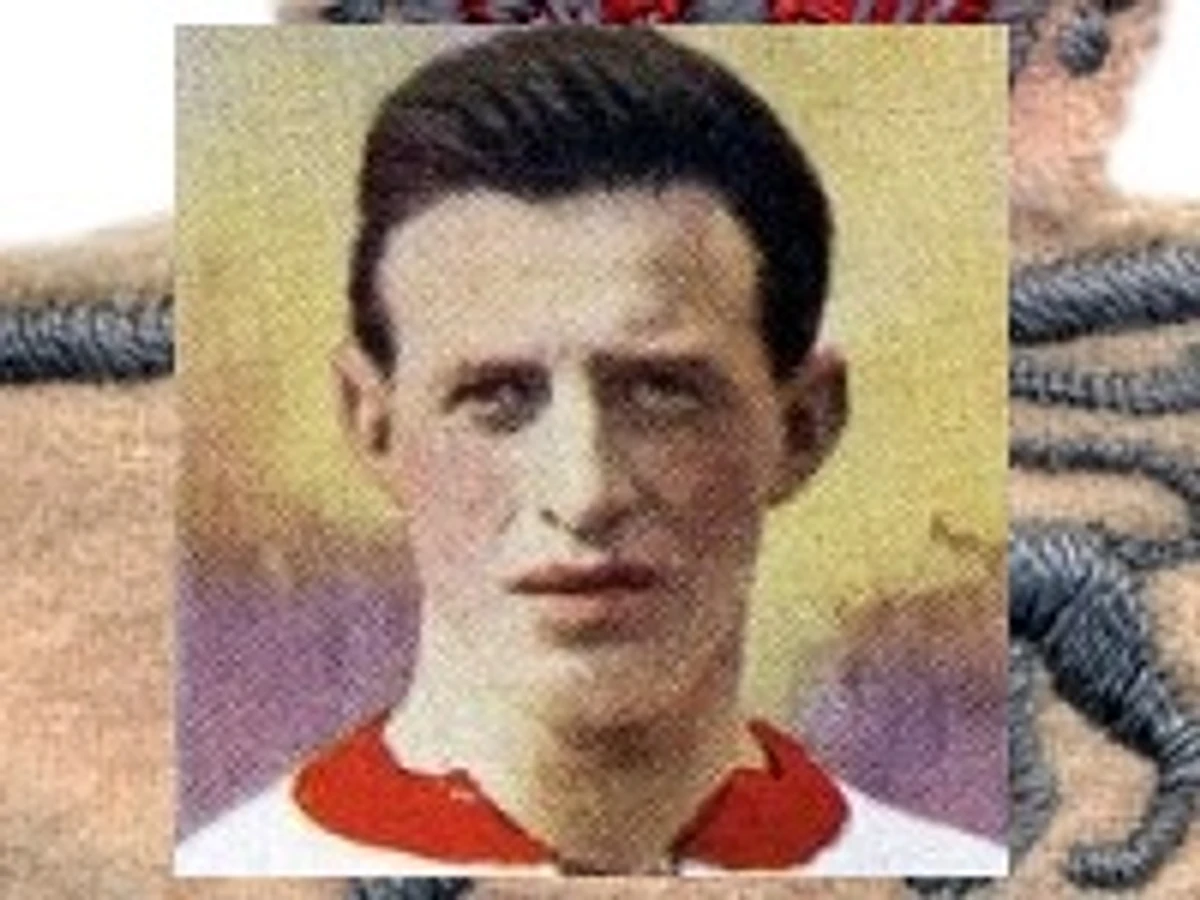

Preston North End were the opposition in this 1934/35 season. Jimmy Connor had picked up an injury in the game at Birmingham just two days earlier in the hectic Easter programme of three games in four days and with the ‘mighty atom’ Patsy Gallacher absent through suspension, the call went out for replacements. George Goddard would fill in for Gallacher and with the squad pushed to its limits, veteran winger, “junior team” coach/assistant trainer and masseuse Tommy Urwin was drafted in.
Sunderland had beaten Preston at Roker Park just three days earlier by three goals to one and now the rematch at Deepdale would see a last hurrah for the remarkable Tommy Urwin, twenty-two years after he made his league debut for Middlesbrough.
Tommy Urwin was born in Haswell, County Durham on 5 February 1896. He lived most of his early life in the Sunderland area. In the 1901 Census he was living at 7 South View, Ryhope. By 1911 he was living with his parents at 39 Eglinton Street, Monkwearmouth, with his parents, however the census records that five of his nine siblings are deceased.
Tommy, recalling his childhood, fondly remembered starting to play football with a milk tin or “a penny bullock’s bladder on killing day”, dreaming of playing for Sunderland and hoping for a ticket to their next game.
He played schools football in Sunderland and in 1910 played for Sunderland Boys in the English Schools Shield at Roker Park, impressing enough to win an English Schools cap shortly afterwards.
He played for Fulwell FC in the Sunderland Non-Conformist League, also turning out for Lambton Star. In 1913 he was working as an engine fitter at the colliery and he signed amateur forms with Shildon and was persuaded to sign professional forms in early 1914. Shildon knew what they were doing – a number of clubs were tracking Tommy and as a professional (earning 25 shillings per week) they could expect a good fee for the flying winger.
Middlesbrough won the race for his signature in late 1914. Shildon pocketed £100 and he got ten golden sovereigns as a signing-on fee. His contract would see him paid £3 per week rising to £4 when in the first team. In the close season his weekly wage dropped to £2.10 per week.
Tommy remembered with mixed feelings his first-ever game against Sunderland on New Year’s Day 1915, a 3-2 defeat at Ayresome Park. The legendary Frank Cuggy took a shine to him and offered some useful tips and encouragement.
Tommy played for Middlesbrough until 1924, playing years he described as very enjoyable.
His career was interrupted by the First World War. He tried to enlist in the Coldstream Guards, but at five foot six inches they declined his application, so he went to the Royal Field Artillery (RFA) and saw active service at Gallipoli and in India. He continued to play football during his military service in morale-boosting and war-fund-raising games, playing not just in the UK but all over the world. He himself particularly remembered playing in India in front of massive crowds and was in Aleppo when he got an improved offer to re-sign at Middlesbrough on an improved contract of £6 per week.
In 1924, Urwin signed for Newcastle (moving a little closer to his Sunderland home in Eglinton Street). Tommy had great respect for Hughie Gallacher the Newcastle captain and was proud to have played alongside him in the championship-winning team of 1926/27.
Tommy earned four England caps as a Newcastle player, three in 1923 and one in 1924.
In 1930 he played his last game for Newcastle against York City. It was time to go home to Sunderland. Tommy claimed he was “homesick” and also a little irritated at having to pay fines for being late when the trains were not running on time!
Johnny Cochrane the Sunderland manager was determined to build a team that would bring success back to the club and the town and Tommy was keen to be part of this, though at thirty-four years old he was clearly in the veteran stage of his career.
Tommy Urwin joined a small select band of players to represent all three North-east teams with distinction when he signed for Sunderland.
He was now living at 37 Hawarden Crescent in Sunderland, with his wife Bertha who would soon present him with a son (David).
Despite being able to play on either wing, Tommy eventually lost his place in the Sunderland team to Jimmy Connor and Bert Davis (who in turn lost his place to Len Duns).
Urwin was extremely fit and retained a good degree of sharpness despite his advancing years. He also had a clever footballing brain that stood him in good stead and made him invaluable as a squad member.
He was soon passing on his experience to younger players and by the time season 1934/35 had arrived, whilst still registered as a player, he was coaching the “junior” players, assistant trainer to the first team and a masseuse to boot!
Johnny Cochrane’s team were really beginning to hit their straps in this season and ran Arsenal very close, finishing runners-up. The Easter programme had depleted resources somewhat but Cochrane appears to have had no qualms about drafting Urwin into the left-wing position for the injured Connor, even though the diminutive flyer had not played a first-team game since February 1932.