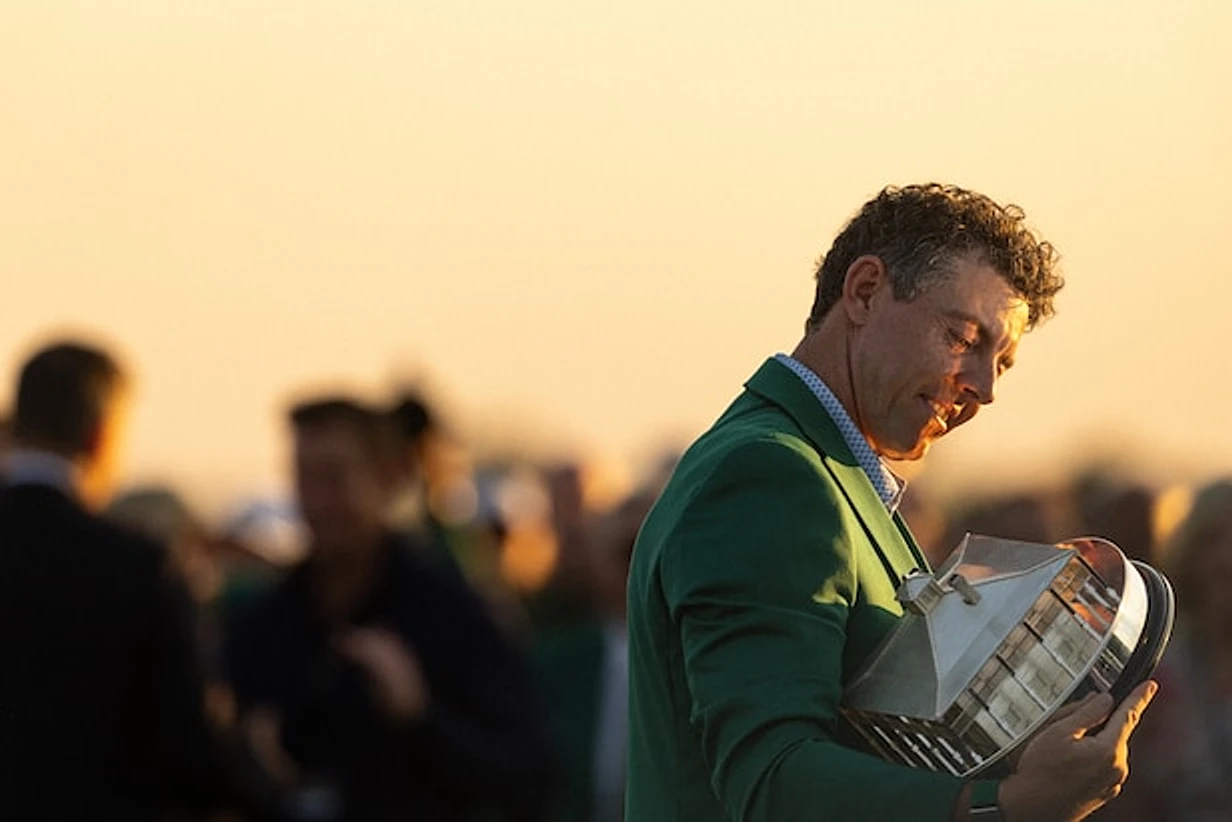

AUGUSTA, Ga. — The Masters is never won on Golden Bell. Never, until this time, after Rory McIlroy banked on experience and skill and gumption for a shot that was supposed to stay safe didn't. Blame the inscrutable wind of Amen Corner, or his inherent refusal to be anyone but himself. His approach flirted with Rae's Creek, kissed the greenside bunker's downslope, and finished six feet from the pin. Harry Diamond, usually stoic, grinned ear to ear. A smile that can only be conjured after you've flown too close to the sun and walked away with your wings dipped in gold.
McIlroy cleaned up the remaining six feet to move ahead by two, an advantage he held until the last. It wasn't steady—of course it wasn't—holding disaster by the hand as he marched toward fate. This afternoon, yesterday, always and forever. It makes for a richer journey, no matter the destination. On Sunday at Augusta National, the destination, despite a detour at the final hole, was a return to where his victory lap began. The Ulsterman bounced back from Saturday's collapse and a slow start to defend his title as Masters champion.
“I thought it was so difficult to win last year because of trying to win the Masters and the Grand Slam, and then this year I realized it's just really difficult to win the Masters,” McIlroy said, after a final-round 71 captured the 2026 Masters by one. “I tried to convince myself it was both.
“I obviously did the bulk of my work on Thursday and Friday. I don't think I would have believed anyone if they said to me all you have to do is shoot even-par for the weekend and you'll win.”
For most of the day the leaderboard was congested, like the beer line at a baseball game in the bottom of the seventh. Part of that can be chalked up to McIlroy, who began his day picking up where he stumbled. It would be unfair to call Saturday a choke, even if he tossed away a historic six-shot lead. It was also impossible to watch what we saw then and early Sunday—par at the second, a double at the fourth, another bogey at the sixth—and not see the tide pull him back. Ground we thought he'd gained revealing it was only borrowed, now reclaimed by the ocean.
McIlroy and Cameron Young idled in neutral after the second hole while the rest of the field made their move. That included Russell Henley and Justin Rose, the latter holding a two-shot lead at the turn. But that fickle squirrel of the property tripped up Rose—bogeys at the 11th and 12th, a three-jack at the 13th. Rose, left at the Augusta altar once more.
McIlroy has long preached about his optimism, that he's not willing to give up or get hurt because that's the toll for the road he chose. On Sunday, he backed those words up, answering the early stumbles with birdies at the seventh and eighth before making the turn. The real move, though, came at Amen Corner. That fortunate shot at the 12th led to one of just three birdies at Golden Bell all day. It was the spark. What had been a grind became momentum. What had been doubt became belief. McIlroy went from survival mode to hunting.
“I played a practice round with Tom Watson in 2009, and he said to me on the 12th tee he always waited until he felt where the wind should be and then just hit it,” McIlroy said. “When I stood up on the tee, it felt like it was off the right, and I looked at the 11th flag, it was blowing right to left. But I was patient, and I waited to feel where the wind should have been coming from, and I knew it was just a perfect three-quarter 9-iron. I aimed it at the middle of the bunker. Probably didn't anticipate it to drift as far right as it did. That's why you give yourself a little bit of margin for error.”
A 350-yard drive at the 13th, coupled with an up-and-down after a long approach, provided another cushion. Up ahead, Scheffler made a late run to 11 under, and perhaps there's no better endorsement of the World No. 1's game than nearly erasing a 12-shot deficit in two days. McIlroy added to the theater with a foul ball at the 18th, forcing him to play up the 10th fairway on his final approach. The heart, always on the sleeve, ready to be hurt. But no pain this time. He blasted out from the bunker, lagged the par putt to an inch, and soaked in knowing his four days of theatrics had earned him the chance to exhale.
This time, there was no collapsing to the ground, no crossing of the threshold that everyone feared he'd never reach. No tears, just smiles and back slaps with Diamond, hugs with family and friends. The emotions didn't arrive until Butler Cabin, where the jacket waited and the weight of what he'd carried finally found its release.
"I was a kid with a dream," McIlroy said. Yes, those dreams, those tears. When he donned the jacket for the first time last year, McIlroy told his daughter to never stop chasing her dreams. This year, he demonstrated that catching a dream doesn't mean stopping. He's two decades into his career and playing at his peak. After this win—his sixth major, making him just the fourth man to defend at Augusta—it's easy to wonder where he can still go. At this moment, he has a compelling case as the greatest European player of all time.
But that ignores the recent past, because these were the same questions we asked last year. And the time between then and now wasn't supposed to unfold like this. Not after McIlroy caught what he'd chased since childhood. The 9-year-old chipping into the washing machine had answered the question that drove him, only to face the silence that follows answered prayers
There was a theory that the green jacket would set McIlroy free, that he'd play unburdened once expectation had been satisfied. That winning would unlock the player who'd always lived inside him—total command, no hesitation, pure instinct. It's tempting to say the freedom we feared might never arrive had simply been waiting for this week. But that narrative doesn't hold, not after Saturday's unraveling and Sunday's early tremors.
Because the truth is simpler and stranger: freedom was never the point. He will never be liberated, and that's half the reason we can't look away. We're drawn to watching him escape restraints of his own making. Last year it was the past tightening around him. This week, the future closing in. But we know—absolutely, certainly—that at some point his hands will be bound again. And we'll have no idea if he can slip free.
It's because McIlroy carries both gift and curse—the same brilliance that lets him dismantle golf's most unforgiving tests makes every failure cut deep to reopen the wound of potential left unrealized. But it's also because of who McIlroy is. Not just what he can do, but how he lets us in. There aren't many superstars in golf, and those that exist tend to keep the rest of us at arm's length, guarding their interior lives like state secrets. Scheffler has made that choice, asking for greatness on his terms.
McIlroy has made his experience ours, turned his private struggles into shared communion. Almost always exceptional, occasionally bewildering, perpetually human. He doesn't hide behind the facade of invincibility that so many champions construct. He carries his heart on his sleeve and his doubts on his face, making himself vulnerable in ways that elite athletes rarely dare. He understands the weight that responsibility carries, the burden of being watched and analyzed and second-guessed. What he may never fully grasp is the weight we've placed on his shoulders—the collective hope, the projected dreams, the desperate need to see someone transcend their own limitations because it gives us permission to believe we might do the same.
He's different now. Harder in some ways, a player and person who has been tested beyond what we imagined he could endure and emerged with something forged in that fire. Last year's story was written entirely in the language of redemption, about ending a drought that had lasted nearly a decade. It took him months to understand what he'd actually won. The career Grand Slam wasn't the destination. Neither was this victory. "This is a stop in the journey," McIlroy said, and in that simple phrase lies the recognition that arrival is an illusion, that the pursuit itself is the point.
“I don't know, I just won my sixth major, and I feel like I'm in a really good spot with my game and my body,” he said. “I don't want to put a number on it, but I feel like this win is just—I don't want to say a stop on the journey, but yeah, it's just a part of the journey. I still have things I want to achieve, but I still want to enjoy it as well.”
Perhaps that's why, when McIlroy was done with all the embraces and laughs, he lifted his arms toward the sky. The gesture was instinctive, unscripted—and the gallery's roar rose with his hands, as if he were conducting them, as if the crowd understood before he did what the moment meant. It was joyful, yet also an acknowledgment. Acceptance. A recognition that this will happen again—the doubt, the collapse, the scramble back to solid ground—and that he will face it when it does.
The message isn't obvious, but it exposes the truth: Rory McIlroy will keep risking collapse because the heights he's reaching for demand he climb without a net. He will dream, and he will suffer for those dreams, and he will stand in front of us with his heart exposed and his hands reaching skyward, asking nothing and offering everything. That is who he has become. That is who he's always been. And now, Masters champion again, McIlroy knows the truth. Winning doesn't complete you. It uncovers what you didn't know you had.