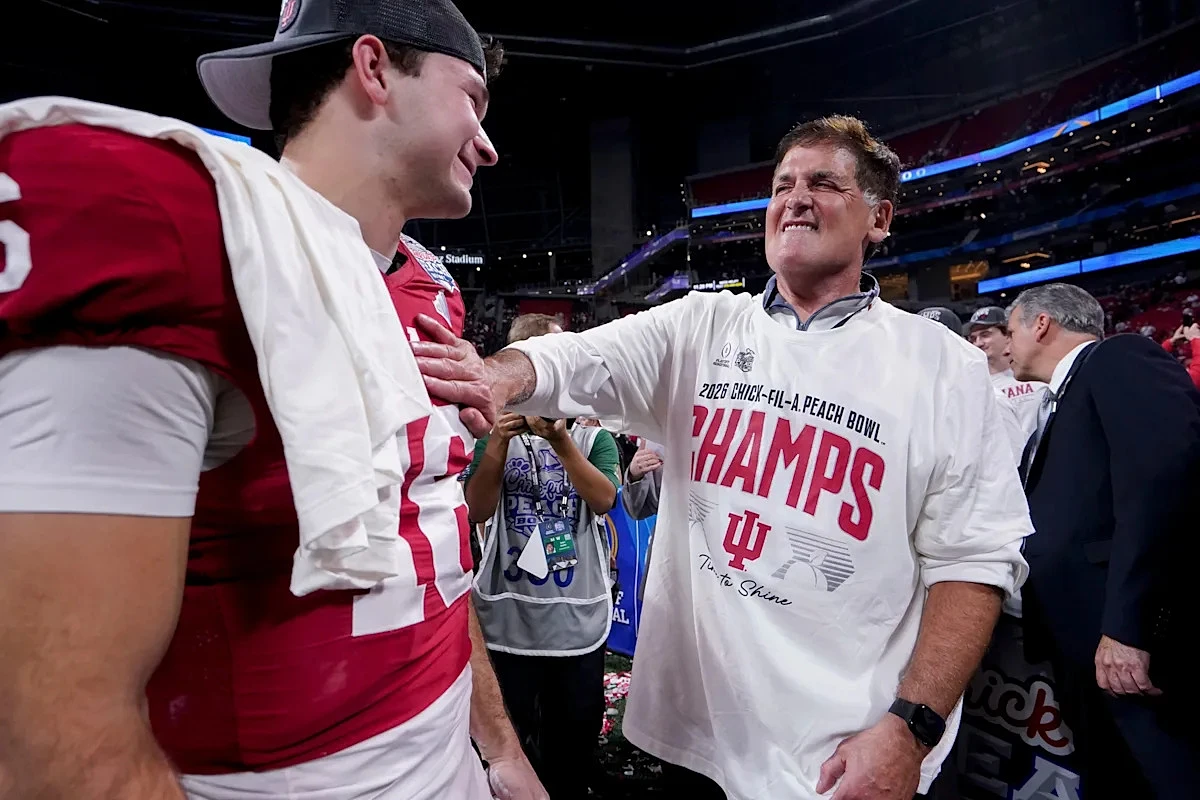
Mark Cuban, the billionaire entrepreneur and Indiana University graduate, recently revealed his pivotal role in securing star quarterback Fernando Mendoza for the Hoosiers—and it all started during a loss.
In a May 5 interview with Front Office Sports, Cuban recalled watching Indiana's 27-17 College Football Playoff loss to Notre Dame in 2024 alongside athletic director Scott Dolson and university president Pamela Whitten. As the game unfolded, the conversation shifted to a potential game-changer: Mendoza, a transfer from Cal who had caught the program's eye.
The Hoosiers were interested, but there was one major hurdle—they needed more NIL (Name, Image, Likeness) funding to land the coveted quarterback. "He's like, 'we've got this quarterback that we really, really like that we think would be great,'" Cuban said. "'We just need a little bit more.' I'm like, 'how much is a little bit?' And so, he told me and I'm like, 'OK, we're on a roll, I'll put up the money to get this quarterback.'"
That donation proved to be a historic investment. Mendoza went on to lead Indiana to a perfect 16-0 season, culminating in a 27-21 victory over Miami in the national championship game. The 6-foot-5 signal caller posted eye-popping numbers: 3,535 passing yards, 41 touchdowns to just six interceptions, and a 72% completion rate. He also added seven rushing touchdowns, improving his total touchdown mark by 30 from his previous season at Cal. His stellar performance earned him the Heisman Trophy and made him the No. 1 overall pick in the 2026 NFL Draft.
Cuban, who graduated from Indiana in 1981 with a bachelor's degree in management, has long been a prominent figure in sports and business. The 67-year-old gained fame as the owner of the NBA's Dallas Mavericks and as an investor on ABC's "Shark Tank." With a net worth of $6 billion (according to Forbes), Cuban's NIL donation was a small price to pay for a season that will be remembered as one of the greatest in college football history.
While Cuban didn't disclose the exact amount he contributed, his story underscores the growing impact of NIL deals in shaping the landscape of college sports—and how a single investment can turn a program into a dynasty.