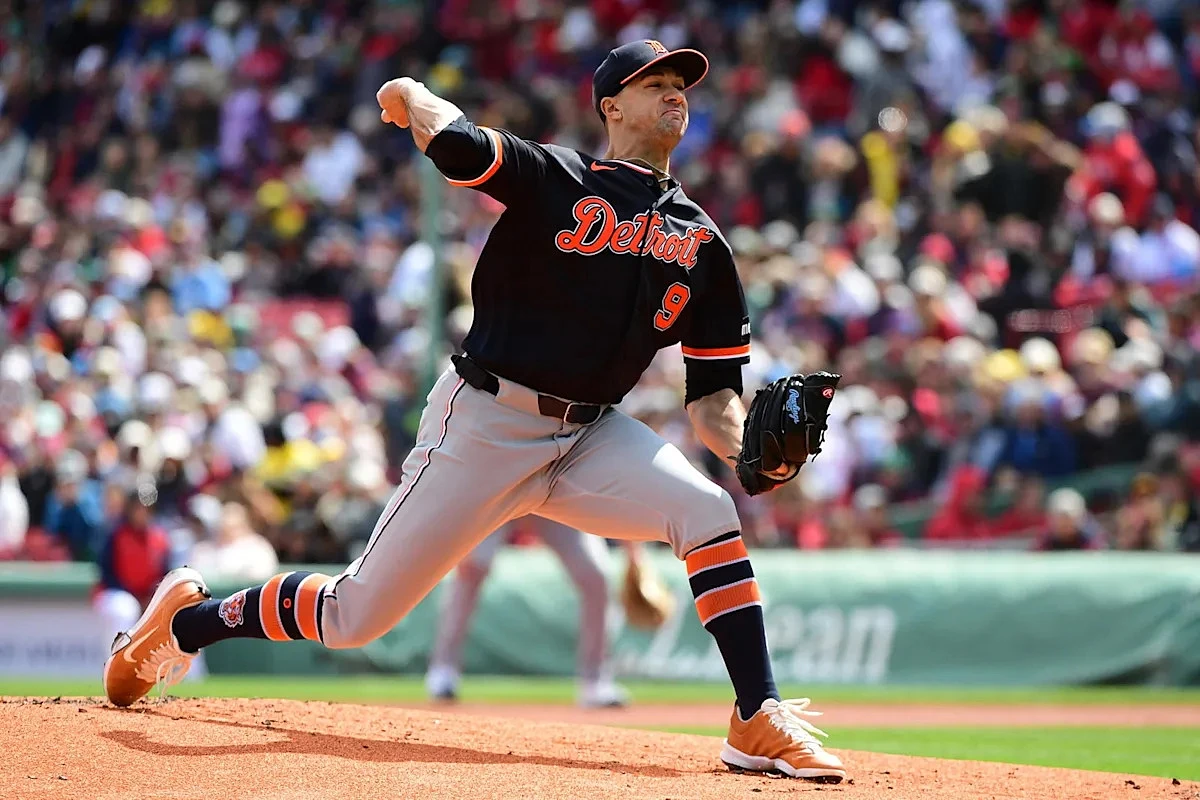


When you think of 11 a.m. baseball, maybe you chalk it up to the kind of thing you see in the minors or in tournament settings. But in today’s 8-6 loss to Boston, the Tigers turned it into one of their sloppiest and weirdest games in recent memory.
Jack Flaherty’s throwing error in the second inning helped put Detroit behind, the six walks kept traffic on the bases all morning, and Spencer Torkelson’s ninth-inning pinch-hit strikeout landed in one of the few spots where a single swing could have changed the feel of the finish. Detroit chipped back late, but the more interesting story from this one is that both Flaherty and Torkelson look less decisive right now than they do when they are right.
Start with Flaherty. Today’s line — 3.1 innings, 3 hits, 2 runs, 0 earned runs, 6 walks, 3 strikeouts — points to command and count leverage more than raw stuff. Baseball Savant backs that up. His average exit velocity allowed is up to 90.6 mph, hard-hit rate allowed is 46.0%, and his xERA sits at 4.72 in 2026.
The velocity itself is not the problem; his average fastball velocity is actually a tick higher than last season, 90.6 mph versus 89.7. The bigger issue is that hitters are not expanding against him the way they did in 2025.
His chase rate has dropped from 29.1% to 19.9%, his whiff rate from 27.3% to 24.4%, and his first-strike rate from 64.2% to 55.7%, while his walk rate has jumped from 8.7% to 15.9%. That is a bad combination for any starter, because it means more hitter-friendly counts and more plate appearances that stay alive.
If you are looking for one external explanation, the strike zone question is fair. MLB says the 2026 ABS challenge zone is a bit tighter than the old human-called zone; on 2-2 counts, league research found the traditional umpire zone measured 449 square inches versus 443 for the ABS zone. Savant’s ABS dashboard also notes that the zone is standardized at 17 inches wide, with the top set at 53.5% of a hitter’s measured height and the bottom at 27%.
So yes, there is a real case that some pitcher-friendly border calls are harder to get now. But I would stop short of blaming Flaherty’s day on a smaller zone. A slightly tighter zone can punish nibbling, but his own Savant profile says the larger issue is that he is not getting enough chase or enough early-count advantage. That is on execution more than environment.
Torkelson’s problem looks different, but the same word keeps coming up: decisiveness. The good news is that he is not flailing at garbage. On Savant, his chase rate is down from 22.4% in 2025 to 16.4% in 2026. That is real improvement. The problem is what comes with it. His zone-swing rate has dropped from 65.9% to 59.0%, his overall swing rate from 44.6% to 36.7%, and his first-pitch swing rate from 31.5% all the way down to 13.6%.
In other words, he is not just laying off bad pitches; he is also passing on too many hittable ones. Savant’s swing/take run values make that point even clearer. In 2025, he was plus-20 on chase pitches and plus-14 overall. In 2026, he is only plus-4 on chase pitches, minus-6 on pitches in the heart of the zone, and minus-2 overall. That is not the profile of a hitter getting fooled by junk. That is the profile of a hitter waiting too long for the perfect pitch.
The underlying contact quality shows the same split. Torkelson’s walk rate is up from 11.1% to 17.3%, so the selectivity is buying him free bases. But his exit velocity has slipped from 90.2 mph to 88.9, his barrel rate from 13.5% to 7.0%, and his xSLG from .456 to .352. His xwOBA has also dipped from .334 to .328, and his strikeout rate is up from 26.0% to 28.4%. So the patience is not translating into more damage right now. It is keeping him from chasing, but it is not putting enough good swings on pitches he can drive. His strikeout in the ninth fit that exact picture: a valuable spot, a chance to do damage, and no swing that changed the inning.
The cleanest read here is that neither guy needs a total overhaul. Flaherty does not look like a pitcher with dead stuff; he looks like a pitcher who has to get back to strike one and re-establish enough threat in the zone to force swings off the plate. Torkelson does not look wild; he looks too careful.
The Tigers can live with selective. What they cannot live with is selective turning passive. So the adjustment for both is pretty simple, even if it is not easy: Flaherty has to attack earlier, and Torkelson has to stop letting hittable pitches pass just because they are not perfect.
These are still small samples — 361 pitches for Flaherty and 362 pitches seen by Torkelson on the Savant pages — but the trend lines are strong enough to notice now. If you are looking for an answer from the minors, there isn't one among starting pitchers and until there's some progress on Justin Verlander or Troy Melton on the injury front, the Tigers for now, are stuck.