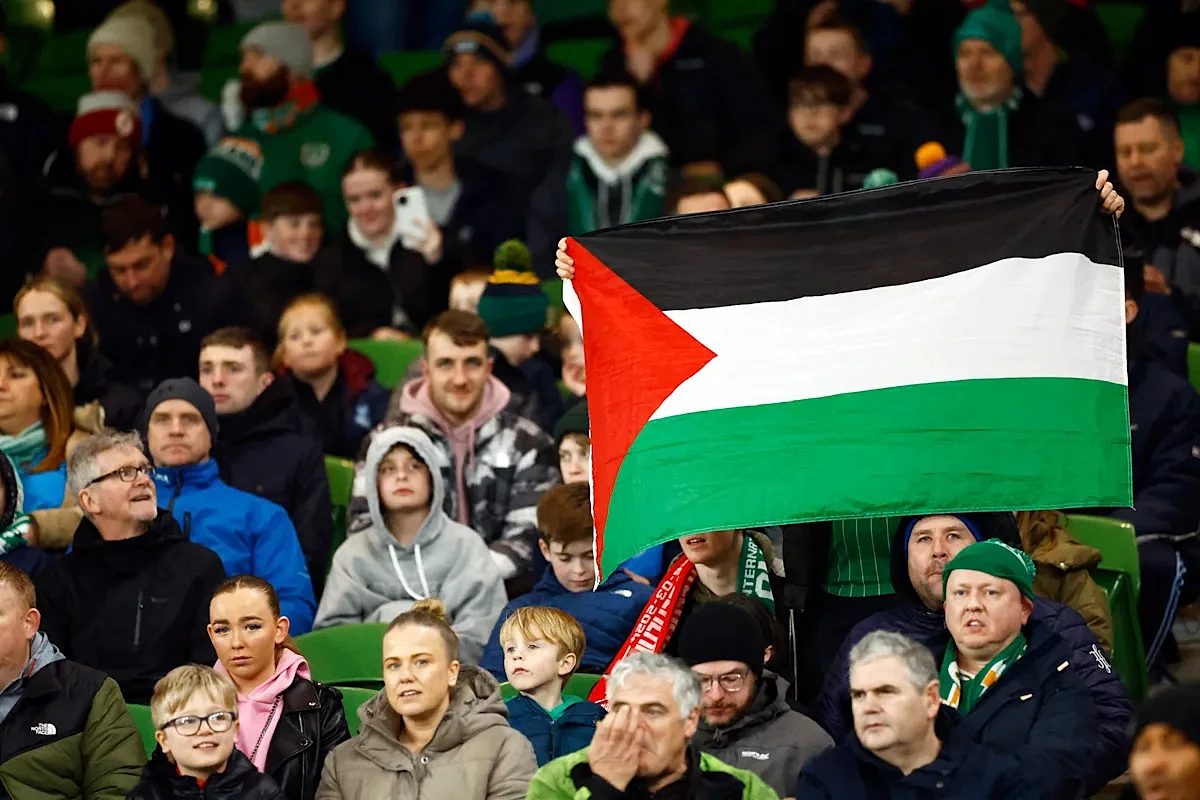
The Republic of Ireland's upcoming UEFA Nations League matches against Israel have become the center of a growing controversy, as a coalition of Irish football stars, musicians, and cultural figures calls for a boycott.
Campaign group Irish Sport for Palestine has sent an open letter to the Football Association of Ireland (FAI), urging the organization to pull out of the scheduled fixtures. The letter accuses Israel of committing "genocide" in its ongoing military campaign in Gaza and violating both UEFA and FIFA statutes by allowing matches to be played on what the group describes as occupied Palestinian territory.
This isn't the first time the issue has surfaced within Irish football. In November 2025, a staggering 93 percent of FAI members voted to push UEFA to suspend Israel under those very statutes. Campaigners now argue that the FAI has a clear mandate to "respect and represent" that overwhelming vote. Israel has consistently denied allegations of genocide in Gaza.
The "Stop the Game" letter has drawn some of the biggest names in Irish football. Signatories include current League of Ireland players, former men's national team manager Brian Kerr, and two-time Women's Player of the Year Louise Quinn. The campaign has also crossed over into popular culture, with Irish rock band Fontaines D.C., hip-hop trio Kneecap, legendary singer-songwriter Christy Moore, and Oscar-nominated actor Stephen Rea all adding their names to the call.
The stakes are high for the upcoming international break. Ireland is scheduled to host Israel at Dublin's iconic Aviva Stadium on October 4, while a September 27 fixture—designated as an Israeli home match—is expected to take place at a neutral venue.
Shamrock Rovers captain Roberto Lopes, who also serves as chair of the Professional Footballers' Association of Ireland, made a powerful statement in the letter. "We can't ignore the humanitarian catastrophe in Palestine; the sheer loss of life there has to take precedence over any sporting consideration," said Lopes, who is set to represent Cape Verde at the 2026 World Cup. "Ireland has an opportunity here to lead and do what others won't."
This situation adds another layer to Israel's complex history in international football. Since the early 1980s, Israel has competed in UEFA competitions after being expelled from the Asian Football Confederation (AFC) in the 1970s, when several nations refused to play against them.
However, not everyone is on board with the boycott. Ireland's Prime Minister Micheal Martin has stated that the two matches against Israel should proceed as scheduled, emphasizing that while his government has been critical of the Israeli government's actions, the games themselves should go ahead.
As the October fixture approaches, all eyes will be on the FAI to see whether they heed the call from their players and the public, or stand firm in the face of growing pressure.