
The NFL Draft has ended, and the grading season has begun. Everyone will debate which teams drafted well and which didn’t. The truth is nobody really knows − and won’t − for years.
We don’t have that luxury with franchise quarterback Joe Burrow. His timeline isn’t measured in draft cycles. It’s measured in hits. When your franchise quarterback’s health defines the future of the organization, the timeline collapses. The window is now.
The Bengals’ offensive line has finished in the bottom five of Pro Football Focus grading in four of Burrow’s five seasons. Last year, they ranked 27th in pass‑blocking efficiency, allowing 220 pressures − including 30 sacks − on 724 passing plays. Of the seven linemen who played more than 150 snaps, not one earned a PFF grade above 65 (on a scale of 0-100).
Opinion: Dexter Lawrence deal proves Bengals are finally serious
The tackles − the two players who matter most − were the specific problem. Orlando Brown Jr. ranked 92nd of 140 qualifying tackles with a 58.2 grade. Amarius Mims ranked 96th, with a 57.8 overall and a 60.8 pass‑block grade that placed him 80th at the position. These aren’t depth players struggling in spot duty. They’re the starters.
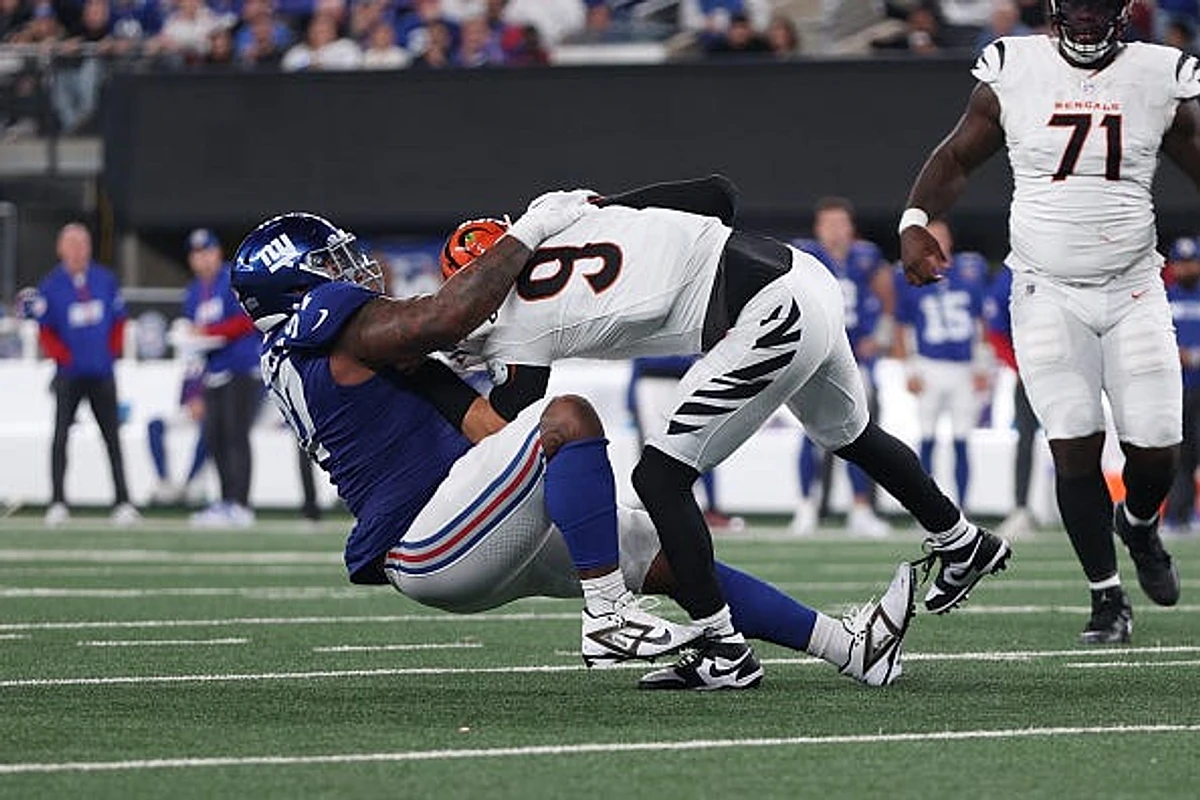
Burrow has been absorbing the consequences for years. In 2021, regular season and playoffs combined, he was sacked 70 times − the third‑highest total in NFL history. A wrist injury cost him the final seven games of 2023. He returned in 2024 and posted one of the great statistical seasons in league history − and still took a beating behind the same unreliable line.
Brown and Mims have been given time and opportunity. Both have graded near the bottom of their position groups in consecutive seasons. Heading into 2025, PFF ranked the Bengals’ offensive line 31st of 32 teams, with the tackles specifically cited as players who would need to improve drastically. They didn’t. That’s the context for evaluating what the Bengals did − and didn’t do − in this draft.
Before a single pick was made, Cincinnati traded its No. 10 overall selection to the Giants for Dexter Lawrence, a Pro Bowl nose tackle. The move had logic. But it locked in the direction of everything that followed. The Bengals built a draft class defined almost entirely by defense: Cashius Howell, a twitchy edge rusher; Tacario Davis, a 6‑foot‑4 corner with 34‑inch arms; Landon Robinson, an interior defensive lineman from Navy. They doubled down on defense and nearly forgot the needs of the offensive line.
Yes, they drafted two offensive linemen who both received positive reviews. Connor Lew, a Round 4 center from Auburn, was ranked by NFL.com as the top center prospect in the class. Scouts describe him as technically sound and highly intelligent. But two problems remain: He’s recovering from a torn ACL suffered in October 2025, and he’s a center − not a tackle. The crisis is at the bookends. Brian Parker II, a tackle from Duke taken in Round 6, is a developmental project, not an answer.
Jason Williams: Big moves, no drama, change? How about the Cincinnati Bengals?
Lew may become a good center someday − when he’s healthy. Brian Parker may develop into a backup. But neither solves the problem that has defined and damaged this franchise for five years: two starting tackles who are among the worst at their positions in the league. Until the Bengals replace Brown and Mims with players capable of protecting Burrow at an NFL level, the offensive line remains a liability no amount of defensive investment can offset.
What makes this draft harder to swallow is what happened with the pick Cincinnati traded away.
The Giants used the Bengals’ No. 10 to select Francis Mauigoa − a densely built, NFL‑ready right tackle from Miami with 42 career starts, strong play strength, and a commanding anchor. He will likely start immediately, protecting 2025 first‑round pick Jaxson Dart. New York used Cincinnati’s draft capital to do the very thing Cincinnati refuses to do consistently: put a proven lineman in front of its quarterback.
And the rest of the AFC North followed the same logic:
• Cleveland drafted Spencer Fano at No. 9 − the Outland Trophy winner and unanimous All‑American with the versatility to play all five positions.
• Baltimore drafted Olaivavega Ioane at No. 14 − the top‑rated guard in the draft, a heavy‑handed Penn State product who confirmed his status with a rock‑solid combine.
• Pittsburgh drafted Max Iheanachor at No. 21 − a raw, high‑ceiling tackle with size, power, and quickness. Developmental, yes, but still a first‑round investment in protection − and Pittsburgh doesn’t even have a confirmed franchise quarterback.
Three division rivals − one rebuilding, one still searching for a starter − all invested first‑round capital in the most reliable insurance the sport offers. The Bengals, with a generational quarterback, invested their top‑pick equivalent in a nose tackle and spent the rest of the draft focused on defense.
Joe Burrow lives in the pocket, not in a five‑year window. Injuries are cumulative. Every blindside hit compounds the ones before it. That’s not a football argument. That’s a medical one.
There is one question this column cannot fully answer: Why hasn’t Burrow demanded better? He has publicly lobbied for Tee Higgins. He has pointed to the defense as the team’s most urgent need. But about the offensive line − the unit that has put him on injured reserve and on the turf more times than any quarterback should endure − he has had nothing but praise. He has never publicly asked for what he objectively deserves. Whether that silence reflects careful locker‑room loyalty or the discretion not to publicly air his grievances, only he knows.