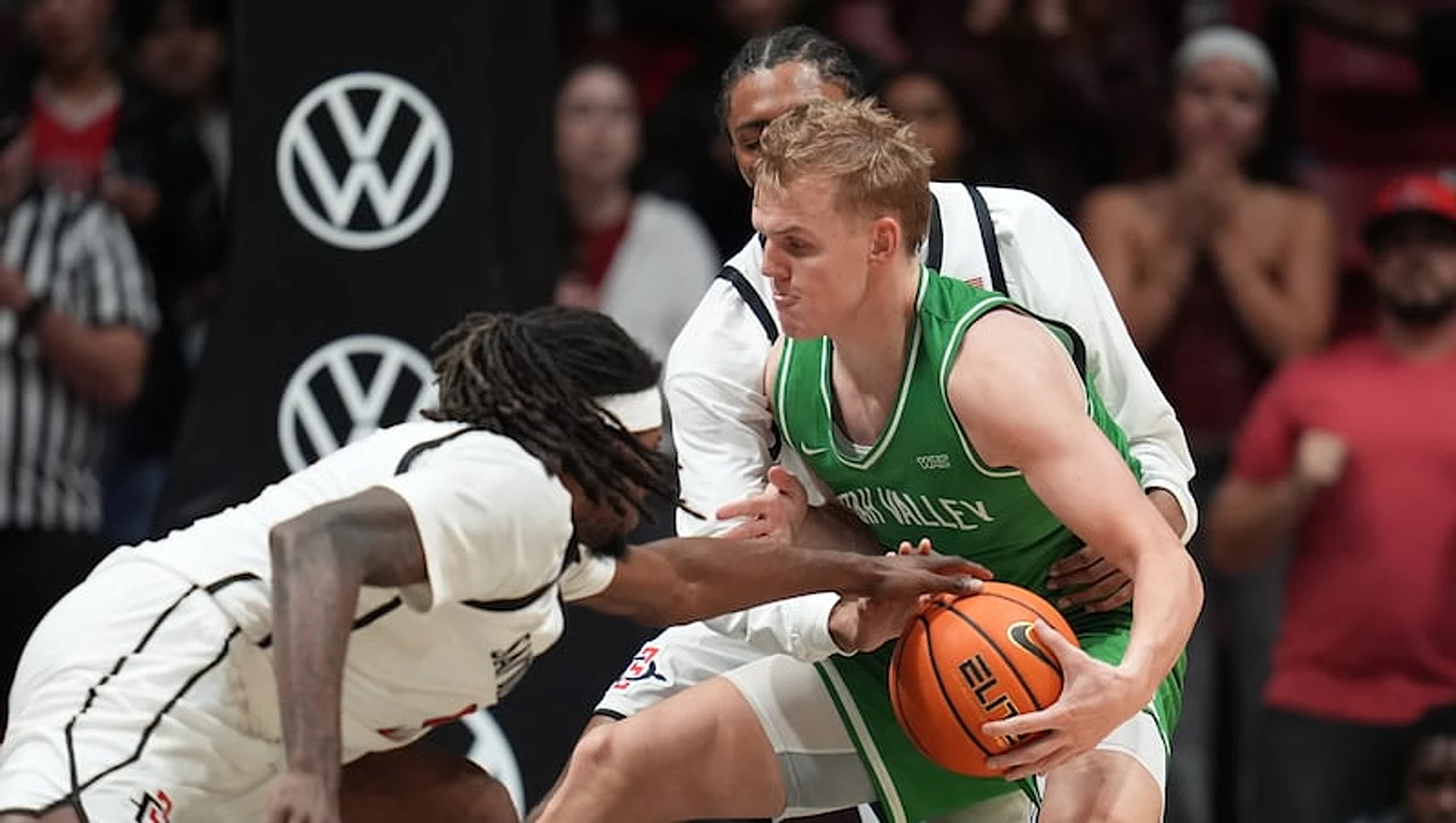

Following Alex Jensen’s first year as head coach, there was a roster overhaul for the Utah basketball team.
That’s not unexpected: Jensen’s first team went 10-22 overall, and the current transfer portal era makes overhauls a lot more common in the sport.
Still, it meant that Jensen and his coaching staff were facing a challenge of putting together a roster that could be a lot more competitive in the Big 12, after the Runnin’ Utes went 2-16 in league play last season.
In the past few days, the Utes have received a flurry of commits — and the end result is a roster for 2026-27 that feels more like the defensive, versatile vision Jensen has for his alma mater.
With international talents Noam Yaacov and Alec Anigbata the latest two to commit over the past two days, Utah’s roster is currently sitting at 15 players based on reported commitments, official signings and what the program’s online roster indicated for next season.
That’s the maximum number of players teams at the collegiate level can have, though there could be late or mid-year additions or other player movement before the year begins.
Though there’s still plenty of time for roster changes before the season starts, here’s my best guess at what the rotation could look like with this group:
Bench depth: Abbey, Katoa, Johnson, Clemmons, McHaney
With the roster now assembled, it’s clear that Jensen and his staff built it with a purpose and vision in mind. At least on paper, there are a lot of complementary pieces, with multiple high-level defenders and efficient shooters.
Those were luxuries that Utah struggled to put together last season, after the Utes played catch-up on the recruiting trail.
Utah’s staff also leaned heavily into its international ties to find talent.
A season to refine their recruiting vision — with general manager Wes Wilcox leading that task — has culminated in a group that appears to live up to the phrase, “The whole is greater than the sum of its parts.”
There will be more versatility on this roster, which should help offset the losses of guys like Terrence Brown and Keanu Dawes, along with other veterans like Don McHenry and Seydou Traore.
The glaring issue with the roster is the lack of height at center — no expected rotation player stands taller than 6-foot-9 — and that will put the onus on guys like Faye and Gomma, the most experienced post veterans, to set the physical tone.
Point guard has a pair of intriguing starting options, and perhaps the best way to look at it is that Yaacov and Burch could be interchangeable, given the situation.
Yaacov has a well-rounded offensive game and Burch showed at Wright State he’s a two-way playmaker as a scorer and defender.
With guys like Holcombe, Chatman, Anigbata, Langarita and Loubaki, there’s versatility for guys to be interchangeable at a variety of positions from two to four, and Schott has a solid offensive game.
Can this group mesh together better than last season’s roster? That’s the big question, and while the Utes aren’t likely to be in serious contention for an NCAA Tournament appearance just yet, there’s a healthy mix of younger and older players on this roster to help establish continuity.
There’s more interchangeability in the backcourt, but the front court could be bolstered if Johnson is able to shake off the mission rust and contribute as a freshman.
Last season, Kendyl Sanders was expected to redshirt, but after Faye’s season-ending injury, Sanders was a heavy contributor as a stretch four. The opportunity might be there for Johnson to fill a similar role.