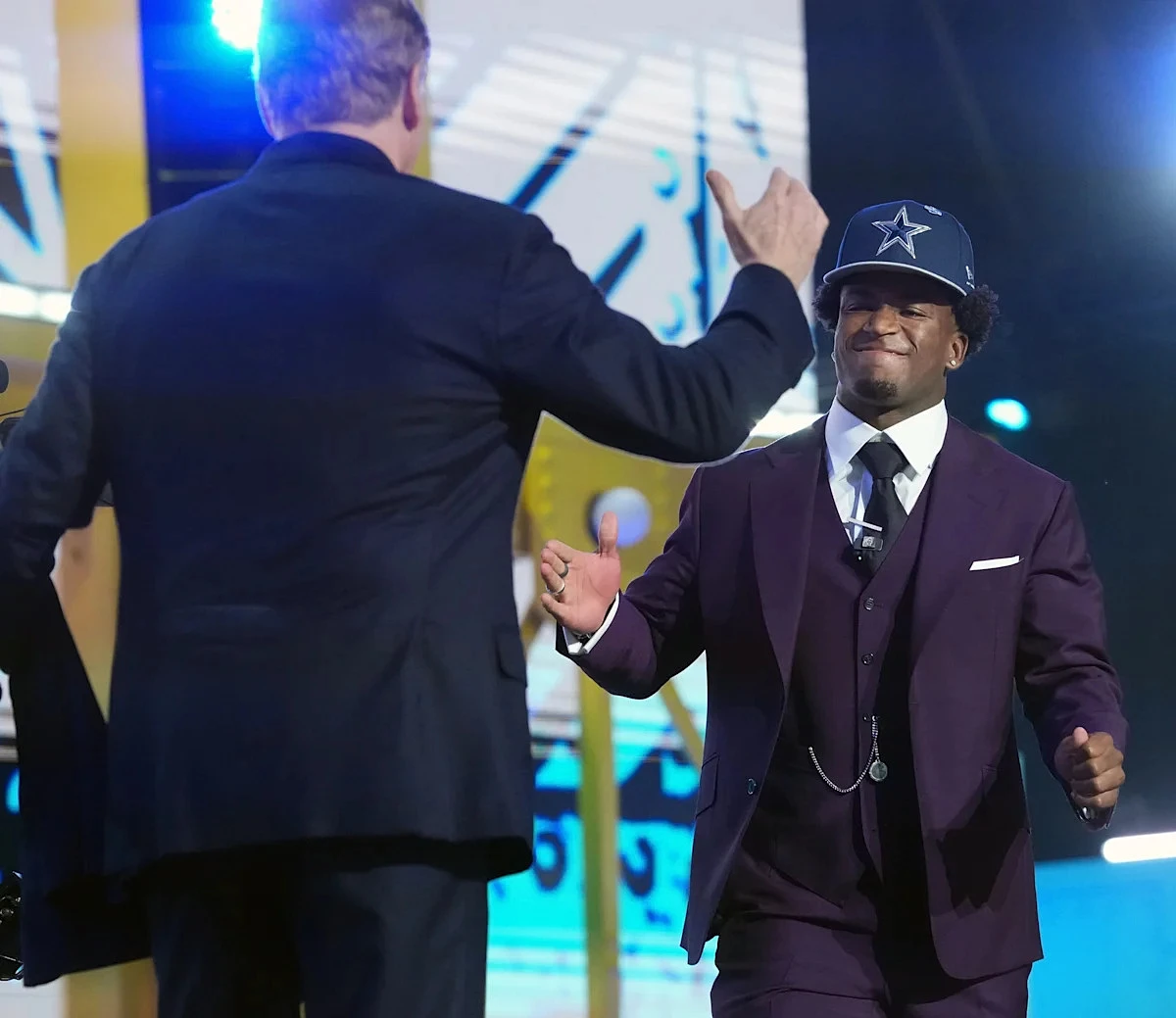


It was a long wait on day two of the NFL draft for the Dallas Cowboys to get in on the action, but waiting until pick 92 produced a similar result to waiting until the 11th and 23rd picks in the first round – more help for the defense. As another run on defense was starting early in a second round where Dallas did not have a pick, the team traded away pick 152 for more of a proven commodity in San Francisco 49ers linebacker Dee Winters.
This latest trade for a defender did not stop the Cowboys from adding a linebacker type when they finally did come on the clock near the end of the third round, marking back-to-back picks in the front seven with Michigan’s Jaishawn Barham.
Now with Caleb Downs, Malachi Lawrence, and Jaishawn Barham drafted, Christian Parker is picking up the pieces from a Matt Eberflus defense that was just all-around bad at all levels in 2025. How do Downs, Lawrence, and Barham fit the current depth chart, and what does having them in the fold mean for players already on the roster from before the draft? Let’s take a closer look.
The most exciting trait for whatever team was going to draft Caleb Downs is his versatility and football IQ, making him a fit for any defense under the sun. Having Swiss army knife type defenders is something a lot of teams covet in the draft, but as is the case with every prospect, having a clear vision for how the player will be utilized is even better, and vitally important. The Cowboys had this right away with Downs.
In the team’s post-draft press conference following the first round, head coach Brian Schottenheimer was very direct when talking about the vision for Downs – who also made it clear he’s been asking Christian Parker for the playbook right off the bat. Schottenheimer said Downs’ “starting point” will be as the nickel in this defense, where he’ll play primarily in the box.
The nickel position is of upmost importance in Parker’s scheme, with Cooper DeJean being his most recent successful player in this role for the Eagles as a second-round pick. DeJean was more of a big-bodied true cornerback, while Downs has the size to be more of a linebacker type nickel in the box, with pass rush upside as a blitzer, and fluid man-to-man coverage skills like a cornerback.
Having Downs as a box defender goes a long way. A safety being among a team’s leading tacklers is typically not a hallmark of a great defense, but Downs’ ability to diagnose running plays with lightning quickness, take precise pursuit angles, and finish tackles in the open field is rare and unique, and allows him make an impact closer to the line of scrimmage.
Downs’ ability to play with fluid hips and mirroring ability in man coverage is equally as impressive, and playing him at nickel will give him the best chance to diagnose plays happening in front of him instead of getting his head turned in coverage as a deep safety. This is a very good thing for the Cowboys defense.
Malik Nabers said that when he played against Caleb Downs in college, Downs was calling out every one of his routes on every play. Caleb Downs was a freshmen!
Currently, the Cowboys have Markquese Bell, Alijah Clark, Trikweze Bridges, and Reddy Steward as players with some ability to play nickel beyond Downs. The fact all four have become well-known names for Cowboys fans says a lot more about the state of the defense as a whole than it does the must-have ability of any of these players. Add in the fact the Cowboys can play DaRon Bland and last year’s draft pick Shavon Revel in multiple spots, and the addition of Downs could make it very hard sledding for any of these bubble players to make the final roster.
The Cowboys drafted another strong character and high upside prospect at a position in Malachi Lawrence. He had the second highest vertical jump of any EDGE player at the combine at 40 inches, one inch shy of Florida’s George Gumbs Jr. Lawrence was second in the broad jump, again one inch behind the leader Dani Dennis-Sutton. He measured in taller than top five picks Arvell Reese and David Bailey, with longer arms and wing span, and loads of untapped pass rush potential.
This pick was the genesis of completing the Micah Parsons trade, so it’s only fitting the Cowboys used it on pass rush, and doing so in a trade down was great work by the organization.
Lawrence was billed by some draft prognosticators as the best pure pass rusher in this class. The obvious downside this comes with is almost always a lack of run defense ability, but Lawrence has more potential than he’s being given credit for at the moment in this area. The Cowboys still envision him as primarily an outside linebacker type pass rusher, but he has the ability to still shed blocks and create penetration from a hand in the ground defensive end role as well.
Coach Schottenheimer spoke about a clear vision for using Lawrence in his rookie season. His relentless pursuit, change of direction ability, sudden quickness, and lower body bend paired with the ability to hunt the football make him the exact type of player the Cowboys want on the field when playing with the lead, getting after opposing quarterbacks forced to drop back and throw. Schotty specifically mentioned the fact Lawrence will be chasing mobile quarterbacks in Jalen Hurts, Jaxson Dart, and Jayden Daniels.
Limiting big plays and creating turnovers by going after the ball should be two of the highest priority goals for the Cowboys defense in 2026. Lawrence had 12 sacks and three forced fumbles in his last two collegiate seasons.
Lawrence doesn’t carry the same “star density” as Caleb Downs, where other players looking to see the field in a similar role have a hard time doing so. The Cowboys pass rush depth chart paints a different picture, one that will rely on keeping fresh bodies on the field in rotational roles. Rashan Gary, Donovan Ezeriuaku project as the closest thing to “starters” in these outside linebacker pass rush roles, but Lawrence should work into the mix as he develops.
Isiah Land, James Houston, and Tyrus Wheat are potential bubble players if the Cowboys find more depth at either defensive tackle or defensive end, and want to shorten up their pass rush rotation for the sake of carrying more versatile defensive linemen throughout the front seven.
The Cowboys made the wait until pick 92 pay off by getting more depth at both linebacker and pass rusher with Michigan’s Jaishawn Barham.
As an EDGE player, Barham ranks in the just the 44th percentile for height and third for weight, but above the 76th percentile in arm length, hand size, 40-yard dash time, and broad jump. When moving these projections to linebacker though, Barham jumps to the 90th percentile in height, 56th in weight, 95th in arm length, and 90th in hand size.
In his two seasons at Michigan as a transfer from Maryland, Barham was a linebacker in 2024 and a mix of linebacker and edge rusher in 2025, giving the Cowboys even more versatility and needed depth at more than one position.