

On Tuesday, we talked about Cainings. The San Francisco Giants introduced Los Angeles Dodgers ace and international superstar Yoshinobu Yamamoto to the concept, with the most common type of Caining in existence. Call it the Standard Caining. In the Standard Caining, a pitcher has a very good game, but their offense doesn’t do enough. Because they had merely a very good game, rather than a great one, they’re rudely handed a loss when their incompetent offense fails to do their job.
Matt Cain, to pick a random name to use as an example, received a losing decision on 26 different occasions in which he pitched at least six innings while allowing two or fewer earned runs. Yamamoto’s impersonation was quite admirable, as the reigning World Series MVP pitched seven mostly-dominant innings but, thanks to a three-run first and a lifeless offense, received a notch in the L column.
Today, we talk about a less common variant of the Caining, one that the Giants introduced to Dodgers ace and international superstar Shohei Ohtani. Let’s call it an Advanced Caining. In the Advanced Caining, a pitcher goes above and beyond with not just a good game, but a great one. But the offense is, once again, inept. And eventually, the pitcher is forced to leave the game, leaving a bullpen to wear the blame when the magic runs out.
Matt Cain, to once again pick a random and arbitrary name to use as an example, had 17 different instances in which he pitched six or more innings, gave up zero or one runs, handed the bullpen a tie or a lead, and then watched, arms dangled over the railing, as the bullpen lost the game, and the offense did nothing to keep it from occurring.
Ohtani now is intimately acquainted with an Advanced Caining which, admittedly, has an added flair to it when the pitcher getting Advanced Cained is also the designated hitter anchoring the offense doing the Advanced Caining. It’s a vicious cycle being both the Cainer and the Cainee.
The two-way sensation had a game that, Giants fans will be loathe to admit, lived up to the hype. He struck out the side in the first inning, albeit working around two singles. He set down the side in order in the second, and then again in the third, and then once more for old time’s sake in the fourth. He cruised through the fifth.
It wasn’t until the sixth inning that Ohtani appeared to be an any sort of danger, and even then he dismissed of it easily. The Giants waited until there were two outs to try any sort of shenanigans, with Matt Chapman reaching on an infield single, and Rafael Devers smacking a double, his second hit of the day.
But Ohtani, still hitting triple digits even as his night neared an end, overpowered Casey Schmitt and ended the inning with emphasis.
It was his seventh strikeout of the game, which paired well with his zero walks. He’d thrown 23 pitches in excess of 99 mph. He’d given up just five hits. He hadn’t allowed a runner to score, earned or otherwise.
And none of it mattered. Because the Dodgers bullpen couldn’t maintain what he had accomplished. Because the Dodgers offense couldn’t match what he had thrown.
Because Tyler Mahle pitched better than Shohei Ohtani.
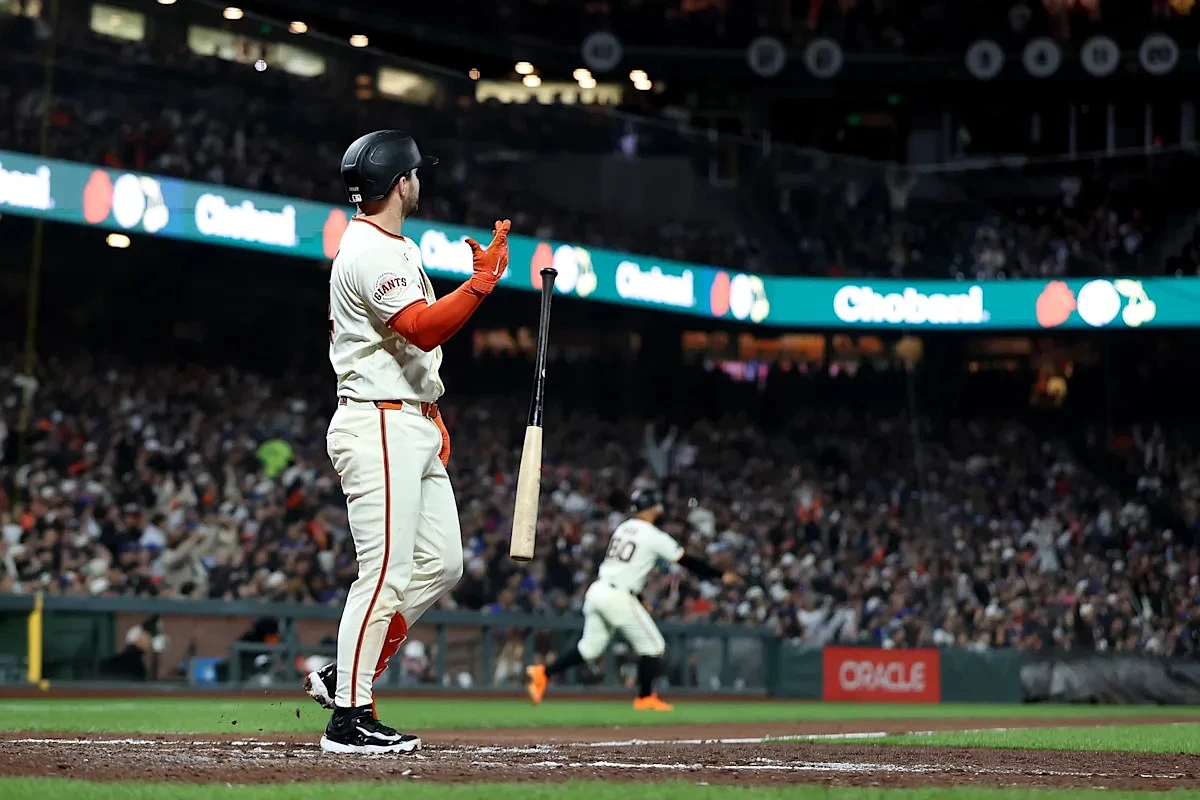
Because Patrick Bailey hit better than Shohei Ohtani.
The Advanced Caining requires a worthy adversary on the mound, and the Giants — despite what you would think entering the series — have provided that worthy adversary, first in the form of Landen Roupp, and next in the form of Mahle.
Mahle was excellent on Wednesday. He was beyond excellent. He was so good that someone in the comment section will be mad at me for mentioning Ohtani’s name six times before ever getting to Mahle’s, and that person will be right.
The veteran, whose debut season with the Giants had been a debacle prior to this game, not only matched Ohtani, but surpassed him. He threw the same number of pitches (91) as his opponent, but made it through seven innings, instead of six. He gave up the same number of baserunners (five), but none of them were extra-base hits. He faced a runner in scoring position in just two innings, and one was because Drew Gilbert took a truly atrocious route to a routine fly ball and instead let it fall for a single.
He had his help, mind you: Devers, Willy Adames, and Luis Arráez in particular had some standout defensive plays to keep the outs coming. But all great performances require a supporting cast, and Mahle’s showing was exactly that: greatness, with a fantastic supporting cast. And when you do that against the Dodgers, you earn some fans.
And ahh, what the hell, here’s Devers proving my point:
And so, as Mahle walked off the mound for the final time, as fans stretched and sang, we had been treated to two of the three components of the Advanced Caining: a great performance by a pitcher (Ohtani), and a great performance by an opposing pitcher (Mahle) in response.
All that was left was the third and final component: an offense eager to face anyone other than the star pitcher, and a bullpen prepared to waste a great start. And if it wasn’t clear to you until now, that offense was the Giants’, and that bullpen was the Dodgers’.
Southpaw Jack Dreyer replaced Ohtani, taking the mound for the bottom of the seventh inning in a scoreless game.