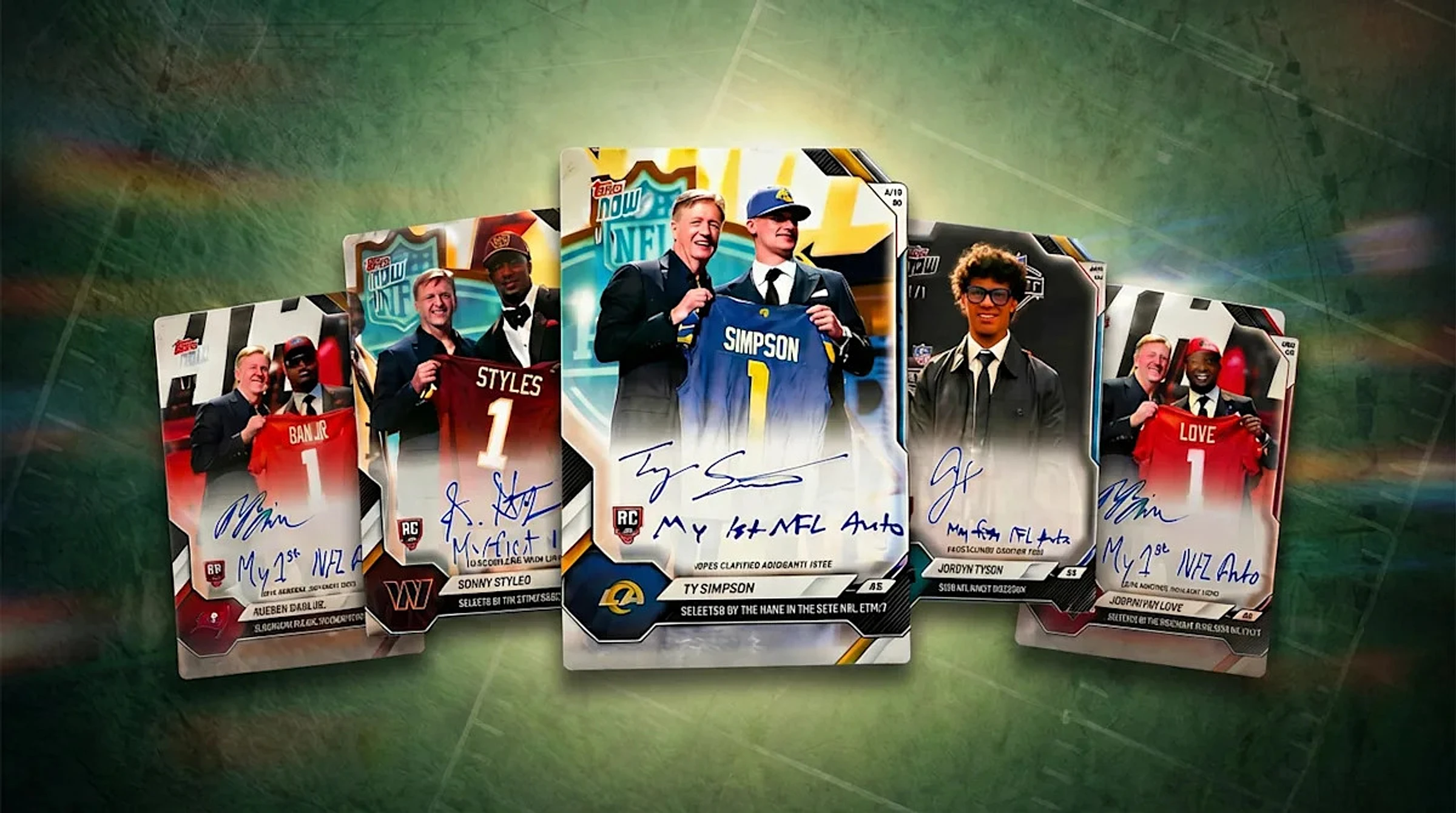


Ninety seconds after a player is drafted, a photo is taken, printed onto a trading card, signed on stage, and released to the public for purchase. The sale window lasts 72 hours. The final print run is determined entirely by how many people buy in.
In that sequence, Fanatics collapses what used to take months into seconds.
David Bailey, the No. 2 overall pick, held up his jersey on stage and within 90 seconds was signing his first Topps NOW card on national television. Even the No. 1 overall pick, Fernando Mendoza, who wasn’t in attendance, had his selection transformed into a Topps NOW card within minutes, illustrating how draft-night moments are immediately converted into collectible assets regardless of where the player is located.
This isn’t happening in isolation. It arrives as Fanatics re-enters the NFL card market with full licensing control, reintroducing flagship products like Topps Chrome Football and reshaping how football cards are created and distributed.
This is not just a faster product cycle, it is a different market structure entirely.
To understand how fast this market moves, look at the physical mechanics of the draft stage itself.
When a draftee walks on stage and is congratulated by Commissioner Goodell, the two of them hold up a jersey, marking the exact moment the player sees his last name on an NFL uniform. Stationed right in front of the stage, a Topps photographer snaps the picture. Within 90 seconds, the card is printed backstage and transported directly to the player, who signs it live on television.
The event and the product are created simultaneously.
For decades, the lifecycle of a sports card followed a predictable path. The event happened first. Media coverage built the narrative. Cards were released months later. The market formed gradually, shaped by performance and availability.
Fanatics is replacing that sequence with something else entirely.
Now, the event occurs, the product is created instantly, and it is sold immediately. Supply is not determined in advance. It is finalized after a 72-hour window based on how many people choose to buy. The card is no longer a product of the moment. It is issued as part of the moment.
What Fanatics has built is a system that collapses the event, the product, and the market into a single sequence. The result is what can be described as a “90-second market,” where supply is defined only after demand is observed. What Fanatics is introducing here represents one of the more significant structural changes to how sports cards enter the market in recent years.
Jeremiah Love’s draft-night jersey moment and corresponding Topps NOW autograph card show the same sequence repeated across the first round, as players like Carnell Tate, Arvell Reese, Sonny Styles, and Ty Simpson moved from selection to signed card within minutes.
The rookie card has historically been the most important card in an athlete’s legacy. The 1952 Mickey Mantle and 1986 Michael Jordan cards are not just collectibles. They are blue-chip anchors of entire markets.
But those cards were released after the moment, once performance and narrative had time to develop.
These Topps NOW cards represent the first licensed NFL cards for these players. They are the first official autographs, tied directly to the draft moment and signed immediately after team selection.
That raises a familiar question. What defines a true rookie card? The first card issued, or the one that becomes the standard?
Baseball has already seen this debate with Shohei Ohtani, where collectors weigh his 2018 flagship releases against earlier 2013 BBM cards. The distinction between first and most meaningful has never been fully settled.
That same question now enters football, in real time.
These draft-night releases may represent the closest thing to a pure “moment-based rookie card” the NFL has seen.