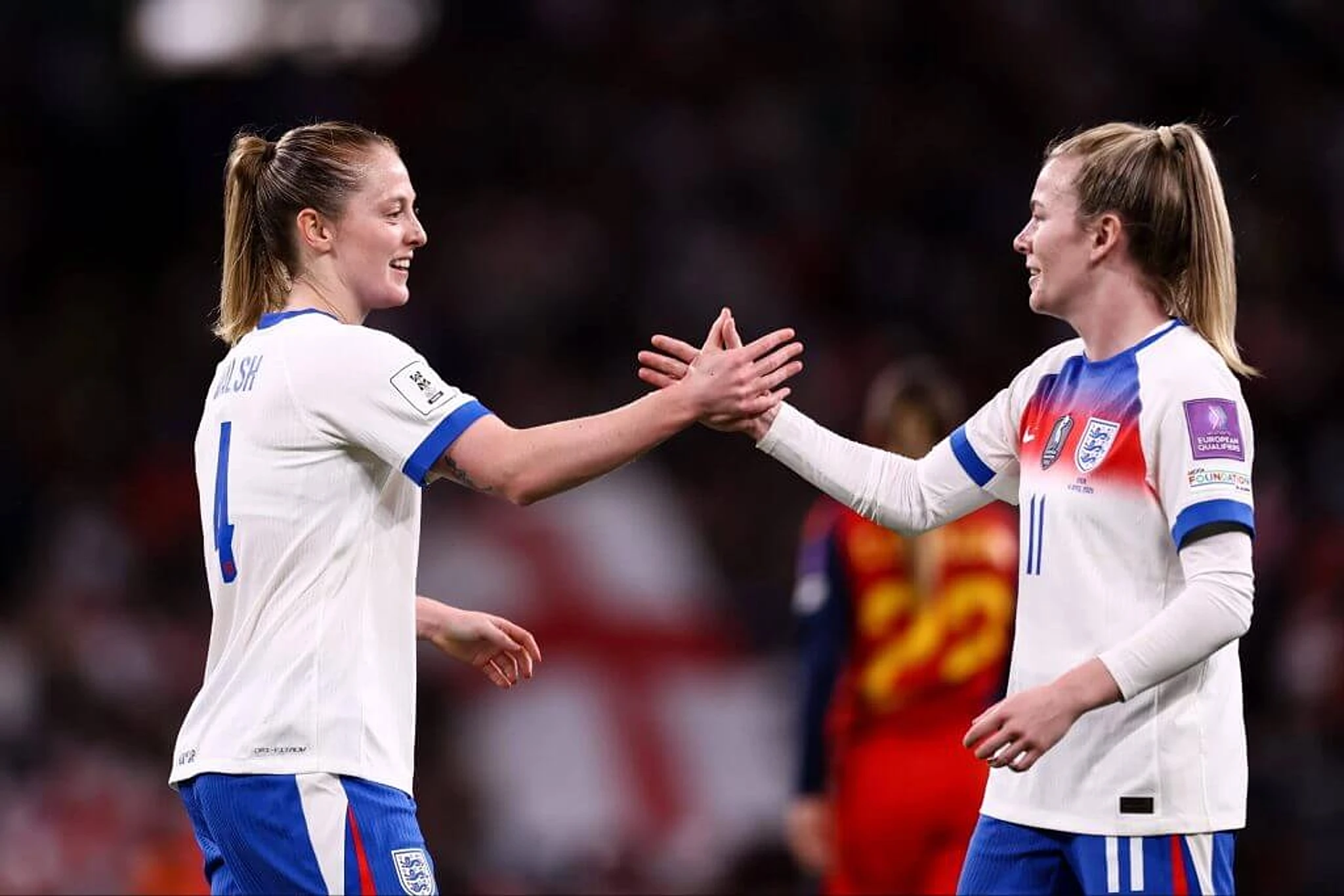

Four wins from four and England sit top of their 2027 World Cup qualifying group.
The reigning European champions impressed in their 1-0 victory over Spain and though the second half against Iceland tested England’s nerve (and goalkeeper Hannah Hampton’s prowess), England again won 1-0, demonstrating the steely tenacity that has so often pushed them onto the right side of fine margins.
Head coach Sarina Wiegman made just two changes to her starting XI between Spain on Tuesday and Iceland on Saturday, with captain Leah Williamson returning after a month out with a hamstring injury to replace Lotte Wubben-Moy, and Laura Blindkilde Brown coming in for Lucia Kendall.
Using all five substitutes against Iceland provided a reminder of the depth at Wiegman’s disposal as she considers who might make the cut for the 2027 Women’s World Cup, with 26 places up for grabs.
Work still needs to be done for England to qualify as group winners (they sit three points clear of second-placed Spain, who host the reverse fixture in June), but the end of April’s international break offers us a chance to take stock. The Athletic has cobbled together a list of the 40 players most likely to make the cut for next summer’s tournament in Brazil.
The following is an educated guess and it’s important not to get too bogged down in the numbers. These aren’t strict rankings and the names will change as the year progresses — though it’s safe to say the players towards the top are England’s key protagonists.
The cog that keeps the England machine ticking. If Walsh is on form, England play well. There have been struggles in her first full season at Chelsea but Wiegman trusts her enormously, handing her the captain’s armband in Williamson’s absence for her 100th cap in the 1-0 win over Spain. The perennial concern is a quality backup option for her and that’s why Walsh remains the player England simply cannot do without.
England’s clear No 1 — this time last year, there was still a debate between her and Mary Earps — showed her class with an acrobatic save to deny Spain an equaliser in stoppage time and was then absolutely sensational in the second half against Iceland. Her distribution was not always reliable at Wembley but mostly, it provided England’s best route to attack on the counter.
An excellent international break, assisting England’s only goal against Spain with an unusual scooped pass for Lauren Hemp before the roles were reversed for the only goal against Iceland, a smart finish on the run from Hemp’s pass. The Arsenal striker scored the Euro 2025 final equaliser and is in good form for Arsenal, scoring against Chelsea in the Champions League quarter-finals.
England have played 19 tournament games under Wiegman and Stanway has started them all. The energetic all-round midfielder will surely start every match next summer too, barring fitness problems — and assuming she settles well at her new club, as she has announced she is leaving Bayern Munich at the end of the season.
Will be 35 years old next summer but her performance against Spain last week shows that those trademark driving runs remain crucial. Besides, right-back remains a position where England have no clear, natural backup.
England’s captain will always start if fit, although given the solid performances of Wubben-Moy and others, England can more easily absorb an injury at centre-back than at right-back or in midfield.
Another sure starter on the wing who reacted first to score England’s opener at Wembley. Unfortunate not to score a second, hitting the woodwork following a cheeky backheel from Bronze. Can provide an alternative No 9 option.
Finally established in England’s first XI. For all her trickery in the final third, James has gone up in Wiegman’s estimations due to her increased defensive diligence. Deployed as a winger against strong opposition, Wiegman has also used James as a central attacking midfielder in games where England are likely to dominate possession.
Had not played for England since October due to injury but went straight back into the starting XI. Wiegman seems to prefer her at left-back rather than centre-back, where she plays for Manchester City.
Has played in every game bar one, due to illness, since Euro 2025 and is increasingly becoming a mainstay under Wiegman — she has remained the constant as Wiegman has brought in Maya Le Tissier, Wubben-Moy and Williamson alongside her. Tidy and proficient in an unfamiliar centre-back partnership with Wubben-Moy to thwart Spain, and good at bringing the ball forward against Iceland.
Out injured for this camp but remains one of Wiegman’s trusted players, and neither of her stand-ins was overwhelmingly impressive. Russo’s status as the undisputed first-choice striker works in Toone’s favour — on and off the pitch, they have a great relationship.
A very good season with Arsenal, in part thanks to Williamson’s injury problems, means she was trusted to start against Spain, and Wubben-Moy performed excellently. However, much as is often the case at club level, Williamson returned to England’s starting XI as soon as she was fit. Wubben-Moy has been in all three of Wiegman’s tournament squads without playing a minute — she is, at least, closer to being a first choice than ever.
Almost exclusively used as a super-sub but Kelly’s track record of delivering huge moments makes her one of England’s key players.
Absent from the February camp due to injury and did not feature in the blockbuster fixture against Spain, although she came in as England laboured in the second half against Iceland. Mead has started 10 of Arsenal’s 17 WSL matches this season, and with her contract expiring in June — the same month as England’s final two qualifiers — her next move feels crucial.