

The 2026 edition of the NFL draft fast approaches. Fans of the Cleveland Browns are hoping this could be another foundational draft after the 2025 one was successful. Although the process of free agency can fill holes and provide quality depth, teams are built through the draft. Every NFL club needs its first three rounds of draft picks to become dependable roster members in order to build the roster and become productive players.
The NFL began in 1920 as the “American Professional Football Association.” Two years later, the league name was changed to the “National Football League.”
Rosters did not have any guidelines on how they were to be formed. Teams signed whoever they wanted, for whatever amount of money. The norm back then was being paid per game instead of an annual salary. Most NFL teams played their home games in baseball stadiums because they were large venues. The New York Football Giants played in a polo stadium.
The league’s origins were that its teams were based in medium-to small-sized cities and towns, such as Portsmouth, OH; Muncie, IN; Rock Island, IL; Rochester, NY; Toledo, OH; Decatur, IL; Canton, OH; and Louisville, KY. The only large cities involved were located in Chicago, Cleveland, Detroit, and Buffalo.
Only a handful of league teams played for the title each year because they had large crowds and could afford the blue-chip college players coming out each year, whereas the bottom third of the NFL signed the afterthought players.
As described in Part 1, Philadelphia Eagles owner Bert Bell came up with an idea to make a list of all eligible players, then allow the worst team to pick first, all the way down to the best club choosing last. He proposed his idea at the 1935 owners’ meeting. The story continues.
In Bell’s biography, “On Any Given Sunday: A Life of Bert Bell,” he writes that he informed the other owners:
“I’ve always had a theory that pro football is like a chain. The league is no stronger than its weakest link, and I’ve been a weak link for so long that I should know,” as his book states. “Few teams control the championships. Because they are successful, they keep attracting the best college players in the open market, which makes them more successful.”
Of course, the prosperous franchises had the most to lose if such an arrangement were to be instigated and take place every year. After all, these few teams were getting all the best talent, had large crowds every game, played in the most title games, and were crowned as league champions frequently.
The two men viewed as some of the NFL’s greatest influencers as owners, George Halas of the Bears, and Tim Mara of the Giants, were for the idea right off. This was a huge surprise. Both men stated in the owner’s meeting that they realized that fans came to see spirited games, and when one roster was never competitive, it tended to become one-sided and a boring contest.
Both Halas and Mara knew that folks came out to see a competition and should get what they paid for. Hopefully, parity would redeem itself as better attendance for the entire league, which would also increase each game’s visitors’ share. This was discussed, and in the end, the other owners agreed. The first such event would not be put off, but would take place several months later, early in 1936.
While the NFL headquarters were located in Columbus, Ohio, on February 8, 1936, the first NFL college draft took place at the Ritz-Carlton Hotel in Philadelphia.
Oddly enough, when Bell made his presentation to the other owners, the word “draft” was never mentioned in Bell’s tender.
To be completely accurate, officially, this event is not called “The NFL Draft.”
Its official name to this day is: “The Annual Player Selection Meeting.”
Although “NFL Draft” is plastered everywhere, as soon as TV coverage begins, you will notice that the main host will introduce the event as “Welcome to the annual player selection meeting.”
At the conclusion of the 1935 season, the Lions won the Western Division with a 7-3-2 record while the Giants took the Eastern Division, going 9-3-0, just one game over the Packers and two games above the Bears. Back then, only division winners went to the playoffs, and went straight to the NFL Championship Game.
The Eagles finished 2-9-0, the Redskins went 2-8-1, the Pirates 4-8-0, and the Dodgers ended up 5-6-1. At season’s end, all of the owners convene for a meeting, which is the assembly where Bell brought forth his draft idea.
This meant that Bell’s Philadelphia club would select first. The teams were aligned from worst to first, as Bell envisioned. A list of 90 potential college players was compiled from which to choose. It was decided that nine rounds would be held.
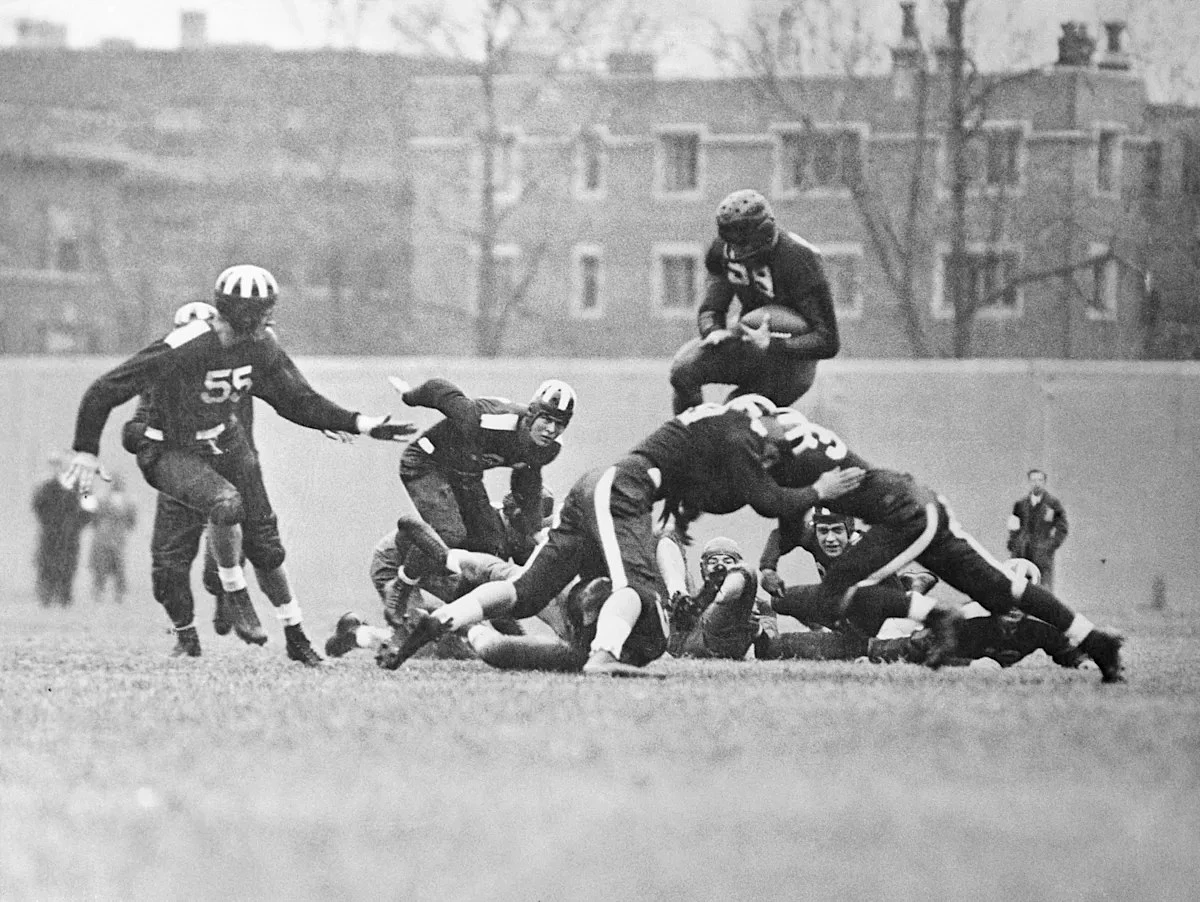
1935 was the first year for the Heisman Trophy, then called the “Downtown Athletic Club Trophy.” All-American halfback Jay Berwanger of the University of Chicago was the first trophy winner as the nation’s best college player. Bell thought that meant quite a bit and was excited to choose him with the first overall pick. All Bell could think about was how the people of Philadelphia would come out on Sundays to see college football’s best player. He was known as “the one-man football team” and was a very gifted and versatile athlete.