

Jori EpsteinSenior reporterWed, April 22, 2026 at 5:02 AM UTC·10 min readWhen Jerry Jones, Stephen Jones and Brian Schottenheimer logged onto a Zoom meeting in January, they were, Schottenheimer admits, tired.
The Dallas Cowboys brass had already interviewed eight defensive coordinator candidates in short order. Energy was fading as they prepared to meet candidate No. 9.
Then a candidate 21 years younger than any of the Cowboys’ last three coordinators presented his vision.
Christian Parker knew how and when he wanted to coach cornerbacks on the nuances of press coverage and how today’s corner can integrate safety and linebacker responsibilities. Parker knew how and when he wanted to feature five-man fronts to smother quarterbacks, and he understood the nuances of third-down responsibilities from his most recent responsibilities as Eagles defensive pass game coordinator.
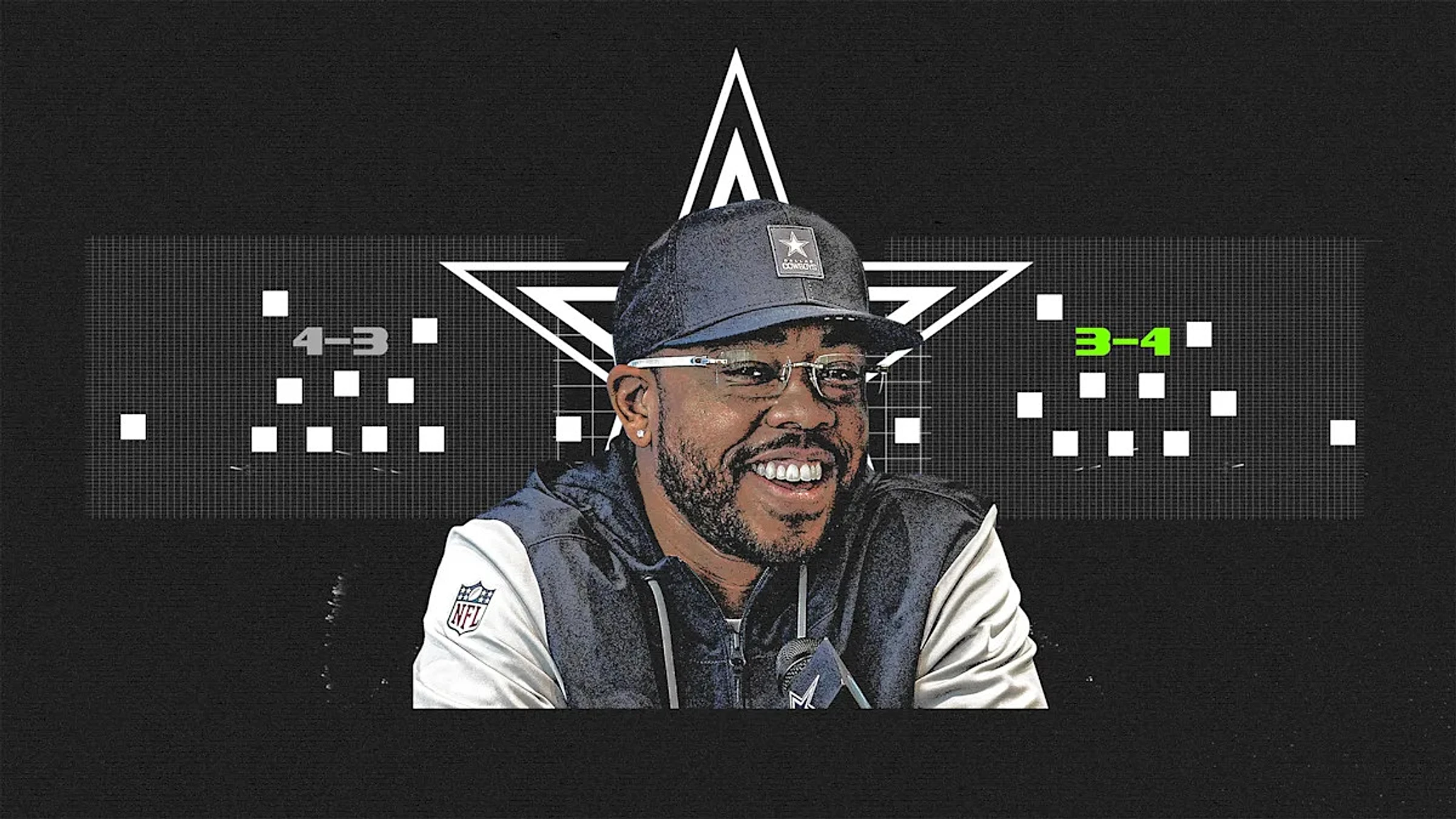
And Parker wasn’t afraid to shake up a Cowboys scheme and personnel group that has rooted its identity in a 4-3 base (four defensive linemen, three linebackers) for the last 13 seasons.
“Whenever you form a defensive structure, it’s about the players that you have,” Parker said at his introductory news conference. “So core principles, we’ll be a 3-4 by nature. But 4-3 spacing will be appropriate — 4-2-5 in nickel. Different front structures, coverages behind it.
“I would say being multiple is probably the most important thing.”
Parker was resolute — if not quite as cavalier as Bill Parcells 20 years ago, who “walked down the hallway and said, ‘Boys, we’re switching,’” then-Cowboys quarterbacks coach Sean Payton remembers.
Then-defensive coordinator Mike Zimmer, whose background was in 4-3, was becoming a 3-4 play-caller.
“It wasn’t much conversation,” Zimmer told Yahoo Sports.
This Cowboys shift is different, coming from the coordinator up rather than the head coach down.
Nonetheless, two decades after the Cowboys took two seasons to feel like their personnel makeup and player buy-in could successfully green-light the transition from a 4-3 defense to a 3-4, Dallas is at it again.
The 34-year-old who has coached under top defensive minds Vic Fangio, Vance Joseph and Ejiro Evero plans to blend a background in exotic fronts and shutdown secondaries as he aims to compel a struggling Cowboys defense to threaten like its potent offensive counterpart.
Cue the addition of some key personnel, the evolution of some returning players and a step-by-step development plan? The Cowboys are banking on the combination to help them contend in 2026.
The next step in that process comes Thursday night, when the Cowboys currently own the 12th and 20th picks.
Jerry Jones did not promise Parker both first-round picks would go to defense when he was hired. But Parker was asked at his Feb. 18 introductory news conference whether he would advocate for that.
The 3-4 defense has surged in recent years, responding in part to offensive principles from the Shanahan-McVay system that emphasizes outside-zone runs. Twenty NFL teams are currently employing 3-4 base defenses, an NFC talent evaluator who tracks schematic trends told Yahoo Sports. Twelve are running a 4-3.
Neither scheme is inherently or indisputably dominant, coaches and evaluators say. But 4-3 defenses, which front two defensive tackles and two defensive ends, tend to create more pressure on the quarterback and allow players to penetrate more simply in order to generate maximum pressure.
Three-four defenses, meanwhile, tend to front bigger and stronger players as the three defensive linemen are often asked to defend two gaps (two spaces between offensive linemen) each, thus requiring more size and stoutness.
Coordinators implementing a 3-4 prefer bigger players as well as players who can read and react sharply, given the complexity of accounting for two gaps and determining exact responsibilities after the snap requires a high level of communication and processing in order to fulfill assigned responsibilities before it’s too late.