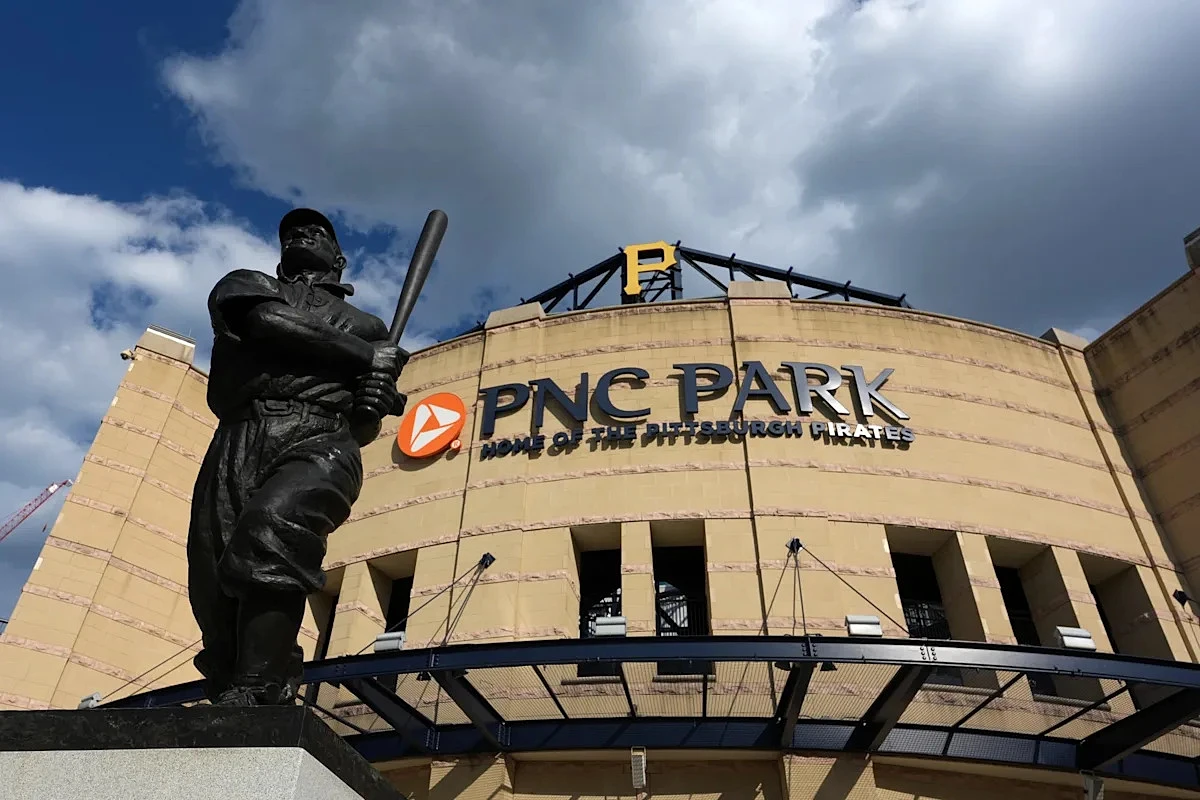


Pittsburgh has lately embodied the harshest causes for concern about the state and future of baseball and broadsheets alike.
The Pirates are coming off seven consecutive losing seasons and struggling to draw five-digit crowds at each game. And whatever the news and mood around PNC Park, another Steel City institution has wondered if it will be there to help contextualize and immortalize any modest or magnitudinous moments for the long haul.
On April 14, the Venetoulis Institute for Local Journalism confirmed it will assume custody of the Pittsburgh Post-Gazette. The deal takes effect May 4, one day after the paper was slated to close down.
Ostensibly, Pirates beat writer Colin Beazley and any pinch-hitting colleagues can breathe easier. But this development’s finer points yield mixed messages.
Venetoulis is the organization that made The Baltimore Banner its first signature enterprise. Poynter Institute author Angela Fu, among others, noted that, despite its plus points, The Banner has yet to turn a profit.
Fu’s April 15 newsletter quoted an anonymous Venetoulis spokesperson as promising no Post-Gazette staffers are subject to layoffs. Yet Fu, the Nieman Lab’s Sophie Culpepper, and others highlighted Venetoulis chairman Stewart Bainum’s advisory to the Post-Gazette that its “current business model does not support the current size of the newsroom.”
Bainum even admitted in the paper’s own report by Kris B. Mamula that “we certainly don’t have all the answers.”
This all happened while Beazley and company covered a Pirates-Nationals series, where the other team’s marquee hometown paper has recently evoked a worst-case scenario that may still lurk.
In the three-plus months that the Post-Gazette’s perdition looked like a fait accompli, it made melancholy sense to those who have worked opposite its baseball scribes. The circumstances may have at least subconsciously braced them for any outcome.
Gordon Wittenmyer knows how fragile stability can be in this business. His 16-year run covering the Cubs ended three offseasons ago when NBC Sports Chicago cut his job. Today he chronicles the Reds for the Cincinnati Enquirer.
Through those two National League Central assignments, he has witnessed more of Pittsburgh’s situation than most other MLB reporters. Reached by Awful Announcing before the Post-Gazette’s meltdown was averted, he admitted that paper was looking wobbly for quite a while with its revolving door of Pirates correspondents.
Wittenmyer added, via email, that Pittsburgh’s paper of record was making lighter waves due to “the relative irrelevance of the Pirates in the last decade or so.”
Could the ballclub’s or any local team’s performance in the win-loss column and at the gate sway the Post-Gazette’s new owner’s commitment to coverage? Only time will tell.
But standings aside, writers are key to bolstering baseball’s public posture, as New York Daily News Mets reporter Abbey Mastracco stressed in an email to AA.
Masctracco also knows, having endured two layoffs herself, that no recovery is foolproof.
“We’re worried about the industry because if cuts like that can happen at the Post, they can happen anywhere,” she said.
That’s the Washington Post, which compounded 2026’s winter of discontent by dropping its whole, long-celebrated sports department. And while it has since enlisted Banner alum Danielle Allentuck to cover the Nationals, it hasn’t exactly restored its pre-February frame.
The shockwaves from the shutdown rattled Mastracco on multiple levels. A prestigious brand synonymous with exemplary intermarket colleagues had loudly quit the industry. It had ditched the District of Columbia’s sports readers.
But in her remarks to AA, Mastracco led off with the human element.
“I was more concerned with the financial future for the reporters affected,” she said, “especially since the jobs getting cut aren’t being replaced. Media companies seem hell-bent on proving we can do more with less without any sort of overall leadership or guidance at the top, just to be able to justify the financial moves they make that benefit everyone but the actual journalists doing the work and creating the product.”