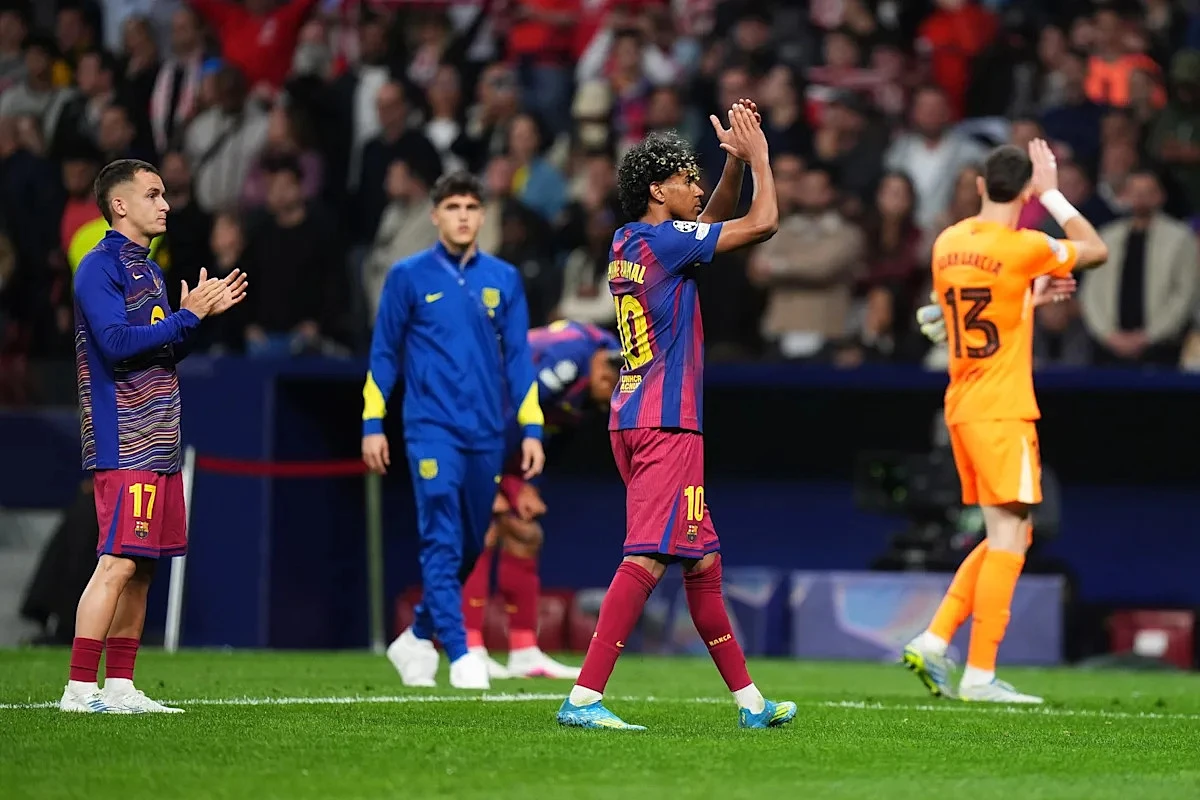


FC Barcelona did not just lose to Atletico Madrid. They relived something that has been plaguing them since 2018.
They relived the familiar feeling of climbing club football’s equivalent of Mt. Everest with purpose, only to discover, once again, that the final stretch demands something that they are still learning how to produce on command.
The 3-2 aggregate defeat to Atletico Madrid in the 2025/26 UEFA Champions League quarter-finals is not an isolated incident. It is a pattern re-emerging in a team that, somewhat paradoxically, feels closer to the finish line than it has felt in years.
For thirty minutes in Madrid, everything looked different.
Barcelona came out like a team that decided not to carry their wretched recent history with them. Four minutes in, Lamine Yamal scored after having come close seconds into the game, driving with the ball, purposefully slicing through the Atletico defence.
Twenty minutes later, Ferran Torres made it two. The tie was level. Atletico were wobbling. They almost conceded another, seconds later, but Juan Musso somehow managed to save Fermin Lopez’s header. It felt like the script was being re-written in real time.
Moments later, the reel snapped. One transition, one lapse and Barcelona were immediately reminded of just how unforgiving this competition is.
So near, yet so far for Barcelona. (Photo by Angel Martinez/Getty Images)
Ademola Lookman’s goal did not just tilt the tie again; it knocked the stuffing out of the Catalans’ desire to overcome a first-leg defeat.
Suddenly, Barcelona, who thought they were escaping their past, found themselves pulled right back into it. A disallowed goal and a red card later, the final minutes of the tie dissipated into frustration rather than belief.
Different year, different players, but the same feeling.
The most uncomfortable truth about the elimination is not the scoreline. It is how familiar it felt.
Barcelona can still dominate matches. They can control possession, dictate rhythm, stretch opponents and create a truckload of chances.
A one-off tie in the Champions League isn’t decided by these virtues, though. It is decided by which team handles the chaos – duels, transitions and second-balls better. And, this is where this Barcelona feels incomplete.
Hansi Flick warned about Atletico’s danger in transitions even ahead of these encounters. He spoke about duels, about discipline and about avoiding exactly the kind of moments that ultimately decided the tie. The warning was spot-on. The execution just wasn’t there, though.
That is what they need to work on now. Not quality, not talent, but finding a way to survive in disorder.
Refereeing was once again the centre of attention. (Photo by Denis Doyle/Getty Images)
Barcelona did not leave this tie quietly. The first leg had already planted the seeds of outrage, a controversial incident in the box, a penalty not given, a foul that wasn’t carded and many more such refereeing outrage.
The club filed a formal complaint to UEFA. Players, including Raphinha, made their anger public after the elimination. Some of that anger is understandable. But it is also dangerous.
While refereeing decisions can shape moments, they rarely decide entire ties. Barcelona did not lose, solely because of the referee. They lost because, over the course of 180 minutes, they left too many moments open to punishment.