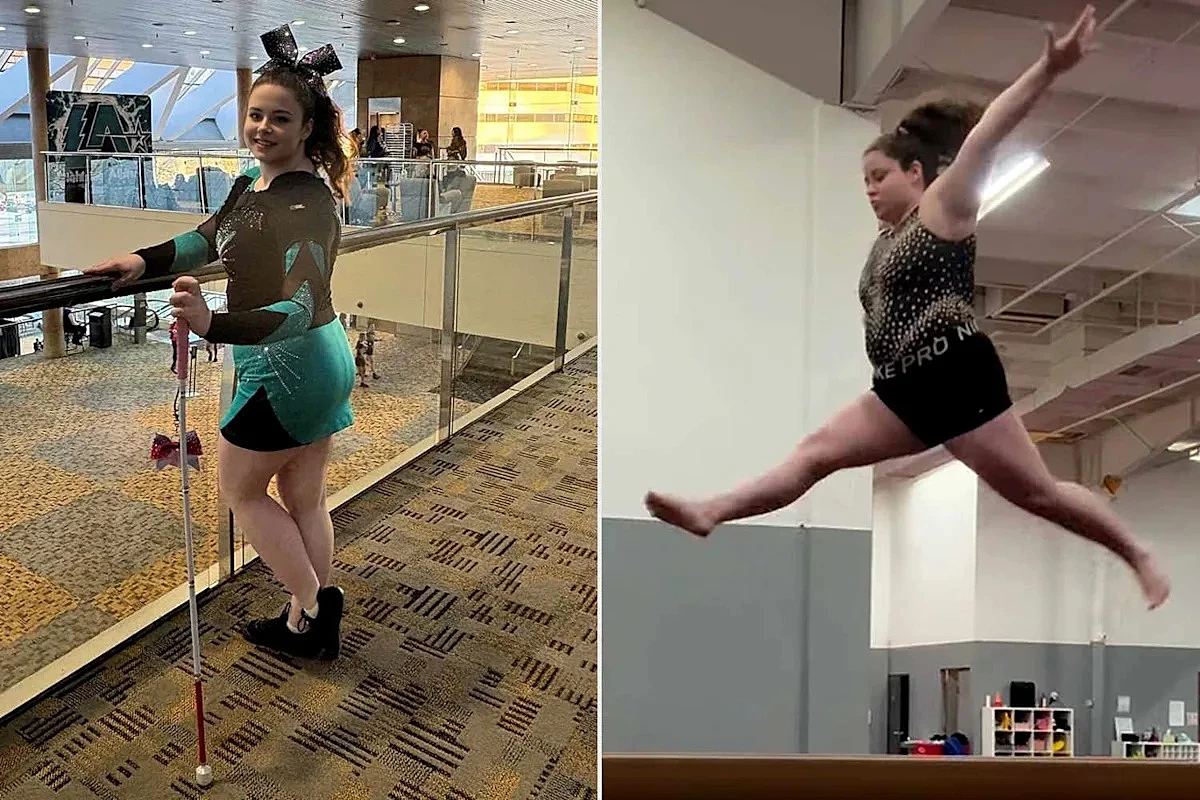


NEED TO KNOWSteph Malfatti, born with CHARGE syndrome, has limited vision but excels in gymnastics and aerial sports
She overcame societal doubts through adaptive training and now coaches both disabled and non-disabled athletes
Her viral videos and public speaking aim to inspire others and increase representation for people with disabilities
Steph Malfatti doesn’t see the world the way most gymnasts do, but that has never stopped her from learning how to move through it with precision, confidence and a deep trust in her own body — something many athletes spend a lifetime trying to build.
Born with CHARGE syndrome — a condition that affected the development of multiple organs, including her optic nerve — Malfatti has lived with limited vision since birth. She learned to adapt early, but as she got older, the challenges she faced had less to do with her physical abilities and more to do with how others saw her.
“I have little to no vision in my left eye… and in my right eye I can only see about 5%,” the 29-year-old tells PEOPLE exclusively, explaining that she mostly perceives broad shapes and light, only able to make out details like large font when objects are held very close.
“There were a lot of times in my life where I felt isolated or different, or people didn’t take me as seriously,” she says, recalling how those feelings followed her through school and into other areas of her life, often reinforced by expectations placed on her before she even had the chance to prove herself.
That began to change when she found sport — not just as an outlet, but as a space where effort and ability mattered more than assumptions.
She first began competitive cheer at 14, which eventually introduced her to gymnastics and aerial, disciplines that rely heavily on spatial awareness, timing and control — all of which she learned to navigate in her own way.
“I heard a lot of ‘you can’t’s before I met these coaches,” she says. “I was really lucky to work with two coaches when I first started who were willing to try and try again with me to figure out how to make it work.”
Those early years were defined by trial and error, as she and her coaches worked together to adapt each movement in ways that made them both possible and safe, often rethinking techniques that are typically taught visually.
What could have easily become a source of frustration instead became something far more meaningful, helping to reshape not only her abilities but also her sense of self.
“I really enjoy the challenge of all of them,” she says, explaining that even the most basic skills require an extraordinary level of focus and determination — especially when building them without relying on sight.
“He made me feel like the extra time spent trying to figure out how to make skills work for me was worth it,” she continues, adding that those experiences are a big part of why she now coaches both disabled and non-disabled athletes, determined to create the same kind of supportive environment she once needed.
Now, years later, Malfatti is doing things that once seemed impossible, relying not on sight but on repetition, spatial awareness and an intense connection to her own body, which she has trained to respond instinctively.
That foundation has allowed her to turn fear into confidence.
“One of the things I do is count my steps,” she explains, describing how she orients herself within a space, adding that returning to the basics during every training session has helped turn complex movements into muscle memory — something she calls “a powerful tool for any athlete.”
“It’s such an amazing feeling to do something that seems scary and conquer that feeling,” she says. “That’s a feeling that can’t be duplicated.”
Over time, those once-daunting moments have become opportunities — not just to succeed, but to share that success with others, whether through competition or simply hearing the reaction of a crowd.
That reaction has followed her beyond the gym, especially after a BBC feature about her journey went viral in 2017, just before she went on to win Cheerleading Worlds with Team England’s para-cheer team.