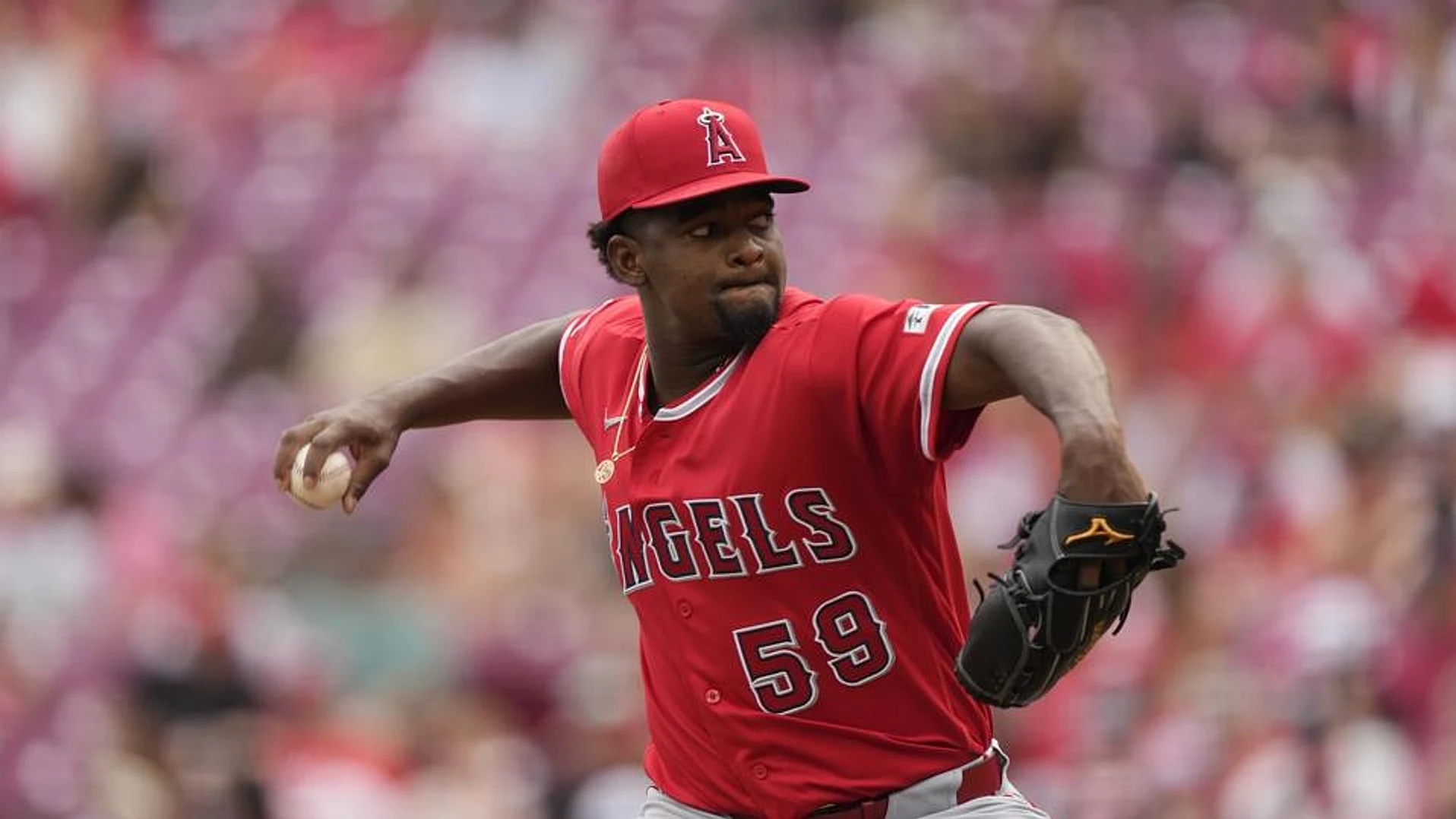


Los Angeles Angels pitcher José Soriano throws during the seventh inning of a baseball game against the Cincinnati Reds in Cincinnati, Sunday, April 12, 2026. (AP Photo/Carolyn Kaster)
You’ll see the words “it’s still early” in just about every article I write here during April and May. Both from a team and player perspective, there’s an awful lot of noise in early season numbers. Looking at the surface numbers alone, one would think there’s some real Sandy Koufax stuff going on in Southern California, with the Angels’ Jose Soriano off to a 5-0, 0.28, start.
The easy part? He’s not THAT good. But he is really good, and if you keep tabs on this space, you already knew that. He’s been the one promising guy among the Angels’ pedestrian rotation over the last couple of years, though he kept you wanting more. He was basically the Southern California version of the Giants’ Logan Webb, but with far less impressive surface results. Tons of sinkers and groundballs, but quite a bit of authoritative contact allowed. Big arm, not as many missed bats as you would like.
Each offseason, I unfurl my Pitch Grades series, which passes judgment on every qualifying offering thrown by pitchers with 135 or more innings pitched, based on their pitch-specific contact management and bat-missing performance relative to the league. More often than not, pitchers’ actual results fairly closely correlate with their pitch grades, which are then aggregated into starting pitcher Grade Point Averages.
Webb has been an outlier every year, faring poorly in my Pitch Grades analysis. He ranked deep in the bottom quartile of the 2025 rankings with a 2.49 GPA. Soriano, on the other hand, ranked in the top quartile with a 3.50 GPA. Only two of his pitches, his sinker and knuckle-curve, qualified for pitch grades, and they both earned “B+” marks thanks to above average bat-missing performances. His (and Webb’s) actual results were undermined by very authoritative exit speeds allowed across all batted by types. Soriano’s exit speeds allowed were over a full standard deviation worse in the air, on a line and on the ground in 2025. Poor team defense also hurt him, making him merely a promising mid-rotation starter with intriguing upside.
Well, on the surface, one would have to say that he’s offered a pretty good glimpse of that upside thus far in 2026. But what do the batted ball metrics tell us?
A whole lot. Soriano has flipped the script, and is now allowing well lower than average exit speeds across all batted ball types. His average line drive exit speed allowed of 85.4 mph - well over two standard deviations lower than league average - has keyed an overall mark of 86.4 mph (over one standard deviation lower).
Again, it’s early, but there’s a lot to like in this early numbers, and some of it is sustainable. His 10.4% liner rate allowed is not - it will regress upward toward the mean. But his grounder rate is still very high (and pretty stable) at 58.2%, and his pop up rate has more than doubled to 1.5%. His fly ball rate is sharply up to 29.8% (his average launch angle allowed sits at a career-high 3.5 degrees) , and he has had some good fortune there - hitters are 0 for 5 on flies between 97-100 mph against his four-seamer. That won’t remain the case as the weather warms.
Adjusted for exit speed/launch angle, Soriano “should have” a “Tru” ERA of 2.24, in line with his 2.33 FIP and obviously far above his minuscule 0.28 ERA.
He has made some key changes in his pitch usage that have made him much less predictable, keying his excellence to date. He’s cut his sinker usage from 49.1% to 31.3% while increasing his four-seamer usage from 8.6% to 23.8%. It’s a firm four-seamer, averaging around 98 mph. Hitters must respect it. And though hitters have hit it hard (with some hard luck, as discussed in the last paragraph), it has taken hitters off of the sinker and knuckle-curve, allowing those two pitches to play up. Those two offerings’ pitch-specific whiff rates are way up this season, from 6.7% to 11.9% and 15.4% to 21.9%, respectively, turbocharging his increase in dominance.
It really is a subtle change that has boosted his effectiveness markedly. His overall whiff rate increase isn’t that eye-catching (11.3% to 12.8%), but when you start missing tons of bats with a fastball, you join the game’s elite group of starters. Only Carlos Rodon posted a higher full-season sinker whiff rate in 2025 than Soriano’s current mark (and Soriano’s 2025 knuckle-curve whiff rate is higher than any 2025 qualifier).
So there is a lot of very real stuff going on with Jose Soriano right now. Yes, some of these additional fly balls he’s allowing will go over the wall as the weather warms, but he’s still a very ground ball-centric hurler, and has added layers of power and deception to his game that simply weren’t there previously. It would behoove Logan Webb to get into the pitching lab and make some tweaks as well.
This article was originally published on Forbes.com