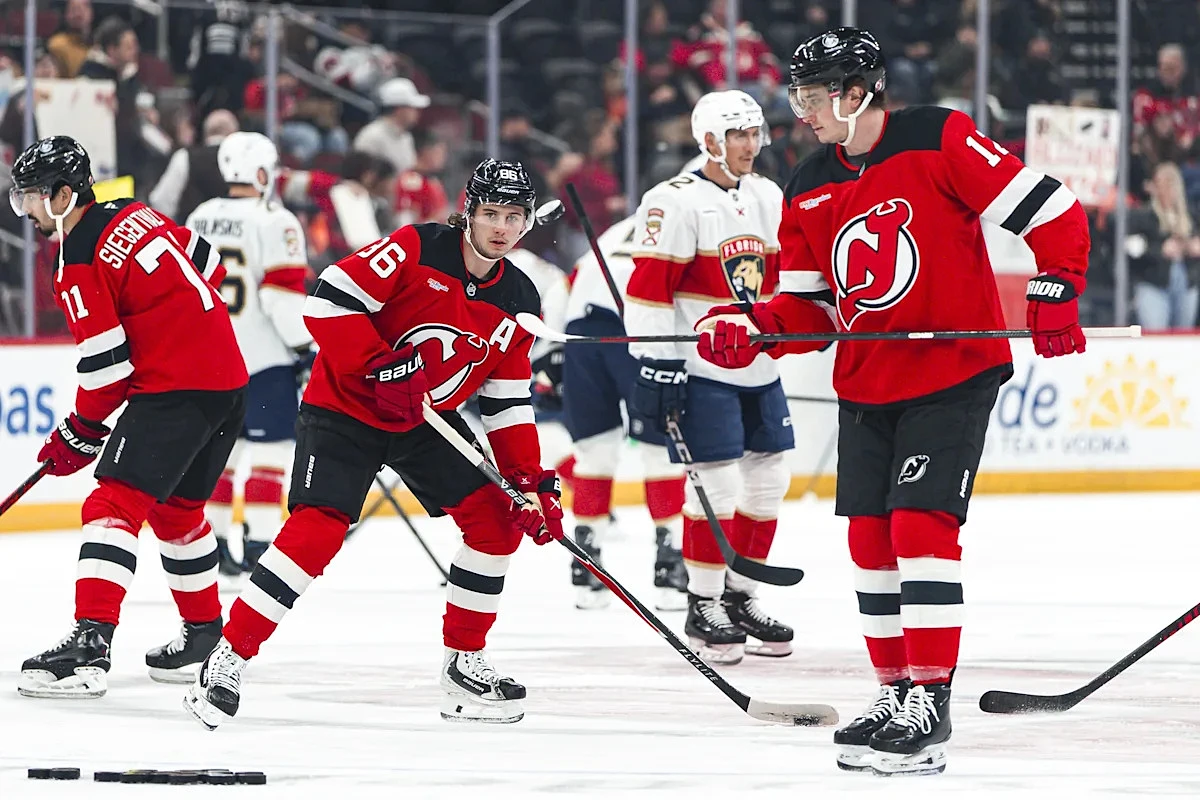


As fans watch playoff hockey, there are a couple things certain to be on their mind. First and foremost will be how physical the games get. For a certain type of Devils fan looking at our roster, they will see guys like Jack Hughes and Jesper Bratt and wonder how they are going to survive the playoffs when they make it back. Second will be the quality of depth that other teams get out of their forwards. Most of the teams in the playoffs do not have one-line attacks: the best playoff teams, and the ones to watch out for, are those with great second and third lines.
The traditional model of a fourth line is that of a more defensive, physical group. They may be more proficient at forechecking, and most of their goals will be of the greasy type. Deflections, crashes, and the like account for most of what people would consider to be traditional fourth line offensive contributions. Many hockey coaches over the past several years have adopted a model where these lines play more often. The concept of “rolling four lines” theoretically leads to more rested players and more sustainable play throughout the game.
There is a big problem with that for the New Jersey Devils. As every tuned-in hockey fan knows, they have one of the best top six center duos in the league in Nico Hischier with Jack Hughes. But what some may not have caught onto yet is that they have a third center who has been undersold as a bottom six center in Cody Glass who has shown signs of possessing top six capability. Just over a month ago, I wrote about why Glass and Arseny Gritsyuk deserved increased roles on the team, and I said there:
Glass is not producing dangerous shots like a low-end defensive third-line center, he is producing shots like a high-end two-way second line center while playing low-end third-line minutes. The only Devils who are better at producing center-lane dangerous shots at a higher rate than Cody Glass are Nico Hischier and Timo Meier, who have 70 and 61 inner-slot shots, respectively, compared to Jack Hughes’s 42 and Glass’s 37. Of those players, only Cody Glass converts on those chances above league average…Glass could easily make it so the fourth line only has to play a few minutes each night if he played more at five-on-five, and he has shown time and time again that he is effective on special teams when given the opportunity.
The question that Sunny Mehta needs to answer this offseason is not which players can do more with 10 or 12 minutes per game. Replacing Maxim Tsyplakov with a better fourth line version is not going to tip the scales, sending the Devils from being a lottery team to a Stanley Cup finalist. Instead, Mehta should be looking for three guys to play 16, 17, 18 or more minutes each night behind the presently-established top six. We have already been able to identify Cody Glass and Arseny Gritsyuk as guys who can play to larger roles, but there is still a missing piece. Is it Lenni Hameenaho? Maybe, but he needs to show quite a bit of offensive growth in year two, and I do not think the Devils should rely on him making that jump. To Hameenaho’s credit, though, he was dealt a rough hand with some of the highest defensive usage rates on the team despite his rookie status. The Devils also have Stefan Noesen in recovery, but I would wait to see what he looks like in camp before giving him that much ice time.
But my vision for Cody Glass getting nearly as much ice time as Hischier and Hughes relies on that third line becoming a group that is difficult to play against on each end. Last July, I wrote about the penalty kill and how top offensive players like Nico Hischier could be relied on less in favor of depth players with stronger defensive metrics. This part is of note:
If the Devils’ top penalty killers remain Hischier, Bratt, and Mercer, and two of those players remain ineffective penalty killers, the Devils are wasting their minutes. Over the course of a game or season, how much more fatigued is Nico Hischier because he takes top penalty killing matchups? Taking him out of that role might hurt his chances of winning a Selke award, but there are either two roads there. Either Nico improves as a penalty killer and actually puts himself into that conversation, or the team pulls back on those minutes to put him in more offensive situations, where he thrives most.
Sheldon Keefe went in the opposite direction here, playing Nico Hischier more than any other Devils forward on the penalty kill. Per Natural Stat Trick, the Devils’ results with Nico on the ice on the penalty kill were decent, but not nearly as good as they were when Lindy Ruff was behind the bench.
2022-23: 2:07 PK TOI/GP, 1.77 SHG/60, 6 PPGA/60 (-4.23 G/PK60)
2023-24: 1:27 PK TOI/GP, 0.62 SHG/60, 4.31 PPGA/60 (-3.69 G/PK60)
2024-25: 2:05 PK TOI/GP, 0.78 SHG/60, 11.64 PPGA/60 (-10.86 G/PK60)
2025-26: 1:56 PK TOI/GP, 1.21 SHG/60, 8.44 PPGA/60 (-7.23 G/PK60)
With Hischier playing so much on the penalty kill, how much was the bottom six playing at five-on-five? While Jack Hughes was up at 16:39 of five-on-five ice time per game, Nico Hischier was at 14:39, with Cody Glass at 12:07 and Nick Bjugstad at 9:24 (or Lammikko at 9:45 and Glendening at 8:14). Let’s compare that to the Edmonton Oilers, where Connor McDavid played 16:56 per game, followed by Leon Draisaitl at 16:01, Jack Roslovic at 14:06, and Ryan Nugent-Hopkins at 13:16. Adam Henrique sat at 10:45 per game, while Curtis Lazar was at 8:20. Those six played the most at center for the Oilers, but they like to load up their lines, position be damned at times. We can also compare to the Colorado Avalanche, who added Nazem Kadri to be their third-line center. Since that trade, Mackinnon has played 16:22 per game, followed by Brock Nelson at 13:22, Kadri at 13:15, and Jack Drury at 11:13. Of note here, though, is that Drury played most of the season on the third line before the Kadri acquisition. When Zakhar Bardakov was the fourth-line center, he only played 7:02 per game.
The point is, the Devils can do a lot to get their offensive threats more ice time, while relying on depth less at five-on-five. Those two or three minutes might not seem like much, but those are three, four, or five shifts that could turn from fourth line defensive nightmares to more opportunities for scorers to score. But what is the difference between a fourth-line shift and a first-line shift, anyway? Despite the fourth line this year almost never being used as a shutdown group, matching up pretty consistently against other fourth lines around the league, they were destroyed. Let’s compare their most consistent member, Paul Cotter, to Glass, Hischier, and Hughes at five-on-five by real and expected on-ice results:
Cotter: 10:17 5v5 TOI/GP, 1.11 GF/60, 3.02 GA/60 (-1.89 G/60), 2.06 xGF/60, 2.87 xGA/60 (41.81 xGF%)
Glass: 12:07 5v5 TOI/GP, 2.69 GF/60, 2.33 GA/60 (+0.36 G/60), 2.44 xGF/60, 2.55 xGA/60 (48.89 xGF%)
Hischier: 14:39 5v5 TOI/GP, 1.85 GF/60, 2.5 GA/60 (-0.65 G/60), 3.21 xGF/60, 2.61 xGA/60 (55.12 xGF%)
Hughes: 16:39 5v5 TOI/GP, 2.54 GF/60, 2.89 GA/60 (-0.45 G/60), 3.06 xGF/60, 2.61 xGA/60 (53.91 xGF%)
If the fourth line is going to put up results like the ones they did this season, they need to play far fewer minutes at five-on-five. What should be a line that has little overall impact on the course of the season was a genuine burden because of the gulf of disparity between their offensive production and defensive play. I now hope that Nick Bjugstad can add some stability to that fourth line, but he also has some occasional value up the lineup as a faceoff man.
But if the Devils really want to maximize the results they get out of this roster, Hughes, Hischier and Glass should all be playing around 16 minutes at five-on-five each game. Cody Glass impacts the game on a defensive level like nobody else on the team, and the Devils could have a great 1-2-3 punch there if they all actually get the ice time. For Glass, playing 16 minutes at five-on-five each night means over 300 more minutes of ice time over a full season. That could be the difference between Glass chipping in an extra five, six, or seven goals or Nick Bjugstad scoring two or three in the same minutes. Also, per HockeyViz, Glass’s defensive impact this season made him the fourth “first-line” quality player on the team, alongside Hischier, Hughes, and Jesper Bratt.