
Take yourself back to March of 1978. Specifically, Saturday, March 11. It’s a cold, windy day. The Super Bowl is history. The NBA season is winding down, but without cable television, there is only one game on TV each week—and that is today at 1:00. And it’s a good one. The Boston Celtics, still a year away from snagging Larry Bird, defeat the Los Angeles Lakers 108–106 at the old Boston Garden.
Later tonight, you might have a date. You’ll take your date to see the top movie in the country, Close Encounters of the Third Kind. If you’ve already seen that one, you’ll opt for a new futuristic space movie called Star Wars.
If you don’t have a date, you’ll stay home and watch The Love Boat and Kojak.
But the real treat for sports fans comes on at 3:00 on ABC. It’s called the Superteams competition. It’s a spinoff of the highly popular Superstars series, which pitted top athletes from various sports against each other in a decathlon-type format of oddball events.
There’s a lot of nostalgia for the 1970s, and I understand it. It was a simpler time—a time of World Book encyclopedias, wall telephones, and cars that started breaking down after 50,000 miles. I even had a quadraphonic stereo in my room, from which I would blast Edgar Winter’s “Frankenstein” at all hours. Do you remember taking pictures of what you were eating for supper, then taking the film to the drugstore to be developed, making 100 copies, and handing them out to friends—and even total strangers? No, I don’t either. Okay, I made that last one up to highlight the vanity of Facebook meal photos. I get it—you’re eating healthy. Good for you.
The Superteams show was an annual event that pitted the Super Bowl–winning team (the Dallas Cowboys) against the World Series winner, the New York Yankees. Except bossman George Steinbrenner would not allow his players to participate, so the next man up was the American League runner-up, the Kansas City Royals.
Each team had ten participants. The Royals were represented by Freddie Patek, George Brett, Dennis Leonard, John Mayberry, Hal McRae, Amos Otis, Tom Poquette, Darrell Porter, Paul Splittorff, and Frank White.
Some of the Cowboys who participated were Harvey Martin, Cliff Harris, Charlie Waters, Roger Staubach, Robert Newhouse, Danny White, Drew Pearson, D.D. Lewis, Ralph Neely, Billy Joe DuPree, and Randy White.
It’s kind of amazing in retrospect. The Royals sent their entire starting infield, plus two outfielders and their star designated hitter, to participate in a nonsensical made-for-TV event—and people ate it up.
Running relayTandem bike relayObstacle courseSwimming relayVolleyballWar canoe race
If the event was tied, a winner-take-all tug-of-war would decide it.
As you can see, it’s not the Olympics. But it was great, campy fun, and ABC took it very seriously. Basketball great Bob Cousy was the “commissioner” of the event. Keith Jackson and O.J. Simpson conducted player interviews. Bill Russell provided expert commentary.
The players spent a couple of weeks in Hawaii with their wives, children, and/or significant others. It sure beat Kansas City in February.
The first Superstars show aired in 1973, and I remember the swimming event like it was yesterday. It featured skier Jean-Claude Killy, race car driver Peter Revson, Olympic pole vaulter Bob Seagren, and former heavyweight champion Joe Frazier. “Smokin’ Joe” struggled in the pool and had to be rescued by lifeguards. When interviewed afterward, Frazier sheepishly admitted he didn’t know how to swim and said, “How was I to know I couldn’t unless I tried?” Joe Frazier is no quitter. “That Mark Spitz is a tough mutha******!” I don’t recall if ABC managed to bleep that out. Revson looked solid in winning the 100-meter event, but it was the Olympian Seagren who won the championship.
Video of some of the 1978 team events can be found online, including the running relay. The relay covered three-quarters of a mile. Freddie Patek, all 5’4″ of him, led off with a 110-yard sprint against Cowboys defensive end Harvey Martin, who stood 6’5″. Patek covered the distance in about 12 seconds, winning his leg—but not by much. For a big man, Martin could move.
Frank White ran the second leg, another 110 yards, against Danny White, who edged ahead at the end. The next three legs were all 220-yard sprints. George Brett was next for the Royals against Charlie Waters, and by the end of this leg, the Cowboys had opened a lead. Brett handed off to Tom Poquette, who was promptly outpaced by Billy Joe DuPree, giving Dallas a commanding advantage. It’s not that Poquette was poor—DuPree was simply a terrific athlete.
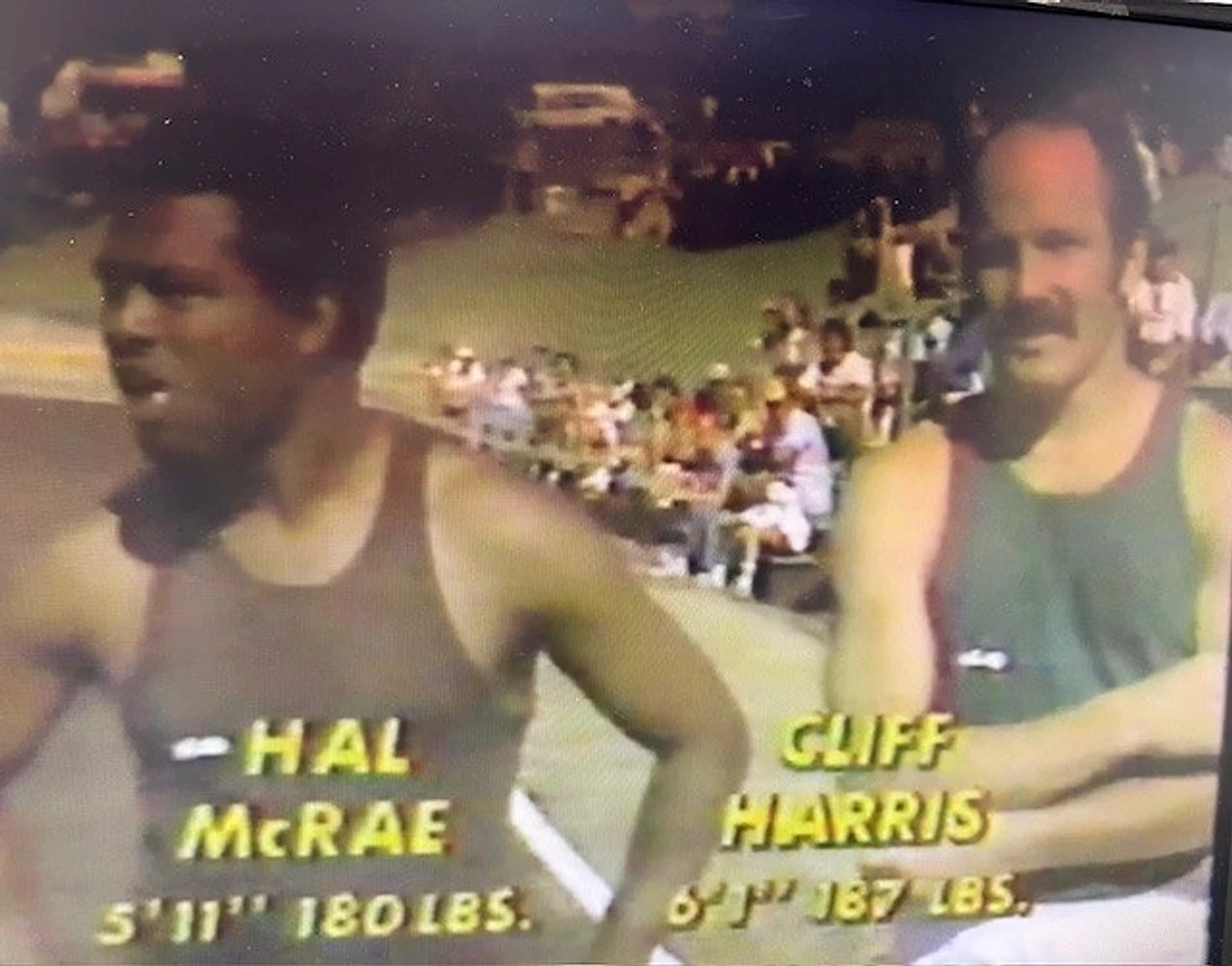
Amos Otis ran the final 220 against Drew Pearson. By the time Otis handed off to anchor Hal McRae, the Royals were about seven seconds behind. Seven seconds in track is a lot. McRae had to finish with a quarter-mile sprint against Cliff Harris. Harris ran hard for the first 200 yards before easing into a jog, finishing in about 64 seconds. McRae, ever the competitor, closed to within about ten yards on the final turn before running out of gas. He finished just under 60 seconds. The 440 is a man’s race, but McRae ran out of track. The Cowboys won in 2:41.24 to the Royals’ 2:45.34.
Watching the old TV coverage, the athletes look slow, but their times were respectable. That’s the distortion you get when you’re used to watching world-class athletes like Sydney McLaughlin-Levrone or Quincy Hall run the 400 meters. I’ve always thought the Olympics should include one average person in each race so we can truly appreciate how fast elite athletes are.
The next two events – the tandem bike relay and the obstacle course – were both won by the Cowboys.
The obstacle course was wonderful. Robert Newhouse and Darrell Porter led off and arguably had the best race of the day. It took a course-record time from Newhouse to nip Porter. Porter was a fabulous athlete who had a scholarship to play quarterback at the University of Oklahoma, back when Sooner football was big medicine.