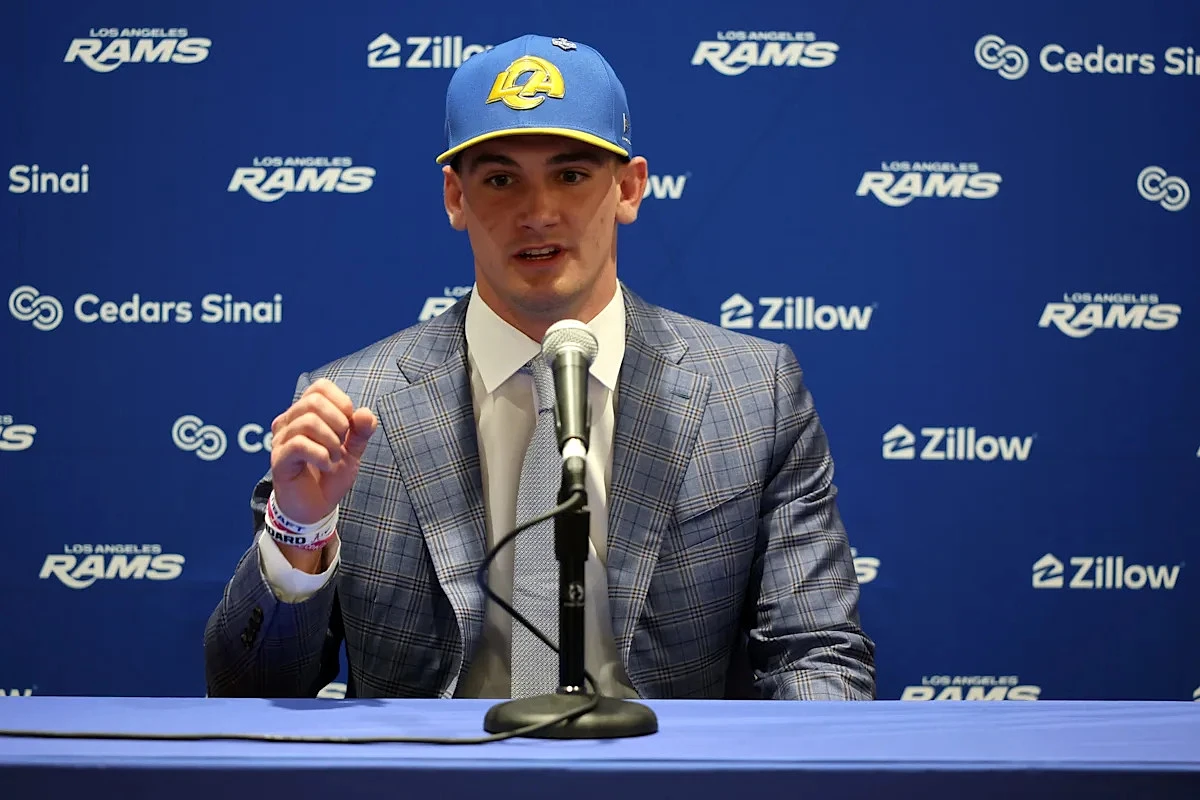


There wasn't much that the Los Angeles Rams needed in the 2026 NFL Draft. It was almost like they were grocery shopping with a stocked pantry and fridge at home.
They treated the draft that way, too. Not to say they dismissed in the least bit. But for a team that already had Super Bowl aspirations before the draft commenced, they didn't feel pressed to take a player who could make a substantial difference in 2026.
The result? A future-focused draft class that features a lot of offensive talent and minimal attention paid to some of their biggest needs – or at least ones that were perceived as needs from the outside looking in.
It was a small, five-player class, which shows the Rams don't expect to have many roster openings this fall. That's a good sign for the Super Bowl favorites, too.
The Rams were projected to have 10 picks in the 2026 NFL Draft earlier this offseason. Then they traded away three picks this year for Trent McDuffie, dropping them down to seven selections. In the sixth round, the Rams packaged two seventh-round picks in order to move up 10 spots for CJ Daniels.
Les Snead said earlier this offseason that the Rams felt the draft was thin at the end, so it’s not surprising they prioritized quality over quantity by trading up for Daniels. Plus, their roster is in good enough shape that they don’t exactly need a large number of rookies competing for spots on the team.
There will be very few open roster spots available in training camp.
So much for going all-in on the win-now strategy, huh? It’s admittedly hard to go all-in during the draft unless you’re trading up aggressively in the first round, but the Rams did the opposite with their first two picks.
They took two players who probably won’t contribute much in 2026, barring injury. Ty Simpson will sit on the bench for a year or two, at least, while tight end Max Klare is buried on the depth chart at an extremely deep position.
In fact, there’s a chance none of the Rams’ rookies will have a meaningful impact this season. This was a class that had an eye on the future rather than focusing on winning a Super Bowl now.
By prioritizing the future, the Rams essentially said they have a good enough roster to contend for a title. They didn't need a rookie to come in and contribute right away. They prepared for the future, knowing a rookie – even at No. 13 – wouldn't have put them over the top.
Entering the draft, wide receiver and linebacker were viewed as two of the Rams’ biggest needs. They didn’t draft a single linebacker and they waited until the sixth round to take a receiver. CJ Daniels is a good prospect but it’s not as if the Rams drafted Makai Lemon or Omar Cooper Jr.
At linebacker, Omar Speights got a big vote of confidence with the Rams ignoring the linebacker spot. He’s not assured a starting job next to Nate Landman in base packages, but his stock is on the rise after the draft.
There were a whopping 22 tight ends selected in the draft this year, which was two shy of the record set in 2002. It’s the second-most in the common draft era, showing just how heavily teams leaned into the position.
Is it a coincidence that this happens after the Rams caught the league by surprise with their frequent usage of 13 personnel with three tight ends on the field together? Probably not.
It’s yet another trail McVay is blazing, completely shifting the way his offense operates in an attempt to keep defenses on their toes. The Rams added another tight end themselves, continuing to skew more toward 13 personnel and slightly away from 11 personnel.
It was a deep tight end class regardless but after seeing what McVay did with Colby Parkinson, Terrance Ferguson and Davis Allen last year, it’s no surprise teams are following suit.
The Rams took five players who hailed from Power 4 conferences: two from Alabama, one from Ohio State, one from Missouri and one from Miami. They didn’t take any small-school prospects, though some of the guys they drafted did start at smaller schools – like Keagen Trost and Daniels.
Picking from big schools can sometimes be a safer way to play the draft, knowing they went up against quality competition in the SEC, Big Ten and ACC.
By no means is it a bad strategy, but it’s worth noting that the Rams have steered more toward Power 4 prospects in recent years after targeting smaller schools previously.