
Jordan ShustermanSenior writerFri, April 24, 2026 at 7:43 PM UTC·13 min readOne month down, five to go in the 2026 MLB regular season. Four weeks of action are in the books, with teams having played between 24 and 26 games, or roughly 15% of their schedules. Soon, all of our “it’s only April” caveats will no longer apply as the sample of data grows to the point that we can start trusting the results as reality.
For now, we’re left to take stock of what has happened thus far with the caveat that we’re looking at a limited sample. Even so, over just a few weeks of play, some big themes have emerged that will be worth monitoring for the rest of the year.
Here are six big takeaways one-sixth of the way through the regular season:
Maybe we shouldn’t be surprised; this division did send three teams to the postseason last year, including the Brewers with the best record in baseball. But the degree to which the NL Central has separated itself in April has been stunning.
This has partially been the product of a wonky early schedule that has featured hardly any intradivision games, thus limiting the chances for these teams to beat up on one another. Instead, all five clubs have seized their opportunities to prove themselves against the rest of the league, resulting in the NL Central accounting for five of the 10 best records in MLB at this point.
The Cubs and Reds are tied at the top at 16-9, though they’ve taken vastly different routes to first place. The Cubs are riding a nine-game winning streak, powered by an offense that is fully healthy and starting to fire on all cylinders. Chicago is missing a ton of key arms due to injury, but its elite defense and strong showings from Shota Imanaga and Edward Cabrera have ensured reliable run prevention nevertheless. The Cubs’ plus-43 run differential ranks third in MLB.
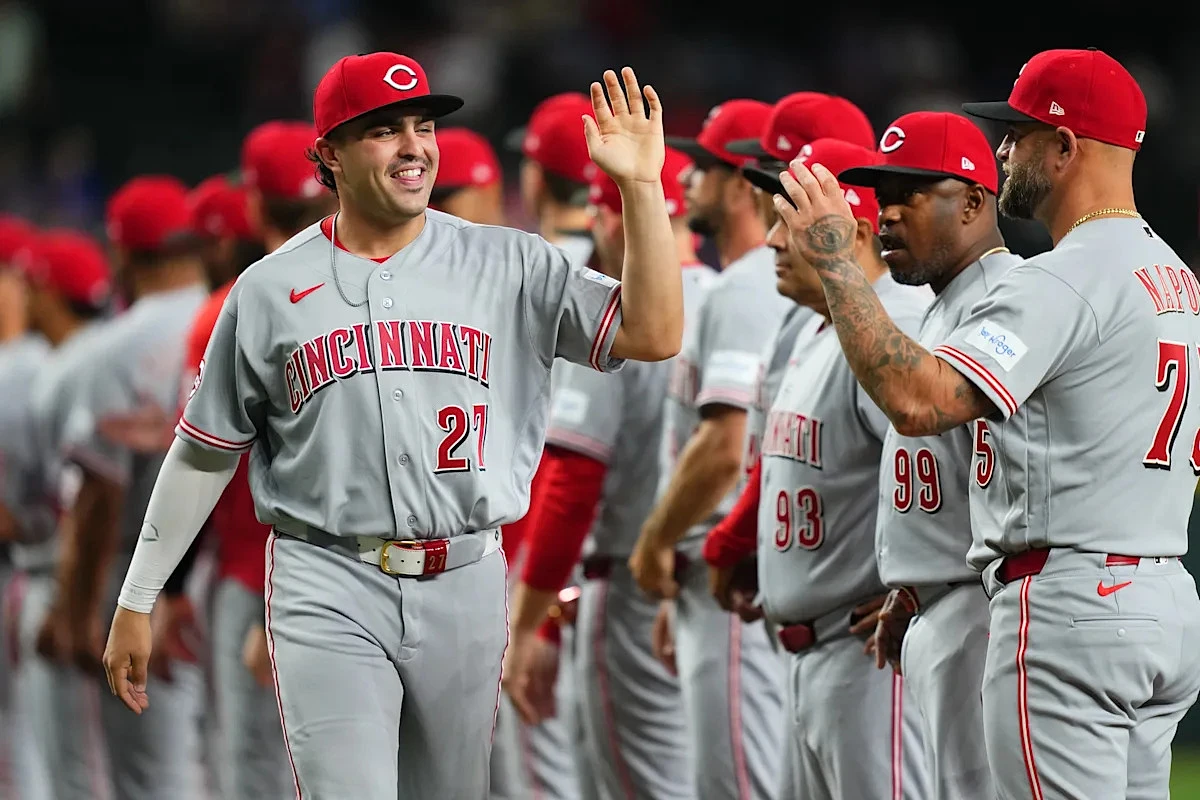
The Reds, meanwhile, feature a negative run differential at minus-2, but their pitching has been stellar, even without an inning from ace Hunter Greene. Elly De La Cruz and rookie Sal Stewart have formed one of the best 1-2 position-player punches around, but the rest of the offense has been abysmal and will need to improve if the Reds want to remain in the mix atop this division.
Next in line are the Cardinals, a team many thought would be rebuilding this year but one that thus far has proven rather competent, with an exciting young position-player group led by one of baseball’s biggest breakout stars, Jordan Walker. The Pirates aren’t far behind St. Louis, and they’ve looked like the better team, leaning on their terrific pitching staff led by Paul Skenes and a revamped lineup that has provided far more consistent run support than a year ago.
Last year’s champs, the Brewers, are currently bringing up the rear, though they’re the only last-place team in baseball with a winning record, at 13-11. The Brewers are still waiting for Jackson Chourio to return from injury, and their bullpen has been uncharacteristically shaky in the early going.
Another quirk of the standings through one month — and the flip side of the NL Central’s dominance — has been the complete lack of a standout team in the American League outside of the New York Yankees, who sit at 16-9 with a plus-37 run differential, the fourth-best mark in baseball behind the Braves, Dodgers and Cubs. The National League accounts for eight of the nine best records in baseball through one month of play. Of course, that’s not to say all the bad teams are in the American League: The six worst records in MLB are an even split of AL (Astros, Red Sox, Royals) and NL (Rockies, Mets, Phillies) teams.
For the most part, though, much of the American League has spent the first month floating in the messy middle, with a lot of the clubs that were expected to be contenders off to uneven starts. That group includes last year’s ALCS participants, Toronto and Seattle, each sitting multiple games below .500 as a brutal string of injuries has hampered the Blue Jays and the Mariners’ biggest bats have only recently started to look like themselves after an ice-cold start. Cleveland and Detroit, both postseason teams last year, have each been solid, but the Tigers had to dig themselves out of a 4-9 hole to get to where they are now, and the Guardians haven’t won more than two games in a row, limiting their ability to climb the standings. And then Boston, the last 2025 AL playoff team, is a total mess at the moment.
It seems like the Yankees are pretty good — that much we know. But after that? We’re still waiting to see which teams step up as convincing contenders. Perhaps Baltimore or Texas can break into that discussion, with the Rangers in position to do so considering the slow start of the AL West. But at this point, we’re welcoming any and all nominations.
Four years ago, the Phillies and Astros met in the World Series, signaling the opening of a championship window for Philadelphia and reasserting Houston’s status as the gold standard of the American League. The Astros claimed the title in six games, a clean triumph for the franchise after their 2017 championship was sullied by the sign-stealing scandal. It was a disappointing conclusion to a magical run through October for the Phillies, but the future looked bright based on the talent in place, and another run at a title felt like a matter of when, not if. The Astros, meanwhile, had some key pieces approaching free agency, but their infrastructure inspired confidence that in all likelihood, the American League would run through Houston for the foreseeable future.
Fast-forward to today, and these two teams find themselves in difficult spots after gradually trending further and further away from the ultimate prize in the years since that World Series. Despite ample regular-season success, the Phillies have endured increasingly early (and painful) eliminations in October, while the makeup of Houston’s roster has changed dramatically, and the Astros just missed the postseason for the first time since 2016.
These troubling trends aside, there was considerable hope entering 2026 that both teams had enough high-end talent to contend, but ugly April showings have squashed that optimism. For the Astros, injuries have tormented the roster for the second year in a row, and they lack the depth to overcome so many key absences, even with Yordan Alvarez playing at an MVP level. And the Phillies have been healthy on offense, but the bats outside of Bryce Harper and Kyle Schwarber have been awful while the pitching has disappointed, leaving Philadelphia with the worst run differential in MLB (minus-51) and tied with Kansas City for the worst record (8-17).
There’s still time for these franchises to course-correct and remain relevant in the postseason picture, but they can’t wait much longer before kicking it into high gear.
This past offseason featured another round of Japanese stars making the leap to the majors. But only one of them — Kazuma Okamoto (four years, $60 million with the Blue Jays) — received a contract in line with industry expectations, while Munetaka Murakami (two years, $34 million with the White Sox) and Tatsuya Imai (three years, $54 million with the Astros) settled for far smaller deals than many projected when they were posted.
We’re a long way from knowing how these contracts will play out, but there has been a clear winner so far among this trio of signings, and that’s Murakami and the White Sox. Murakami’s home run streak ended at five on Thursday, but his prodigious power has been on display from the get-go, as he has racked up 10 home runs in his first 25 big-league games. The 26-year-old is whiffing a ton, as his track record hinted he would, but he’s drawing plenty of walks to help offset the punchouts, and the standout slugging speaks for itself. He has been a treat to watch.
Okamoto, viewed as the safer bet of the two hitters to contribute right away, has struggled to make an impact thus far. He has started nearly every game at third base for Toronto and has collected a few big hits, but his overall output (79 wRC+) has been underwhelming. There are some underlying metrics to feel good about — his 50.9% hard-hit rate and 10.3% walk-rate are both comfortably above league-average — but if the Blue Jays were hoping for a difference-maker, Okamoto hasn’t been one quite yet.
And then there’s Imai, whose Astros tenure barely got off the ground before a stoppage. After three starts — one bad (4 ER in 2 ⅔ IP), one good (5 ⅔ scoreless innings) and one catastrophic (one out recorded, six baserunners allowed) — Imai was placed on the injured list due to what the team described as “right arm fatigue.” He told reporters he was struggling to adjust to life in America both on and off the field, a discouraging development considering the Astros had never signed a player directly from NPB before and apparently have struggled thus far to help Imai make the transition.