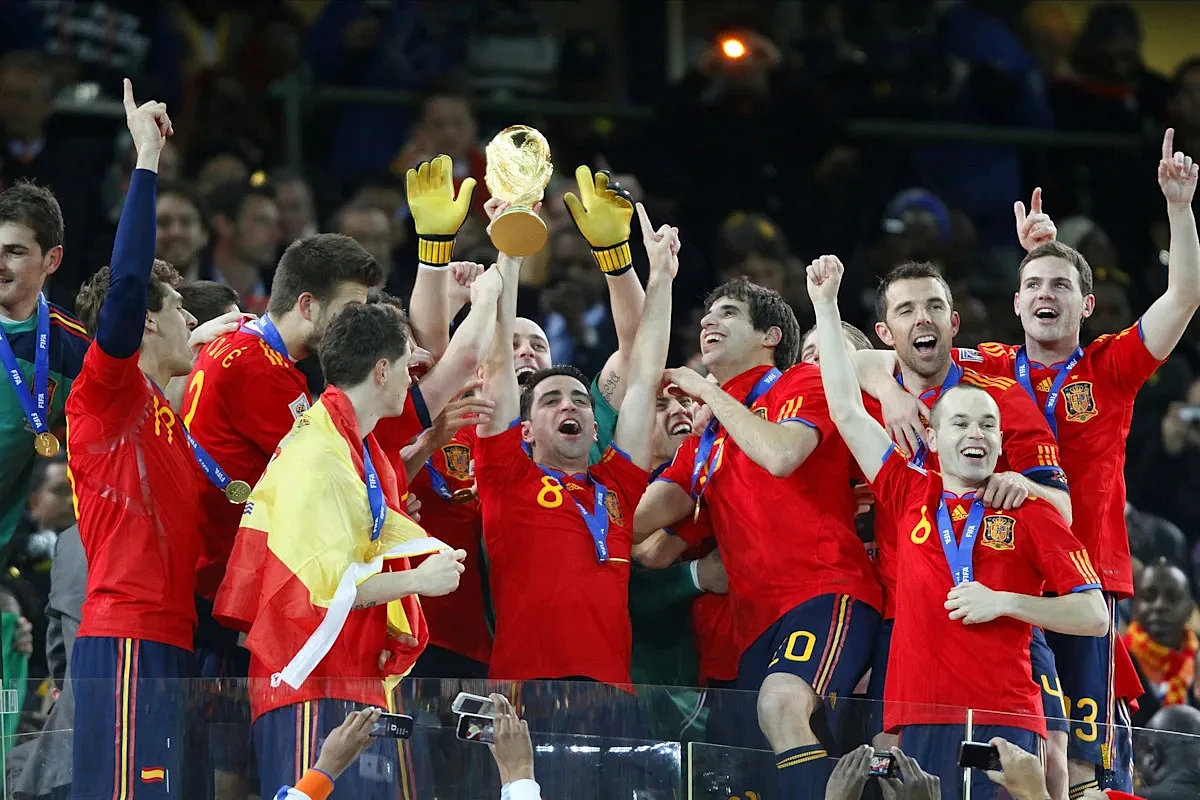
With just 39 days until the 2026 World Cup kicks off, we're looking back at one of the most remarkable championship runs in tournament history—a triumph built on the fierce rivalry between Barcelona and Real Madrid.
When you think of El Clásico, you think of world-class talent, edge-of-your-seat drama, and moments that define generations. But between 2008 and 2012, that iconic club rivalry became the secret weapon for Spain's national team, La Roja.
It all started at Euro 2008, where Spain stormed through the tournament undefeated, keeping clean sheets in every knockout match to claim their first European title since 1964. But the World Cup? That had always been a different story. Spain's best finish came way back in 1950, when they placed fourth in a 13-team field.
Fast forward to 2010. Spain arrived in South Africa still smarting from a Round of 16 exit four years earlier. But this time, the roster was stacked. Manager Vicente del Bosque had a staggering 12 players from Barcelona and Real Madrid at his disposal—names like Xavi, Andrés Iniesta, Sergio Busquets, Iker Casillas, and Xabi Alonso. The El Clásico rivalry had forged them into fierce competitors, but now they were teammates on the biggest stage.
The tournament didn't start smoothly. A shock 1-0 loss to Switzerland—courtesy of a Gelson Fernandes goal—put Spain on the back foot immediately. David Villa's brace against Honduras got them back on track with a 2-0 win, but they still faced elimination heading into the final group match against Chile.
With both teams tied on three points, it was do-or-die. Villa and Iniesta delivered, scoring in a 2-1 victory that sent Spain through. Meanwhile, Switzerland could only manage a scoreless draw with Honduras, ending their campaign.
From there, La Roja found their rhythm. They shut out Paraguay in the quarterfinals, edged Germany 1-0 in the semifinals, and then faced the Netherlands in a tense final that went to extra time. In the 116th minute, Iniesta—one of those El Clásico stars—smashed home the winner. Spain were world champions for the first time in their history.
It was a golden era built on the back of club rivalry and national pride. And as we count down to 2026, it's a powerful reminder: sometimes the greatest teams are forged in the heat of the fiercest competitions.